
Iran's Pezeshkian Defies Trump at UN, Rejects Nuclear Concessions Amidst Ongoing War
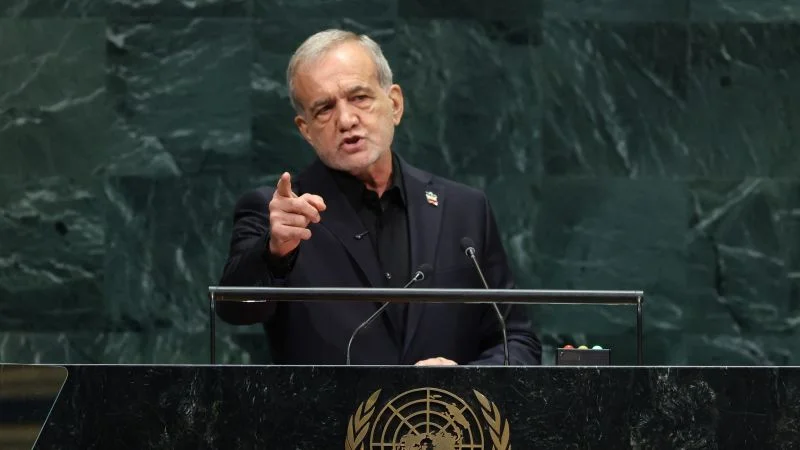
Iranian President Masoud Pezeshkian delivered a historic address to the UN General Assembly in New York, becoming the first leader to speak in person while his country is actively at war with the United States. Seven months after the US and Israel began military operations against Iran, Pezeshkian rejected US demands regarding Iran's nuclear program, missile defenses, and control of the Strait of Hormuz. While US Secretary of State Marco Rubio indicated that recent backchannel talks with Iranian officials yielded no breakthrough, Tehran signaled a willingness to coexist with regional neighbors if security guarantees are met. The speech coincided with a new Iranian negotiating framework requiring Washington to meet specific preconditions before any further dialogue or reopening of the strait.
Key points
- Pezeshkian addressed the UN General Assembly in New York, a historic first for a leader of a country at war with the US.
- Iran refused to yield on its nuclear program, missile defenses, and control of the Strait of Hormuz, which carries a fifth of global oil.
- US Secretary of State Marco Rubio stated that recent talks with Iranian Foreign Minister Abbas Araghchi did not produce major breakthroughs.
- Iran's Supreme National Security Council chief Mohsen Rezaei announced a new framework requiring Washington to fulfill Iran's requirements as a precondition for future talks.
- A ship was targeted near the Strait of Hormuz during the speech, killing one person and prompting caution advisories from maritime authorities.
Background
This confrontation follows months of escalating tensions, including a US naval blockade and economic sanctions that have reduced Iranian trade by 25-35% and driven inflation to approximately 66%. Previous diplomatic efforts, including a Memorandum of Understanding, have stalled, with Iran demanding compensation and an end to aggression before reopening the Strait of Hormuz. The current standoff represents a shift from earlier attempts at quick deals to a more rigid, precondition-based approach by Tehran.
How outlets are covering it
CNN and CNBC emphasized the historic nature of Pezeshkian's speech and his defiant stance against US aggression, framing Iran as a victim of terrorism. Fox News, through analyst Behnam Ben Taleblu, characterized the speech as predictable and 'crass,' arguing that Trump holds the strategic advantage and that Iran's rhetoric masks a desire for a deal. While CNN and Fox agreed that backchannel diplomacy is ongoing, they differed on its viability; CNN noted the lack of breakthroughs, while Fox suggested both sides are using talks to shape outcomes without moving red lines. Experts cited by CNN offered mixed views on Iran's regional message, with some seeing it as a threat and others as a signal for future coexistence.
Why it matters
The speech signals a potential shift in the trajectory of the US-Iran conflict, moving from active military engagement to a high-stakes diplomatic standoff. The failure of recent talks and the introduction of new preconditions by Iran suggest that a quick resolution is unlikely. The continued instability in the Strait of Hormuz poses significant risks to global energy markets and regional security, while the internal divisions in Iran between hardliners and moderates complicate any potential peace process.
What to watch
The immediate focus will be on whether Washington accepts Iran's new precondition-based framework or escalates military pressure. The status of the Strait of Hormuz remains critical, with ongoing maritime incidents potentially triggering further conflict. Future diplomatic efforts will likely depend on whether the US and Iran can bridge the gap between their rigid positions, with the next potential window for talks possibly linked to the US midterm elections in November.
- Iran’s president laid out Tehran’s demands to the world, from a podium in New York CNN
- Trump likely ‘smirked’ as 'crass' Iranian president lashed out at US in UN speech: expert Fox News
- WATCH: Iranian President Pezeshkian addresses 2026 UN General Assembly PBS
- At the U.N., Iran Says It Will Not Give Up Its Nuclear Program The New York Times
- Iran's president blames U.S., Israel for global instability in defiant UN speech CNBC
Want the full story? Read the original reporting
Read on CNN