
MSCHF and Lexus Unveil 'Motomorphosis': Two Electrified Vehicles Bent into Permanent Animation
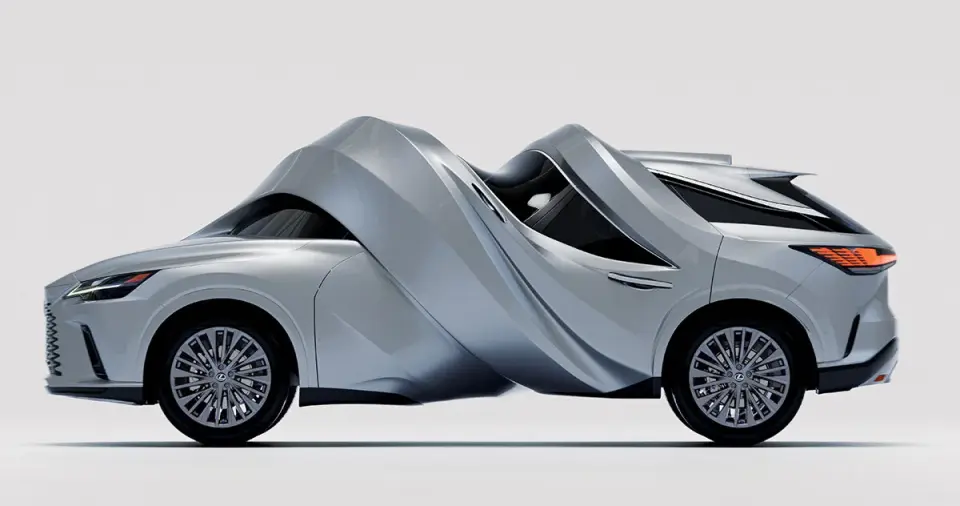
Brooklyn-based art collective MSCHF has partnered with Lexus to create two full-scale automotive sculptures, 'Circle Car' and 'Twisted Car,' for the 'Motomorphosis' exhibition at Chelsea Industrial in New York. The works, which open September 24, 2026, during Armory Week, take the Lexus RZ450e and RX450h+ and physically distort them using techniques borrowed from 3D animation, such as squash-and-stretch and smear frames. The Circle Car bends the RZ450e into a continuous nose-to-tail loop, while the Twisted Car spirals the RX450h+ around a central axis. These pieces are described as 'Form Cars,' inverting the traditional concept car by making movement permanent within the object's shape rather than its function. The sculptures were built using conventional auto-body techniques, including steel armatures and Bondo, alongside actual Lexus parts, though they are not functional vehicles. Lexus frames the collaboration under its 'Electric Made Art' initiative, treating electrification as a medium for artistic expression rather than just propulsion.
Key points
- MSCHF’s 'Motomorphosis' exhibition opens at Chelsea Industrial in New York from September 24 to 26, 2026, coinciding with Armory Week.
- The project features two sculptures: 'Circle Car,' a Lexus RZ450e bent into a closed ring, and 'Twisted Car,' a Lexus RX450h+ twisted into a longitudinal spiral.
- MSCHF describes these as 'Form Cars,' a counterpoint to 'Concept Cars,' where the vehicle’s movement is built into its static shape rather than its operation.
- The sculptures were constructed using standard auto-body shop methods, including steel armatures, thousands of individual pieces, and Bondo overcoats, incorporating some genuine Lexus components.
- Lexus markets the collaboration through its 'Electric Made Art' program, aiming to redefine electrification as an artistic medium that evokes emotional responses rather than just utility.
- The exhibition displays each distorted sculpture alongside its unaltered production counterpart to highlight the transformation and defamiliarization of the vehicle’s form.
Background
This collaboration follows MSCHF’s previous automotive-related projects, such as recycling Mercedes-AMG parts into furniture in 2025 and creating a 'Hot Wheels' car with a missing tire in 2024. It also aligns with a broader trend of automotive brands engaging with conceptual art, as seen in earlier Lexus collaborations with artists like Seabrook Studio and Craft Plastics. The project contrasts with recent automotive news, such as the Tesla-Lexus collision in Encino in September 2026, by focusing on the vehicle as an artistic object rather than a functional transport mechanism.
How outlets are covering it
Designboom emphasizes the visual language of the sculptures, noting how they borrow from 3D animation’s 'smear frames' to make speed legible in a static form. Highsnobiety highlights the technical process, with MSCHF’s Kevin Wiesner explaining that the shapes are 'digitally native, but physically absurd,' and detailing the use of conventional body shop techniques to achieve impossible forms. The Autopian focuses on the sheer absurdity and whimsy of the project, praising the 'magnificently bizarre' nature of the cars and referencing MSCHF’s history of subversive art. Artsy provides a more formal overview, noting the collaboration with Perrotin and Lexus’s marketing strategy, while quoting Lisa McQueen on the goal to explore 'movement, transformation and possibility' through electrification. All sources agree on the dates and location but differ in emphasis: designboom on the aesthetic logic, Highsnobiety on the construction process, The Autopian on the cultural impact, and Artsy on the institutional framing.
Why it matters
The 'Motomorphosis' exhibition challenges the traditional boundaries between automotive design and fine art, using the car as a medium for conceptual exploration rather than transportation. By physically distorting production vehicles, MSCHF and Lexus question the inherent identity of a car, suggesting that its form is as much a product of cultural and artistic interpretation as it is of engineering. The project also reflects a growing trend in the automotive industry to engage with art and culture, moving beyond functional performance to explore emotional and aesthetic responses. For the public, the exhibition offers a unique opportunity to see familiar vehicles reimagined in ways that defy conventional logic, prompting viewers to reconsider the relationship between movement, form, and function in modern design.
What to watch
The 'Motomorphosis' exhibition will be open to the public from September 24 to 26, 2026, at Chelsea Industrial in New York. Following the Armory Week display, it is unclear if the sculptures will tour or be returned to Lexus and MSCHF. The project may influence future collaborations between automotive brands and art collectives, potentially leading to more conceptual explorations of vehicle design. Lexus’s 'Electric Made Art' initiative may also expand to include other artists or mediums, further blurring the lines between technology and artistic expression. The public response to the exhibition, particularly the reaction to the 'Circle Car' and 'Twisted Car,' will likely shape the perception of MSCHF’s work and Lexus’s brand image in the art and design communities.
- MSCHF bends and twists LEXUS cars into surreal full-scale sculptures in new york Designboom
- MSCHF’s Next Hot Product? A “Physically Absurd” Lexus (Exclusive) Highsnobiety
- Finally, A Circular Lexus Like Everyone Wants The Autopian
- Art collective MSCHF transforms two Lexus electrified vehicles into surreal sculptures for Armory Week in New York. Artsy
- DSCENE INTERVIEW: MSCHF on Twisting Lexus Into the Impossible designscene.net
Want the full story? Read the original reporting
Read on Designboom