
Chromologium Launches Interactive Spring Physics Workbench for CSS Motion Design
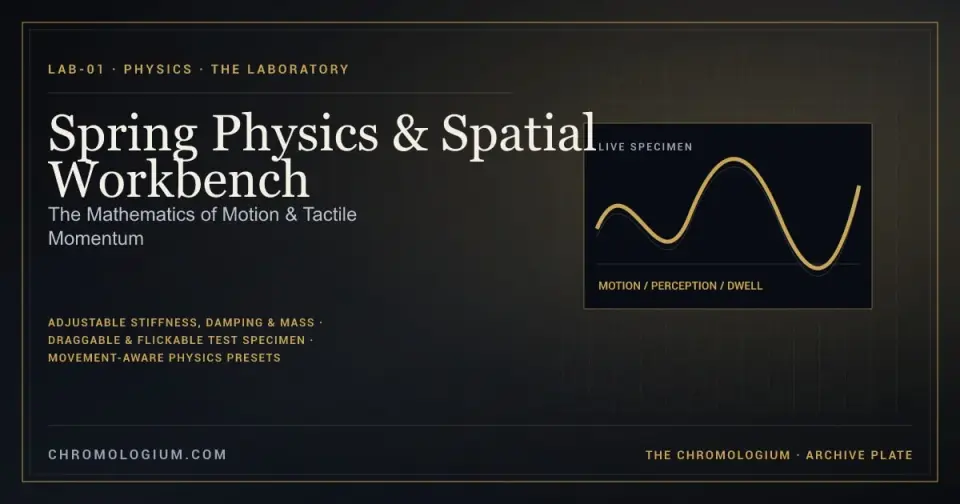
The Chromologium has released a new interactive laboratory tool designed to help designers and developers tune CSS motion using spring physics rather than traditional easing curves. The workbench allows users to adjust stiffness, damping, and mass parameters to simulate how interface elements like drawers and switches settle after user interaction. It provides real-time visual comparisons of different kinetic regimes, such as critically damped versus oscillating motions, and exports the resulting settings as Framer code, CSS, or JSON recipes. The tool emphasizes that mapping physical spring equations to digital materials is an interpretive design choice, not a direct measurement of physical reality.
Key points
- The new 'Spring Physics & Spatial Workbench' (LAB-01) is part of The Chromologium's interactive laboratory suite, focusing on kinetic spring physics.
- Users can manipulate kinematic parameters including stiffness (k), damping (c), and mass (m) to balance velocity and friction in interface animations.
- The tool compares two spring configurations simultaneously, allowing users to pin one recipe and release another to observe differences in overshoot and settling time.
- Output options include copying Framer code, CSS cubic-bezier approximations, or downloading a decision record with the chosen settings and notes.
- The interface highlights that CSS cubic-bezier outputs are approximations and cannot perfectly reproduce every oscillation of a numerical spring model running at 240 Hz.
Background
This release follows The Chromologium's broader focus on curatorial monographs and research into interface physics, cognitive ergonomics, and spatial design systems. Previous works by the organization, such as 'In Praise of Deliberate Friction' and 'The OKLCH Mathematical Manifesto,' have explored the relationship between material aesthetics and technical implementation in web architecture. The new laboratory tool extends this research by providing practical, interactive methods for translating theoretical physical concepts into usable front-end code.
Why it matters
This tool addresses a common challenge in modern web design: creating animations that feel natural and responsive without relying on rigid, fixed-duration easing curves. By allowing designers to experiment with spring physics parameters, it enables more dynamic interactions that adapt to user gesture velocity. This can lead to interfaces that feel more weighted and physical, improving user experience by making state changes, such as opening a drawer or toggling a switch, easier to follow and understand. The ability to export these tuned settings directly into development workflows bridges the gap between design experimentation and implementation.
What to watch
Developers and designers can immediately use the exported CSS or Framer code to implement these spring physics in their projects. The Chromologium may continue to expand its laboratory suite with additional tools for perception, acoustic synthesis, and state matrices, as indicated by its other lab rooms. Users are encouraged to test the provided presets, such as 'Midnight Editorial' or 'Apollo Avionics,' to see how different aesthetic contexts influence the choice of motion parameters.
Want the full story? Read the original reporting
Read on The Chromologium — Curatorial Monographs