
Xen Hypervisor Flaws Enable Cross-VM Memory Access, Prompting Urgent Patches
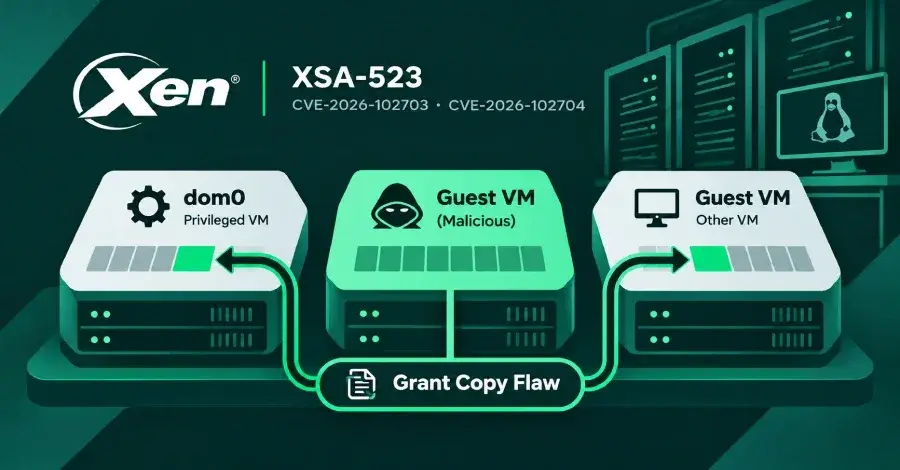
Two critical vulnerabilities in the Xen hypervisor allow malicious virtual machines to read and write the memory of other VMs, including the privileged dom0. The flaws, tracked as CVE-2026-102703 and CVE-2026-102704, affect all Xen versions from 4.6 onward. Patches are available for newer versions, but older releases lack fixes. No active exploitation has been reported, yet the risk is rated Critical due to the potential for complete host takeover.
Key points
- The vulnerabilities reside in the grant copy operation, where Xen reuses permission checks for batch copies within the same memory page, sometimes failing to re-validate access rights.
- A malicious guest VM can exploit this to access memory it does not own, potentially compromising the entire host, including dom0, which manages other VMs.
- The Xen Project disclosed the flaws on November 3, 2026, crediting Anthropic’s Claude model for the initial discovery, validated by Ada Logics and CodeAnt AI.
- Patches are available for Xen 4.17.x through 4.19.x, but no fixes exist for versions 4.6 through 4.16, with 4.16 support having ended in December 2024.
- XCP-ng released a patched version on November 3, requiring a host reboot, while Qubes OS 4.3 users must restart dom0 and reseal secret passphrases for Anti Evil Maid users.
Background
This incident follows a pattern of critical virtualization and software flaws disclosed in late 2026, such as the ChatGPT session hijacking flaw and Atlassian’s file-read vulnerability. While those issues affected specific applications or cloud services, the Xen flaws impact the foundational layer of virtualization, affecting multiple operating systems and platforms built on Xen, including Debian’s bookworm, trixie, and forky releases.
Why it matters
The flaws undermine the core isolation principle of virtualization, allowing a single compromised VM to breach the security boundary and access other VMs’ memory. This could lead to data theft, privilege escalation, or full host compromise, particularly in environments relying on Xen for multi-tenant or security-focused deployments like Qubes OS. The lack of patches for older versions leaves many users exposed until they upgrade or migrate.
What to watch
Users of Xen-based systems must apply the XSA-523 patches immediately, especially those on versions 4.17 and newer. Administrators of older versions (4.6-4.16) should plan upgrades or migrations, as no fixes are available. Qubes OS users should monitor for stable repository updates over the next two weeks. Security teams should audit logs for signs of exploitation, though none have been reported yet.
Want the full story? Read the original reporting
Read on The Hacker News