
Carney and von der Leyen propose undefined EU associate status for Canada amid US trade war
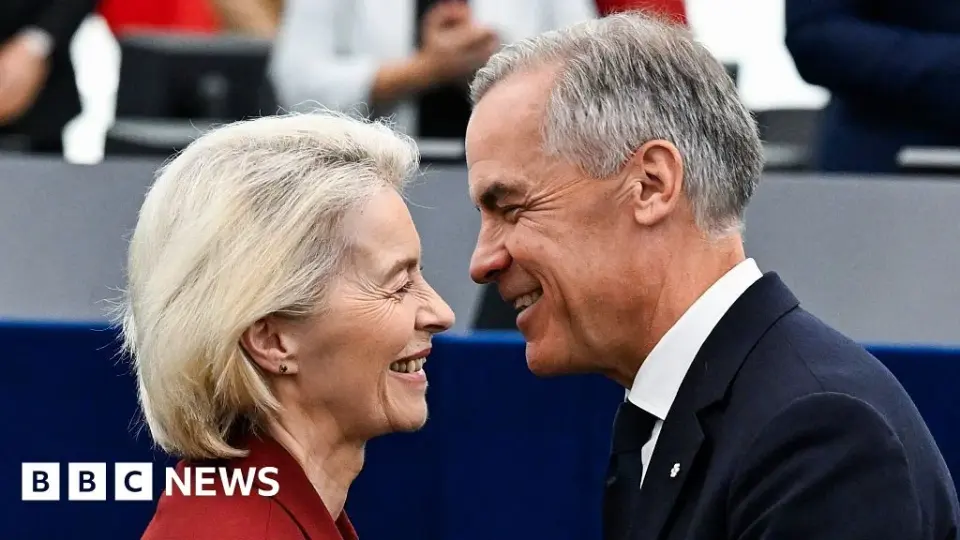
European Commission President Ursula von der Leyen proposed making Canada the EU’s first 'associate member' to deepen ties beyond existing trade deals, a move welcomed by Prime Minister Mark Carney but criticized by President Donald Trump. The status is not currently defined in EU treaties, requiring years of negotiation and unanimous ratification by all 27 member states. Carney emphasized the move is about resilience and sovereignty, not creating a rival bloc, while Trump threatened 'serious tariffs' on Europe if he views the alliance as hostile. The proposal follows a deteriorating US-Canada trade relationship and includes cooperation on defense, AI, energy, and critical minerals, with a Canada-EU summit planned for late October in Montreal.
Key points
- Von der Leyen proposed Canada as the first EU 'associate member' during her State of the Union address, aiming to move the relationship to the 'highest level possible' beyond the existing CETA trade agreement.
- Carney welcomed the proposal but clarified Canada is not seeking full EU membership or creating a 'third bloc' to rival the US, emphasizing resilience and sovereignty instead.
- Associate membership does not currently exist in EU treaties, meaning the process would require unanimity and ratification by all 27 member states, potentially taking years to implement.
- Trump called the proposal 'laughable' and threatened 'very heavy tariffs' on the EU if he perceives the move as a hostile act, continuing an escalating trade war with Canada.
- Key areas of proposed cooperation include AI, critical minerals, defense industrial capacity, energy security (LNG and hydrogen), and the space sector, with Canada also seeking to join the Erasmus Plus scheme.
- A Canada-EU summit is scheduled for October 29-30 in Montreal to discuss the proposed 'Alliance for the Future' in more detail, though Canadian officials have downplayed the immediate likelihood of formal associate status.
Background
The proposal emerges from a broader shift in Canada's foreign policy following a 'geopolitical rupture' with the US, driven by Trump's tariff policies and trade disputes. Canada, which sends roughly 70% of its exports to the US, has sought to reduce its dependence on Washington by strengthening ties with Europe. This follows earlier discussions about EU associate membership for Ukraine, which Kyiv rejected in favor of full integration. The move also comes as Canada and the UK explore closer defense cooperation, including joint participation in the EU's SAFE defense procurement program. Previous archive coverage noted that while the EU is considering the associate status, many details remain undefined, and Canadian Parliament will ultimately vote on the final arrangement.
How outlets are covering it
BBC and CBS News highlight Carney's emphasis on resilience and sovereignty, noting his standing ovation in the European Parliament and his rejection of the idea that the alliance is a rival bloc. CNBC focuses on the economic implications, including the existing CETA agreement and Carney's pledge to impose reciprocal tariffs on US goods. Politico emphasizes the immediate backlash from Trump, who called Canada a 'terrible trade partner' and threatened to cut trade with Europe. Canadian officials, including ambassador-designate Jonathan Wilkinson, have downplayed the immediate prospect of associate status, stating that the focus is on 'driving results' rather than formal membership. Some EU countries are reportedly reluctant to create a new membership category, preferring to build on existing defense and trade agreements. The proposal also raises questions about how it might affect other countries seeking full EU membership, such as those in the Balkans and Eastern Europe.
Why it matters
The proposed associate membership could fundamentally reshape Canada's economic and security relationships, reducing its dependence on the US and strengthening its ties with Europe. It could also set a precedent for new forms of EU engagement with non-member states, potentially affecting other countries seeking integration. The move could escalate tensions with the US, leading to further trade disruptions and geopolitical realignments. For Canada, it represents a strategic pivot toward greater autonomy and diversification of its economic partnerships, while for the EU, it could enhance its global influence and security cooperation. The outcome will depend on the ability of all 27 EU member states to agree on the terms of associate membership, a process that could take years and face significant political hurdles.
What to watch
A Canada-EU summit is scheduled for October 29-30 in Montreal, where leaders are expected to discuss the proposed 'Alliance for the Future' in more detail. The process of defining and ratifying associate membership could take years, requiring unanimity among all 27 EU member states. In the interim, both sides are expected to deepen cooperation in areas such as AI, critical minerals, defense, and energy. The US response will also be a key factor, with Trump threatening tariffs if he perceives the move as hostile. Canadian Parliament will ultimately vote on the final structure of the alliance, and the outcome could influence other countries seeking closer ties with the EU.
- What could EU associate member status mean for Canada? BBC
- Carney says Canada will decide its own partnerships after Trump calls EU proposal ‘laughable’ CNBC
- Trump Wanted Canada as the 51st State. He Ended Up Pushing It Toward the European Union. The New York Times
- Trump threatens to impose ‘serious tariffs’ on Europe if Canada joins EU as associate member politico.com
- Canada's Mark Carney and the EU shrug off Trump's threats, looking to forge an "Alliance for the Future" CBS News
Want the full story? Read the original reporting
Read on BBC