
U.S. Mint Launches Controversial $1 Trump Coin for Semiquincentennial
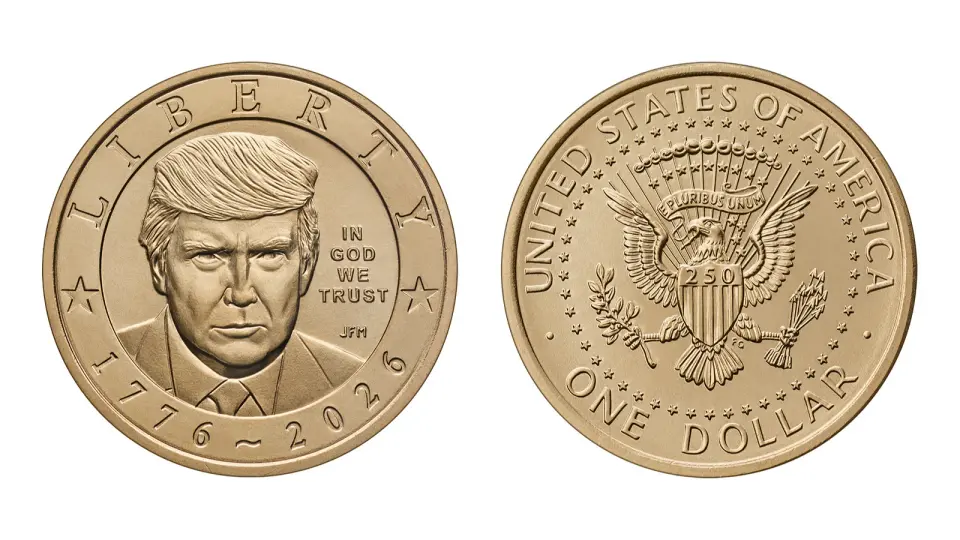
The U.S. Mint began selling gold-colored $1 coins featuring President Donald Trump’s portrait on September 2, 2026, to mark the nation’s 250th anniversary. While the coins are legal tender, they are sold at a significant premium, with 25-coin rolls costing $61 and 100-coin bags $154.50. The release has sparked debate over federal laws prohibiting living presidents on currency, though the administration cites a 2020 law allowing semiquincentennial designs. Critics, including Democratic senators, argue the move prioritizes vanity over democratic tradition, while supporters view it as a patriotic commemoration. Special 'July 4th' marked coins are being randomly distributed in sales.
Key points
- Sales began at noon ET on September 2, 2026, with a two-order limit per household until 2 p.m. ET on September 3.
- The obverse features Trump’s face with 'LIBERTY' and 'IN GOD WE TRUST'; the reverse shows the presidential seal with '250'.
- The coins are composed of copper, zinc, manganese, and nickel, not actual gold, despite their gold-colored finish.
- The U.S. Mint is randomly including 250,000 special-issue coins marked 'July 4th' in the rolls and bags.
- The design was approved by the U.S. Commission of Fine Arts, whose members were appointed by President Trump.
Background
This launch follows a series of Trump-branded initiatives tied to the semiquincentennial, including the expansion of Patriot Passports to 250,000 copies and the Freedom 250 Grand Prix in Washington, D.C. The move also aligns with earlier announcements regarding a potential $250 bill featuring Trump’s face, which requires congressional approval. The 2020 Circulating Collection Coin Redesign Act provided the legal framework for these semiquincentennial designs, distinguishing them from standard currency rules.
How outlets are covering it
ABC7 and AP News emphasize the legal tender status and the approval process by the Fine Arts Commission. CBS News highlights the premium pricing and the specific metal composition, noting the lack of actual gold. Al Jazeera focuses on the legal controversy, citing the 1866 law against living portraits and the 2020 exception, while detailing opposition from Senators Cortez Masto and Merkley. The outlets differ in emphasis: ABC7 and CBS focus on the product details and sales, while Al Jazeera centers on the political and legal debate. All agree on the core facts of the release date, pricing, and design elements.
Why it matters
The release of the Trump $1 coin marks the first time a living president has appeared on U.S. currency in nearly a century, challenging long-standing traditions and federal laws. It reflects the broader trend of Trump-era branding on national symbols and institutions, raising questions about the separation of personal legacy and public commemoration. The controversy highlights ongoing tensions between executive authority and congressional oversight in defining national symbols and currency.
What to watch
The two-order limit per household will lift at 2 p.m. ET on September 3, 2026. The U.S. Mint will continue to distribute the 250,000 special 'July 4th' marked coins randomly in sales. The administration may pursue further Trump-themed currency, including the $250 bill, though this requires congressional approval. Critics may continue to push for legislation to block such branding, while supporters may advocate for further commemorative items tied to the semiquincentennial.
- Heads or tails? $1 coin with Trump's face go on sale ABC7 Los Angeles
- U.S. Mint Puts Trump $1 Coin On Sale forbes.com
- Gold-colored $1 Trump coins are now available, but it will cost you more than $1 to buy one CBS News
- Heads or tails? $1 coin with Trump’s face and gold finish goes on sale AP News
- US launches $1 coin featuring Trump’s face: What to know Al Jazeera
Want the full story? Read the original reporting
Read on ABC7 Los Angeles