
Polling Uncertainty Looms Over 2026 Senate Race as Election Day Nears
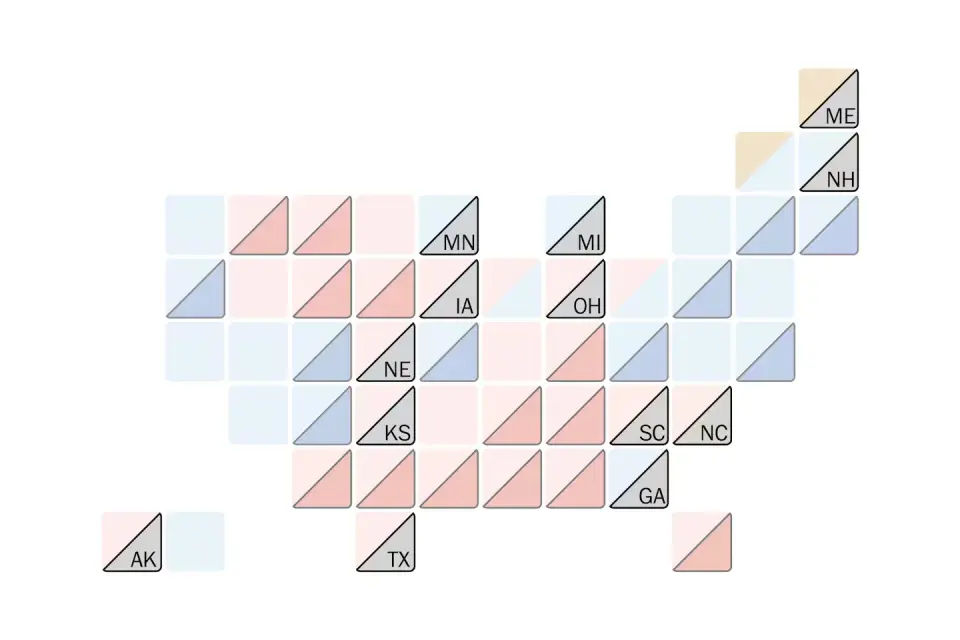
With three days remaining until the November 3, 2026, midterm elections, Democrats are favored to retake the House and potentially the Senate, yet significant uncertainty persists regarding the upper chamber. While national polls have generally tracked the horse race accurately, state-level surveys have faced criticism for low quality and occasional fabrication. Analysts warn that recent historical trends, including Republican outperformance in presidential cycles and Democratic surprises in midterms, suggest current projections may be flawed. The outcome will likely hinge on close margins within the error range of many polls, making precise predictions difficult despite the apparent Democratic advantage.
Key points
- Democrats are projected to win the House and potentially the Senate, but the Senate remains a competitive and uncertain battleground.
- National polls have shown reasonable accuracy for the horse race, though they slightly underestimated Republican turnout in recent cycles.
- State-level polling has suffered from a decline in local journalism, leading to fewer rigorous surveys and the emergence of fake or low-quality polls.
- Historical data indicates that polls often miss in close races, with Democrats previously underestimated in key Senate and gubernatorial contests.
- The margin of error in many races is wide enough that current projections could easily shift, rendering precise outcome predictions unreliable.
Background
Recent coverage from early October 2026 highlighted a competitive Senate race, with betting markets and polls showing it as a coin toss despite a clear Democratic advantage in the House. Voter dissatisfaction with President Trump’s approval ratings and high gas prices from the Iran war were cited as drivers for Democratic gains. Additionally, earlier reports noted tensions over federal observer deployments in Colorado and volunteer efforts to monitor polling places for potential interference, reflecting a broader environment of scrutiny and dispute surrounding the election process.
How outlets are covering it
The Washington Post emphasizes the structural disadvantages Democrats face in the Senate and highlights historical instances where polls failed to predict outcomes, such as Republican outperformance in presidential elections and Democratic surprises in midterms. NPR, through its political correspondents, focuses on the methodological issues in polling, noting that while national polls are generally reliable, state-level surveys have been compromised by a lack of funding for local journalism and the presence of fake polls. NPR also stresses that polls should be viewed as providing a fuzzy range rather than precise margins, and that horse-race polling is less valuable than tracking trends in public opinion on issues. Both sources agree on the uncertainty surrounding the Senate but differ in their emphasis: The Washington Post highlights historical unpredictability, while NPR focuses on the quality and limitations of current polling data.
Why it matters
The outcome of the 2026 midterms will determine the balance of power in Congress, with potential implications for legislative gridlock, oversight of the executive branch, and the direction of policy on issues such as artificial intelligence and abortion. A Democratic win in both chambers could lead to increased investigations and challenges to the current administration, while a split or Republican hold in the Senate could limit legislative progress. The uncertainty in polling underscores the importance of on-the-ground reporting and historical context in understanding election outcomes, as precise predictions may not reflect the final results in close races.
What to watch
Election Day is scheduled for November 3, 2026, with results expected to be closely watched in key Senate races and competitive House districts. The outcome will likely depend on voter turnout, particularly among swing groups such as Latinos in South Florida and South Texas, and the performance of candidates in states like Michigan and Texas. Post-election analysis will focus on the accuracy of polls, the impact of ballot initiatives on redistricting and other issues, and the potential implications for the 2028 presidential cycle, including the performance of progressive and moderate Democrats.
- 4 ways the polls could be wrong — or right — about who will win the Senate The Washington Post
- Can I trust the polls? And other questions from listeners about the 2026 midterms NPR
- Opinion | I oversaw polling for Biden and Harris. Here’s how I’m reading the midterm polls. MS NOW
- Are Trump Voters Refusing to Take Polls? And Other Polling Risks. The New York Times
- The polls aren’t fake. But have pollsters fixed their errors? The Boston Globe
Want the full story? Read the original reporting
Read on The Washington Post