
Big Ten and NBC clarify clock discrepancy after Michigan's controversial Hail Mary win
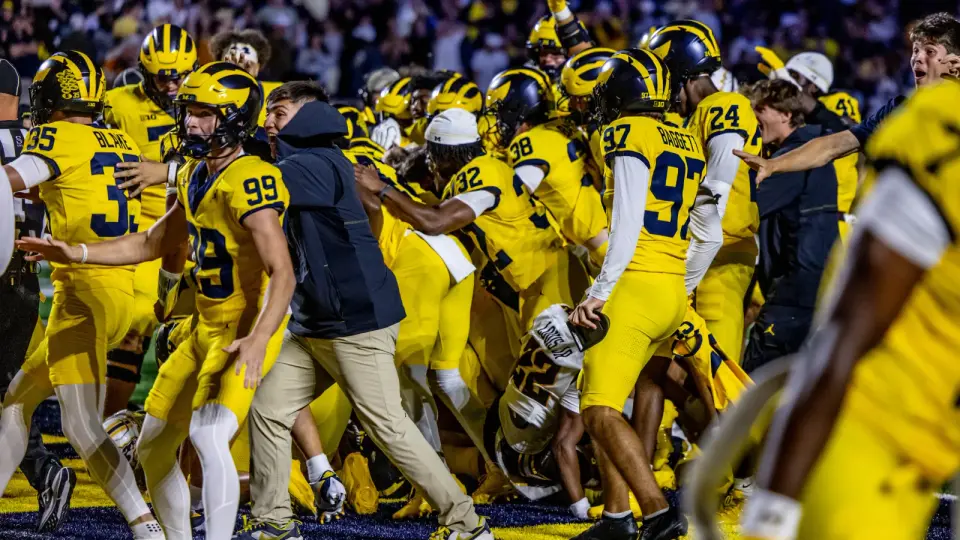
Michigan defeated Western Michigan 13-12 on a last-second Hail Mary pass after Big Ten officials added one second to the game clock following a review. NBC stated its broadcast clock was not the official timekeeper, while Big Ten officials confirmed a synchronization issue between the broadcast and the replay center clock. Western Michigan leadership accepted the ruling without appeal, citing the lack of a formal review process, though the clock discrepancy remains unresolved.
Key points
- Michigan won 13-12 with a 47-yard touchdown pass from Bryce Underwood to JJ Buchanan as time expired.
- Big Ten officials added one second to the clock after a review, contradicting the NBC broadcast clock which showed zero time.
- NBC stated its broadcast is not the official arbiter of time, with the Big Ten responsible for game clock management.
- Big Ten confirmed the broadcast and replay center clocks were out of sync, using a direct stadium clock shot for the ruling.
- Western Michigan president Russ Kavalhuna and coach Lance Taylor accepted the decision, noting no appeal process exists in the Big Ten or MAC.
Background
This incident follows Michigan's earlier dramatic win over Western Michigan, where the Wolverines overcame a late deficit and a contentious finish. Previous coverage highlighted the controversy surrounding the one-second extension and the subsequent debate over the legitimacy of the ending. The current developments focus on the technical explanation for the clock discrepancy and the institutional response from both conferences.
How outlets are covering it
USA Today and CBS Sports both report on the clock discrepancy but emphasize different aspects. USA Today focuses on the technical explanation from NBC and Big Ten, highlighting the synchronization issue between the broadcast and replay center clocks. CBS Sports, however, centers on Western Michigan's leadership response, detailing how President Russ Kavalhuna and Coach Lance Taylor chose acceptance over outrage, despite acknowledging the potential unfairness. The Detroit Free Press (freep.com) adds a legal perspective, noting that NCAA rules make the referee's decision final, meaning the result cannot be overturned even if the call was incorrect. All sources agree on the core facts: the one-second addition, the Hail Mary win, and the lack of an appeal process, but they diverge in their focus on technical, institutional, or legal dimensions.
Why it matters
The incident raises questions about the reliability of game clock systems in college football and the lack of a formal appeal process for controversial calls. It highlights the tension between broadcast technology and official game management, potentially influencing future rule changes or technological upgrades. For Western Michigan, the loss may impact their playoff prospects, while for Michigan, it secures a crucial win in a competitive Big Ten schedule. The broader implications include scrutiny of Big Ten's replay processes and the need for clearer standards in timekeeping to prevent similar controversies.
What to watch
Big Ten and MAC officials may review the clock synchronization issue to prevent future discrepancies. Western Michigan will continue its season as a MAC favorite, while Michigan prepares for its next game against Oklahoma. The College Football Playoff Selection Committee may consider the loss in its evaluations, though the result remains official. Further discussions on improving replay processes and clock standards are likely as the season progresses.
- NBC says broadcast not 'official arbiter' of game clock after Michigan Hail Mary USA Today
- Western Michigan president: Big Ten's replay process not 'as good as it could be' ESPN
- Can Michigan's controversial Hail Mary win over WMU be overturned? freep.com
- Acceptance over outrage: Inside how Western Michigan leaders dealt with controversial loss to Michigan CBS Sports
- Niyo: In Michigan football's great escape, seeing isn't believing The Detroit News
Want the full story? Read the original reporting
Read on USA Today