
"Supreme Court's Unusual Stance on Trump's Disqualification: Key Takeaways and Future Implications"
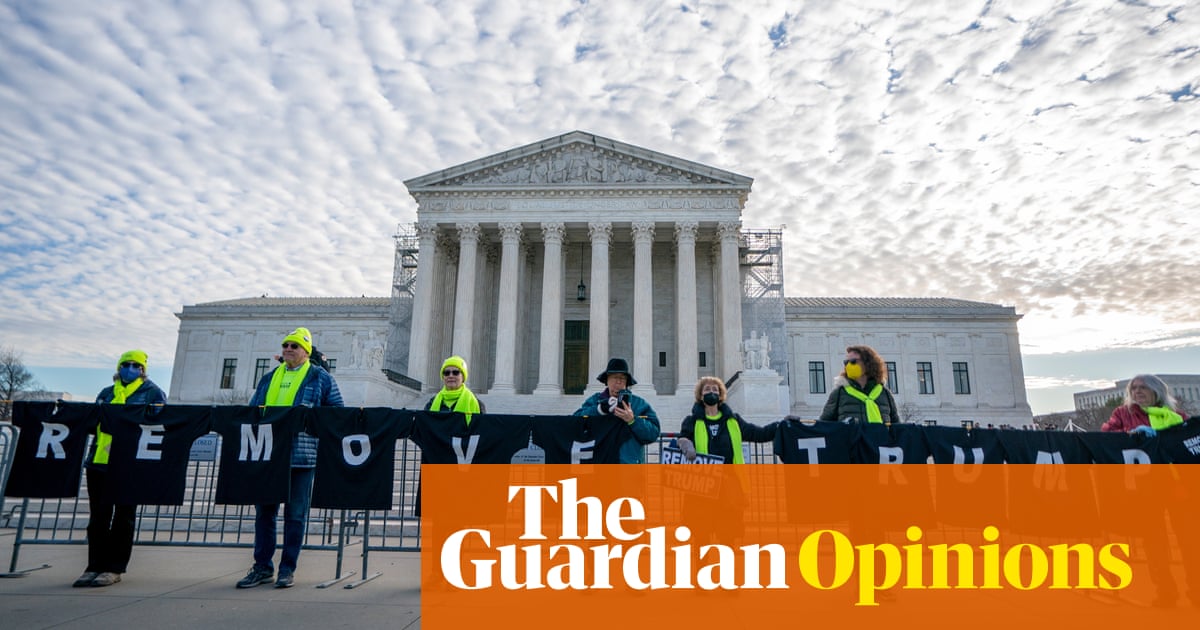
The US Supreme Court's oral arguments in Trump v Anderson, a case about whether Donald Trump is disqualified from holding federal office under section three of the 14th amendment, revealed a bizarre and strained legal debate. Trump's lawyer, Jonathan Mitchell, offered little help, leading the justices to search for an exit strategy. Justice Samuel Alito suggested that states may not have the authority to enforce section three without congressional permission, a notion that contradicts historical evidence and the amendment's language. The justices seemed inclined to fabricate a reasoning to avoid addressing the constitution's substantive protections for democracy. Disqualifying Trump would protect democracy, not undermine it, as he has openly expressed intentions to destroy it. The court's apparent avoidance may leave section three of the 14th amendment orphaned, with enforcement left to Congress, potentially setting the stage for future conflicts.
- US supreme court justices have strange views on whether Trump is disqualified The Guardian
- Will the Supreme Court put Trump back on the Colorado ballot? Key takeaways from the landmark hearing and a look at what's next. Yahoo News
- Three Big Legal Questions The New York Times
- The Hot Potato of Trump’s Disqualification The Atlantic
- John Roberts has a united court on Trump. Now comes the hard part CNN
Reading Insights
0
12
5 min
vs 6 min read
87%
1,044 → 139 words
Want the full story? Read the original article
Read on The Guardian