
France descends into chaos as 550,000 protesters spark riots, looting, and 1,200 arrests
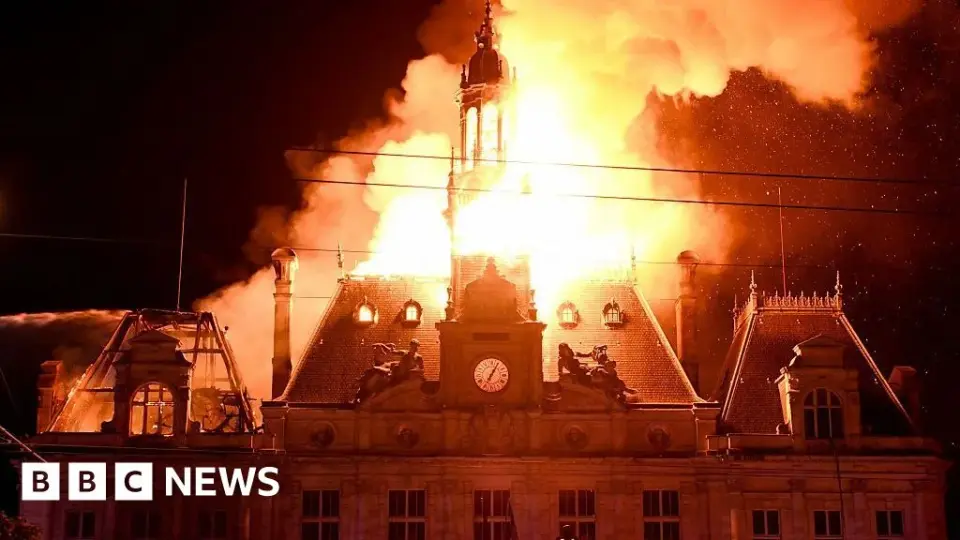
Violent unrest swept across France on Saturday, October 17, 2026, as an estimated 550,000 people took to the streets. The demonstrations, initially focused on education standards and the cost of living, escalated into widespread riots, looting, and arson in major cities including Paris, Lyon, and Limoges. Over 1,200 people were arrested, and 60 law enforcement officers were injured. President Emmanuel Macron condemned the violence, while political opponents blamed the government for failing to address legitimate grievances. The unrest marks a significant escalation in a multi-week protest movement that has drawn in students, unions, and the 'yellow vest' movement.
Key points
- Approximately 550,000 protesters participated in demonstrations across France, with 110,000 in Paris alone, according to the interior minister.
- Over 1,200 people were arrested nationwide, and 60 police officers were injured, including two who were hospitalized unconscious.
- Violence included looting, arson, and clashes with police in Paris, Lyon, Limoges, Marseille, and other cities. The Limoges town hall suffered a partial roof collapse due to a fire.
- A young man lost his hand in Saint-Étienne after a grenade exploded, marking the second such incident in the current protest wave.
- President Macron vowed to prosecute those responsible for the violence, while Prime Minister Sébastien Lecornu accused the far-left La France Insoumise party of instrumentalizing the protests for electoral gain.
- The protests have spread to neighboring Belgium, with solidarity demonstrations in Brussels and Liege.
Background
The current unrest is a continuation of a multi-week protest movement that began in September 2026, primarily driven by students demanding better school conditions, increased funding for teachers, and an end to police violence. The movement has since expanded to include trade unions, the 'yellow vest' movement, and other groups protesting the cost of living. The government has made some concessions, such as promising 3,000 additional supply teachers, but the protests have continued and intensified. The unrest is occurring in a period of deep political uncertainty, with a presidential election scheduled for April 2027.
How outlets are covering it
The French government, led by President Macron and Prime Minister Lecornu, has condemned the violence as an 'escalation' and a 'warm-up' for the presidential elections, accusing the far-left La France Insoumise party of instrumentalizing the protests. In contrast, Jean-Luc Mélenchon, the LFI leader, has defended the peaceful majority of protesters and accused the police of 'unleashing' on demonstrators. Marine Le Pen, the National Rally leader, has supported the police and blamed the far-left for fuelling the violence. CNN and BBC have highlighted the peaceful nature of the initial marches and the subsequent escalation into violence, while Fox News has emphasized the political exploitation of the protests and the police's difficult situation. The BBC and CNN have also noted the significant injuries to protesters, including the loss of a hand in Saint-Étienne, and the police's use of tear gas and water cannons.
Why it matters
The unrest highlights the deep social and political divisions in France, with the government facing criticism for its handling of the protests and the opposition accusing it of failing to address legitimate grievances. The violence and political accusations could have significant implications for the upcoming presidential election, with the far-left and far-right both seeking to capitalize on the unrest. The protests also raise concerns about the state of democracy and the rule of law in France, as well as the potential for further escalation in the coming weeks.
What to watch
The government has expressed hope that the protest movement will ease in the coming days, as schools are closed until November 2 for the All Saints' holiday. However, the political tensions are likely to continue, with the opposition parties using the unrest to criticize the government and the government accusing the opposition of exploiting the protests. The upcoming presidential election in April 2027 will be a key test of the political landscape in France, with the far-left and far-right both seeking to capitalize on the unrest.
- Violent clashes, looting and buildings ablaze in France as over 1,000 arrested after protests BBC
- Half a million protesters sweep France in major show of youth unrest CNN
- Unrest Mars Day of Protest in France, as Student Movement Turns National The New York Times
- Violence erupts at France protests as Macron warns unrest is being exploited Fox News
- Looting and arson in French cities during worst unrest in years Yahoo
Want the full story? Read the original reporting
Read on BBC