
France Mobilizes 70,000 Officers as Museums Close Ahead of Cost-of-Living Protests
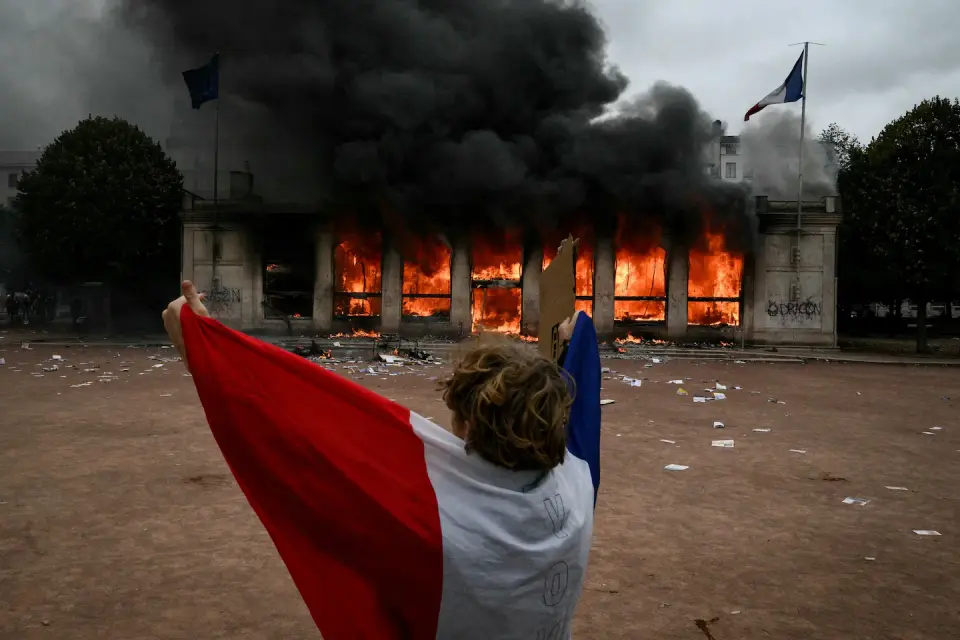
French authorities are deploying 70,000 police officers and closing major museums like the Louvre to prevent renewed violence during planned Saturday protests. The demonstrations, driven by cost-of-living grievances, follow a violent weekend that resulted in nearly 1,000 injured officers and over 3,000 damaged shops. President Macron has banned non-union protests, while student and labor groups continue to mobilize.
Key points
- Interior Minister Laurent Nuñez confirmed the deployment of 70,000 law enforcement officers, including SWAT units, helicopters, and water cannons, across France for the weekend.
- Major cultural institutions, including the Louvre, Musée d’Orsay, and Grand Palais, will close on Saturday to protect staff and artworks.
- The Art Basel Paris fair ended early on Friday, with organizers canceling weekend programs due to security concerns.
- President Macron banned non-union protests, stating the move was necessary to protect businesses and public buildings, though some union-led marches remain authorized.
- Last week’s unrest resulted in over 2,500 arrests, nearly 1,000 injured police officers, and more than 3,000 looted or damaged shops.
Background
The current unrest follows a series of student-led demonstrations over school conditions and rising living costs that escalated into nationwide riots. Previous coverage noted that while some participants had legitimate grievances, the violence included arson and looting, prompting public figures like former footballer Emmanuel Petit to call for order. The government has faced criticism for its initial response to the violence, leading to the current heightened security posture.
How outlets are covering it
The Washington Post highlights the emotional toll on citizens, quoting a Paris shop owner who described the public as feeling 'abandoned' and 'lost.' In contrast, The New York Times focuses on the legal and political tensions, noting that an administrative court overturned a ban on a student march, and that left-wing groups are denouncing the government’s actions as an 'authoritarian shift.' AP News and CNN emphasize the scale of the security operation and the economic impact, such as the early closure of Art Basel. While Macron and Interior Minister Nuñez frame the response as necessary to prevent 'ultraleft' violence, student unions and labor groups like the CGT view the bans as an attempt to suppress democratic expression.
Why it matters
The situation represents a critical test for the French government’s ability to balance public safety with democratic rights. The massive security deployment and closure of iconic cultural sites signal a shift toward a more restrictive approach to protest. If the Saturday demonstrations turn violent again, it could further destabilize the political landscape ahead of the presidential election, where Marine Le Pen is currently a front-runner.
What to watch
Protesters are expected to march in Paris and other cities on Saturday, with the CGT union leading a demonstration in the capital. Authorities will monitor the situation closely, with police prepared to make arrests. The outcome of these protests will likely influence the government’s future stance on labor and student grievances, as well as the political dynamics leading up to the spring presidential election.
- In the streets of Paris, a common refrain: ‘People are fed up’ The Washington Post
- France's Macron tightens curbs on protests, blaming hard left for unrest Reuters
- Louvre and other museums closing for Saturday protests as French authorities deploy 70,000 officers AP News
- In the Wake of Riots, the French Authorities Ban Some Protests The New York Times
- France braces for another weekend of protests as authorities launch massive security operation CNN
Want the full story? Read the original reporting
Read on The Washington Post