
Zelensky Warns of Spreading War as Iran Defies US at UN
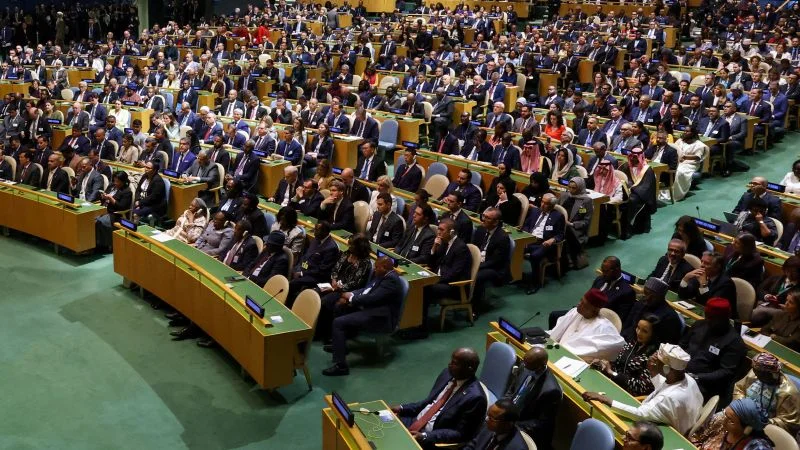
Ukrainian President Volodymyr Zelensky and Iranian President Masoud Pezeshkian delivered contrasting addresses at the UN General Assembly on Wednesday. Zelensky warned that Russia’s war is spreading and called for stricter sanctions, while Pezeshkian vowed Iran would never bow to US pressure despite ongoing military conflict. A US delegate walked out during Pezeshkian’s speech, which followed a three-hour diplomatic meeting between the two nations.
Key points
- Zelensky stated Russia has fired 7,700 jet-powered drones at Ukraine and claimed Russia’s budget deficit is at its highest level, urging the UN to target Russian finances.
- Pezeshkian accused the US and Israel of terrorism, citing the killing of 156 schoolchildren, and declared Iran would not accept limits on its peaceful nuclear program.
- A US delegate exited the chamber minutes into Pezeshkian’s address, marking the first time a president of a country at war with the US has addressed the UN.
- US Secretary of State Marco Rubio confirmed that US-Iran talks were a continuation of past conversations but not a breakthrough, noting the previous memorandum of understanding had collapsed.
- Rubio announced that Russian President Vladimir Putin has been invited to the G20 summit in Miami in December, his first in-person attendance since 2019.
Background
The 81st UN General Assembly is taking place against the backdrop of a four-and-a-half-year war in Ukraine and a seven-month conflict between the US/Israel and Iran. Previous coverage noted that Zelensky had already sought air defense support and urged the US to leverage sanctions against Russia. The current diplomatic impasse is exacerbated by the blockade of the Strait of Hormuz, which has disrupted global energy supplies and caused oil prices to soar.
How outlets are covering it
CNN and The New York Times emphasized the dramatic walkout by a US delegate during Pezeshkian’s speech, highlighting the tension between the two nations. The Guardian focused on the three-hour meeting between Iranian Foreign Minister Abbas Araghchi and US envoy Steve Witkoff, describing it as constructive but noting that Iran’s hardline officials refused to characterize it as a negotiation. Al Jazeera highlighted Zelensky’s specific warnings about AI in warfare and his call for a 'Freya' anti-ballistic program involving ten countries. While all sources agree on the defiant tone of Pezeshkian, The Guardian noted that Iran’s foreign ministry framed the talks as conveying conditions rather than reaching an agreement, whereas CNN suggested the US is prioritizing nuclear issues over the Strait of Hormuz.
Why it matters
These speeches underscore the deepening global divisions over two major conflicts. The US-Iran standoff threatens global energy stability through the Strait of Hormuz, while the Ukraine war continues to strain European security and global economies. The diplomatic maneuvers at the UN, including the G20 invitation to Putin and the stalled Gaza peace plan, indicate a fragmented international order where traditional multilateralism is failing to resolve active wars.
What to watch
The US and Iran are expected to continue indirect negotiations, with the US focusing on Iran’s nuclear program and Iran demanding the lifting of the naval blockade. Zelensky is expected to continue pushing for air defense support and sanctions against Russian energy. The G20 summit in Miami in December may become a critical venue for US-Russia diplomacy if Putin accepts the invitation.
- Live updates: Iran’s president says ‘we will never bow our head’ to Trump in defiant UN speech CNN
- Iranian leader hits back at ‘bully’ Trump in UN speech but signals willingness to talk The Guardian
- UN General Assembly live: Iran ‘victim of terrorism – Pezeshkian to Trump Al Jazeera
- U.N. Live Updates: Iran’s President Accuses U.S. and Israel of Lawless Attacks After Trump Threatens to 'Annihilate' Iran nytimes.com
- Iran’s Pezeshkian accuses Trump of ‘bullying mentality’, vows no surrender South China Morning Post
Want the full story? Read the original reporting
Read on CNN