
Review: Kim Ghattas’s ‘The Best Kind of American’ Links 1984 Assassination to Regional Chaos
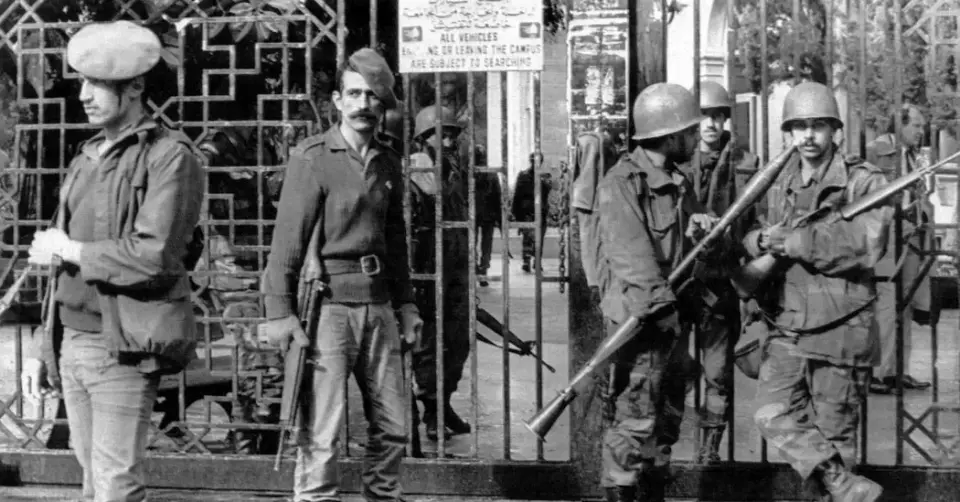
The New York Times reviews Kim Ghattas’s new book, 'The Best Kind of American,' which examines the 1984 assassination of American University of Beirut president Malcolm Kerr. The review highlights how Kerr’s murder, orchestrated by Iranian proxies, exposed the complex web of foreign interventions and local militant activities that destabilized Lebanon. Ghattas connects this event to broader regional conflicts, including the U.S. Embassy bombing and the involvement of figures like Imad Mughniyeh, illustrating how external powers used Lebanon as a theater for their geopolitical struggles.
Key points
- The book focuses on the 1984 killing of Malcolm Kerr, president of the American University of Beirut, by Iranian-backed Lebanese proxies.
- Kerr was targeted for his pro-Palestinian stance and investigation into the disappearance of fellow academic David Dodge, who was abducted in 1982 and sent to Tehran.
- Ghattas links Kerr’s murder to the 1983 U.S. Embassy bombing and the kidnapping of French scholar Michel Seurat, all attributed to the militant Imad Mughniyeh.
- The review notes that Lebanon served as a battleground for external powers, including the U.S., Israel, Iran, Syria, and the Soviet Union, during the 1980s.
- Ghattas’s multilingual background and access to sources in English, Arabic, French, and Persian allow her to detail the intricate relationships between ideology, convenience, and betrayal in the region.
Background
This review appears in the context of ongoing discussions about Middle Eastern instability and the role of external powers in regional conflicts. While our archive contains unrelated book reviews and product tests, the focus here is on historical nonfiction that sheds light on the roots of modern Middle Eastern tensions.
Why it matters
Understanding the 1984 assassination of Malcolm Kerr and the broader context of foreign interventions in Lebanon provides critical insight into the origins of current Middle Eastern conflicts. Ghattas’s work highlights how local actors and external powers interacted to create prolonged instability, offering a lens through which to view contemporary geopolitical dynamics in the region.
What to watch
Readers interested in Middle Eastern history and political violence may find Ghattas’s book a valuable resource for understanding the complex web of alliances and conflicts that shaped Lebanon’s modern history. The book’s detailed exploration of the 1980s could also inform current discussions about regional stability and the role of external actors in the Middle East.
Want the full story? Read the original reporting
Read on The New York Times