
Stubb Condemns 'Waste of Life' at UN, Signs Drone Pact with Zelensky
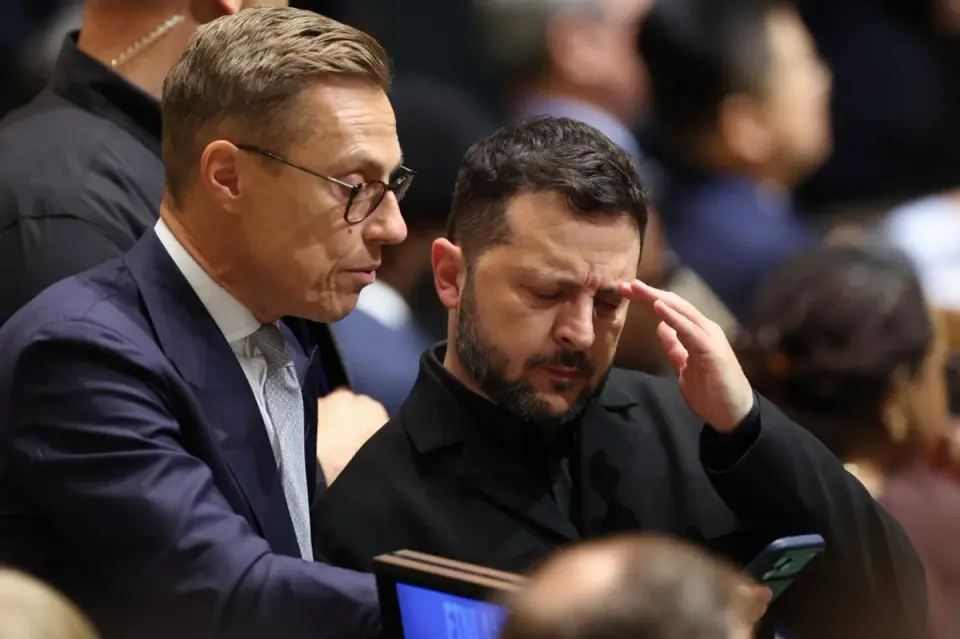
Finnish President Alexander Stubb and Ukrainian President Volodymyr Zelensky signed a new 'Drone Deal' in New York, establishing a joint production and technology-sharing framework for unmanned systems. The agreement, the 11th of its kind, emphasizes mutual security rather than one-way aid. Simultaneously, Stubb addressed the UN Security Council, warning that Russia’s slow territorial gains in Donbas are causing a 'waste of life' with approximately 25,000 monthly casualties. He described the front as a 20-kilometer-wide 'death zone' dominated by drone surveillance, arguing that the war lacks a military solution and requires an immediate ceasefire.
Key points
- Stubb and Zelensky signed the 11th 'Drone Deal,' focusing on joint industrial projects, technology transfer, and expertise exchange rather than simple purchases.
- Stubb stated that Russia has gained roughly 900 square kilometers in Donbas this year, while Ukraine retaken 800 square kilometers, resulting in a static frontline.
- The Finnish president cited a monthly casualty rate of 25,000, comparing the toll to the Soviet-Afghan war to highlight the inefficiency of the current conflict.
- Zelensky emphasized the need to strengthen air defense and protect energy infrastructure before winter, noting discussions with US partners on maintaining sanction pressure.
- Finland joined a UK- and Latvia-led international drone coalition in April 2026 to supply thousands of UAVs to the front lines.
Background
This development follows a period of intensified drone warfare, including a major Ukrainian strike in August 2026 involving over 800 drones and a Russian attack on Kyiv’s SBU headquarters in September. Previous analyses noted that Russia’s reliance on WWII-era mass assault tactics, combined with high casualty rates and shortened training periods, has strained its military capacity. The current 'Drone Deal' represents a shift from unilateral aid to a reciprocal defense partnership, reflecting Finland’s growing reliance on Ukrainian battlefield innovation to bolster its own capabilities along its 1,340-kilometer border with Russia.
How outlets are covering it
Kyiv Post highlights Stubb’s rhetorical framing of the war as a 'lose-lose' scenario driven by drone-enabled 'death zones' that prevent decisive military outcomes. UNITED24 Media focuses on the strategic nature of the agreement, emphasizing the joint production aspect and Finland’s recent entry into a broader international drone coalition. UATV places greater weight on the diplomatic context, noting Zelensky’s discussions with Norwegian Prime Minister Jonas Gahr Støre regarding winter energy resilience and his insistence that sanctions are the only path to peace. While all sources confirm the signing of the deal, Kyiv Post uniquely details the specific casualty statistics and territorial metrics cited by Stubb at the UN, whereas the other outlets prioritize the bilateral cooperation and winter preparation aspects.
Why it matters
The 'Drone Deal' signals a maturation of the Finland-Ukraine defense relationship, moving from assistance to integrated industrial cooperation. Stubb’s UN address provides a high-level Western assessment that the current war of attrition is strategically inefficient for Russia, potentially influencing diplomatic efforts toward a ceasefire. The emphasis on air defense and energy infrastructure before winter underscores the urgency of preventing a humanitarian crisis during the upcoming cold season, while the joint production model aims to sustain Ukraine’s drone capabilities without relying solely on external aid.
What to watch
Observers will monitor the implementation of the joint industrial projects outlined in the Drone Deal and the pace of technology transfer. Diplomatic efforts will focus on securing an unconditional or limited ceasefire, particularly regarding energy and grain infrastructure, as advocated by Stubb. Additionally, the effectiveness of the international drone coalition in supplying front-line units and the impact of sustained sanctions on Russian military capacity will be critical factors in the coming months.
- Finland, Ukraine Seal Major Drone Deal as Stubb Exposes Russia’s Stalled Donbas Offensive Kyiv Post
- Ukraine's Zelenskiy says he signed drone deal with Finnish president Reuters
- Finland and Ukraine Join Forces on Next-Gen Drone Production UNITED24 Media
- Finland and Ukraine sign Drone Deal to boost their defence and security cooperation patriagroup.com
- Zelenskyy Meets Finnish And Norwegian Leaders In New York, Signs Drone Deal With Finland uatv.ua
Want the full story? Read the original reporting
Read on Kyiv Post