
China Opens Pinglu Canal to Slash Southeast Asia Trade Costs
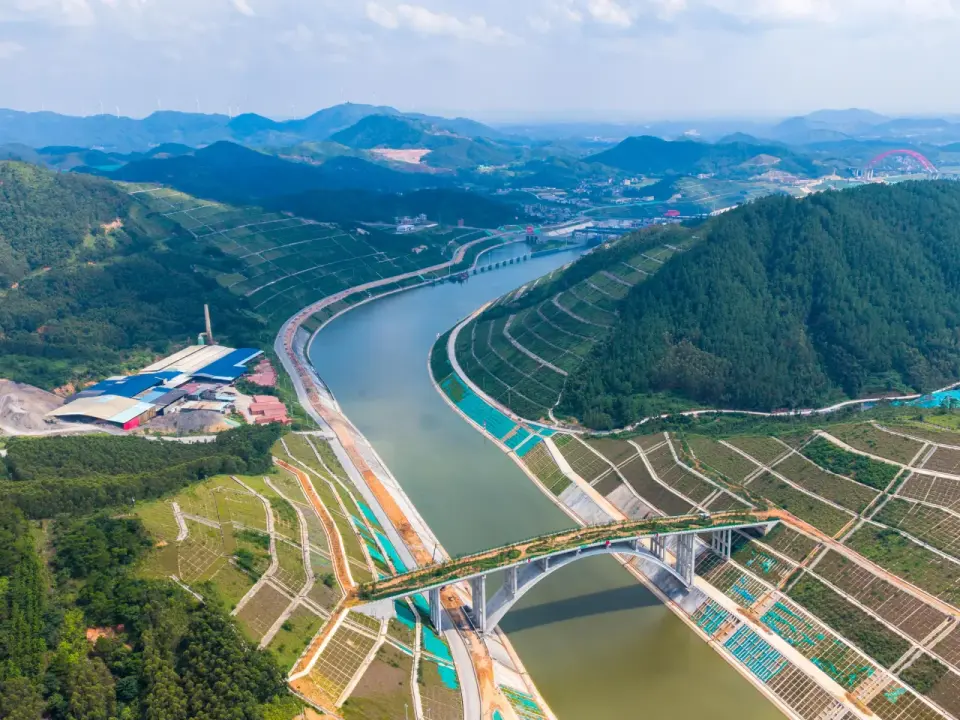
China inaugurated the Pinglu Canal on September 16, 2026, its first modern river-to-sea waterway since 1949. The 134km channel in Guangxi connects the Xijiang River to the Beibu Gulf, shortening trade routes to Southeast Asia by 560km and cutting logistics costs by up to 30%.
Key points
- The canal opened to navigation on September 16, 2026, after construction began in August 2022.
- It costs approximately 72.7 billion yuan ($10.8bn) and accommodates vessels up to 5,000 tonnes.
- Transport costs are expected to drop by over 5 billion yuan annually, boosting trade with Southeast Asia.
- The project is part of the New International Land-Sea Trade Corridor and Xi Jinping’s Belt and Road Initiative.
- Resettlement involved 2,764 households and 11,228 people across four counties in Guangxi.
Background
China-Southeast Asia bilateral trade reached 4.34 trillion yuan in the first half of 2026, up 18.2% year-on-year. The canal complements existing infrastructure like the Beibu Gulf Port, whose container capacity rose from 2.28 million TEUs in 2017 to 10.06 million TEUs in 2025. This follows broader regional trade shifts amid geopolitical tensions, including recent South China Sea disputes highlighted in September 2026.
How outlets are covering it
Al Jazeera emphasizes the canal’s role in reducing dependence on vulnerable maritime chokepoints like the Strait of Hormuz, framing it as a trade security measure. China Daily focuses on the logistical efficiency, highlighting the 560km distance reduction and direct access to the Beibu Gulf. Both sources agree on the economic benefits but differ in emphasis: Al Jazeera stresses geopolitical resilience, while China Daily highlights domestic industrial integration and cost savings.
Why it matters
The Pinglu Canal reshapes trade logistics for Southwest China, linking inland hubs like Chongqing and Chengdu to Southeast Asian markets. It reduces reliance on congested coastal routes and strengthens China’s economic integration with ASEAN, potentially influencing regional supply chain dynamics and trade security in the South China Sea region.
What to watch
Commercial vessels will pass through the canal’s three water gates free of charge until December 31, 2026. Starting January 1, 2027, a nominal fee of one yuan per tonne will apply, lasting until September 2031. Direct commercial sailings to Can Tho, Vietnam, are scheduled to begin post-opening, and Guangxi is developing the 'Pinglu Canal Economic Belt' to attract industries in critical minerals, green chemicals, and AI.
- What’s the Pinglu Canal, China’s new gateway to Southeast Asia? Al Jazeera
- China launches Pinglu Canal, slashing transit time to Southeast Asia South China Morning Post
- Mainland welcomes Taiwan companies to share Pinglu Canal opportunities news.cgtn.com
- China creates fertile farmland with 315 million cubic meters of earth and rock excavated from the Pinglu Canal globaltimes.cn
- China's first river-to-sea canal project opens to navigation China Daily
Want the full story? Read the original reporting
Read on Al Jazeera