
Ukraine's 'Marsupial' Drone-Robot System Solves Delivery Problem US Chased for 30 Years
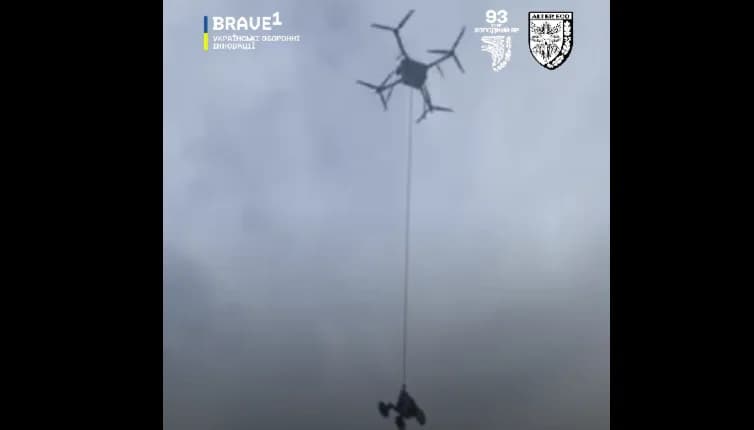
Ukrainian forces have fielded a 'marsupial' system that uses heavy drones to air-drop combat ground robots behind enemy lines, solving a logistical challenge the US military pursued for three decades. The Alter Ego battalion developed the Desantnyk robot in 10 days, and Brave1 is now scaling production. This capability supports Operation Vivaldi, which has liberated up to 250 square kilometers of territory by combining drone dominance with robotic ground assaults.
Key points
- The Alter Ego battalion of the 93rd Mechanized Brigade paired a bomber drone with the Desantnyk ground robot, achieving combat use within 10 days of conception.
- This 'marsupial' concept allows robots to bypass mined terrain and reach targets dozens of kilometers behind frontlines, a task ground robots cannot perform alone.
- Brave1, a state defense cluster, is assisting in moving the system from prototype to serial production for wider distribution.
- The 3rd Army Corps used similar airborne robot drops during Operation Vivaldi, striking Russian supply lines more than six miles behind the front.
- Ground robots are also clearing mines, handling 60 percent of mine-clearing tasks in the 3rd Corps area without risking human sappers.
Background
Ukraine's military has increasingly relied on unmanned systems to offset manpower shortages. Previous archive coverage noted Ukraine's use of drones for capturing Russian soldiers and the broader shift toward autonomous warfare. The current developments represent an evolution from simple surveillance or strike drones to complex, multi-platform logistics solutions that integrate air and ground robotics.
How outlets are covering it
Euromaidan Press emphasizes the technological breakthrough, highlighting that the US pursued similar concepts for 30 years without fielding them, and notes the rapid 10-day development cycle. Ars Technica focuses on the operational impact, detailing how these robots supported Operation Vivaldi by clearing 18 miles of routes and enabling infantry advances. The Modern War Institute provides a strategic lens, arguing that Operation Vivaldi demonstrates a path to operational-level victory through 'drone dominance' and deep-strike campaigns, but warns that Ukraine must now scale this success to achieve a decisive breakthrough. The Telegraph source was inaccessible due to a security block, so its perspective is unavailable.
Why it matters
This innovation addresses a critical bottleneck in modern warfare: delivering autonomous assets to contested areas. By solving the 'last mile' problem for ground robots, Ukraine can project force deeper into enemy rear areas without exposing human troops to mines or drones. This capability could shift the balance of power by allowing Ukraine to disrupt Russian logistics and command structures more effectively, potentially forcing a strategic reassessment by Moscow.
What to watch
Brave1 is facilitating serial production of the Desantnyk robot to equip more units. The 3rd Army Corps is expected to continue using these systems in Operation Vivaldi's subsequent phases. Analysts suggest Ukraine must now focus on mobilizing society and international partners to sustain the production of middle-strike drones and ground robots necessary for a broader operational breakthrough.
- Ukrainian soldiers solve drone-delivery problem US military has chased for three decades Euromaidan Press
- Robots make combat airdrops, clear mines as Ukraine defeats Russian pincer Ars Technica
- Revealed: Secret robot offensive that ‘killed 3,000 Russians’ The Telegraph
- Drones only need 2 nights to lay a minefield that would take troops 2 weeks: Ukrainian corps Yahoo
- An Overture to Victory: Operation Vivaldi and Ukraine’s Path to Battlefield Decision Modern War Institute -
Want the full story? Read the original reporting
Read on Euromaidan Press