
Germany escalates security response after third drone found near Leipzig hub
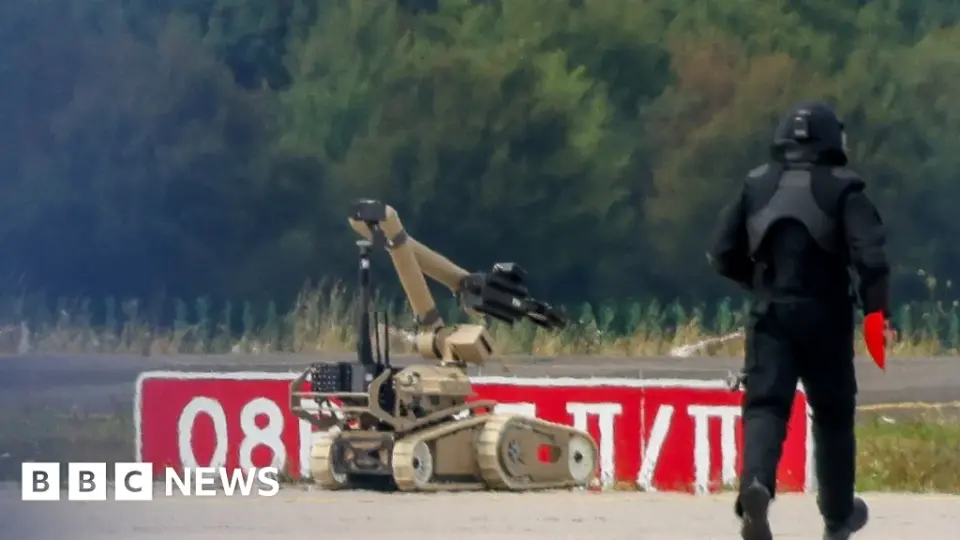
German Chancellor Friedrich Merz has warned that perpetrators of recent drone incidents will face consequences, following the discovery of a third drone and military explosives near Leipzig/Halle Airport. While Berlin has not officially blamed Moscow, security experts suspect Russian involvement in the sabotage attempts targeting NATO and Ukrainian logistics hubs. The government is now planning to expand anti-drone defenses and empower intelligence agencies to conduct cyber countermeasures against foreign attackers.
Key points
- A third drone was found in Kabelsketal on August 14, containing traces of the military explosive hexogen, following an initial incident on August 4 where an explosive-laden drone was found near a Ukrainian Antonov cargo plane.
- Investigators believe a second drone collided with a DHL cargo aircraft on the same night as the first incident, causing damage to the tail section and forcing the plane to divert to Marseille.
- Chancellor Merz stated that Germany is increasingly a target for 'unscrupulous' attackers who are willing to accept severe property damage or casualties, though he stopped short of naming a specific suspect.
- The German government is planning to strengthen drone defenses and allow security services to hack attacker computer servers, while reaffirming its support for Ukraine in the ongoing conflict with Russia.
- The incidents have raised concerns about hybrid warfare, with police warning that unauthorised drone flights over sensitive sites like military bases and energy terminals may be coordinated by foreign agents.
Background
This incident follows a series of unauthorised drone sightings over sensitive German infrastructure in recent months, including military bases and logistics hubs. Previous reports indicated that German authorities were already preparing to double the number of anti-drone experts and expand security bases in response to what Interior Minister Alexander Dobrindt described as daily hybrid warfare. The Leipzig/Halle Airport is a critical node for NATO logistics and Ukrainian military aid, making it a high-value target for potential sabotage.
How outlets are covering it
While all sources agree on the discovery of multiple drones and the presence of military explosives, they differ in their emphasis on the political and security implications. The BBC and The Guardian focus on the government's cautious approach, noting that Berlin has avoided direct accusations against Russia despite intelligence sources suspecting Moscow's involvement. The Financial Times highlights the broader context of hybrid threats, linking the drone incidents to regional elections where the far-right Alternative for Germany is expected to gain support, and notes a separate foiled arson attack on a drone factory in Slovakia. All outlets confirm that Merz is planning to expand security powers, but The FT specifically mentions the potential for cyber countermeasures against attackers abroad.
Why it matters
The repeated drone incidents near critical logistics hubs signal a potential shift in the nature of threats facing European nations, moving from traditional military conflict to covert sabotage and hybrid warfare. The German government's decision to expand intelligence powers and anti-drone defenses indicates a significant escalation in security policy, which could have implications for civil liberties and international relations. Furthermore, the targeting of infrastructure used for Ukrainian military aid underscores the interconnectedness of the Russia-Ukraine war and European security, with potential consequences for NATO logistics and regional stability.
What to watch
The German government is expected to release more details on the investigation and its findings regarding the perpetrators of the drone attacks in the coming days. Merz has indicated that the government will present its findings and comment on them shortly, potentially leading to formal accusations or further security measures. The expansion of anti-drone defenses and the empowerment of security services to conduct cyber countermeasures are likely to be implemented in the near future, with potential implications for the protection of critical infrastructure across Germany and Europe.
- Germany's Merz warns attackers will 'pay price' after drone incident BBC
- Third drone and suspected military explosives found near Leipzig airport The Guardian
- Germany to say who's behind attempted airport drone attack soon, says Merz Reuters
- Another drone found at Leipzig airport as Germany warns of ‘unscrupulous’ attacks Financial Times
- Germany news: Third drone found in Leipzig airport probe DW.com
Want the full story? Read the original reporting
Read on BBC