
Fox News Host Retracts Support for Iran War as Public Backlash Grows
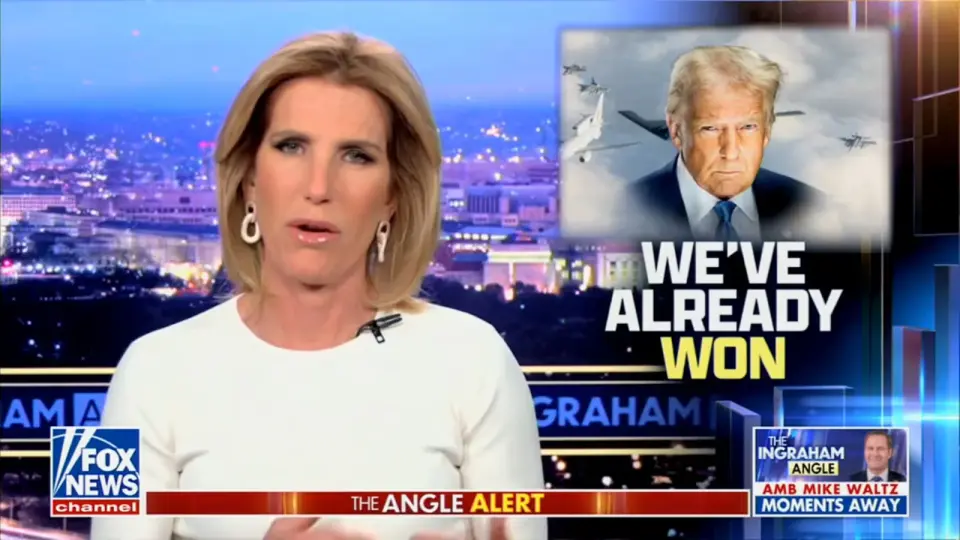
Laura Ingraham has publicly reversed her stance on the U.S.-Israeli war in Iran, claiming she opposed the conflict from its inception. This recent shift contradicts her earlier enthusiastic support for the military strikes, which began in late February. Critics argue her new position is a strategic pivot to align with declining public opinion and rising costs, rather than a genuine change in policy. The conflict, which has cost over $38 billion, continues to face legislative resistance in the House of Representatives.
Key points
- Ingraham stated on September 21 that she opposed the Iran war 'from day one,' a claim disputed by her own previous broadcasts.
- In early March, Ingraham fully endorsed the military strikes, stating that objections to the action 'withstand serious scrutiny' and that Trump had 'already won' in Iran.
- The U.S. House of Representatives has voted three times to constrain military action in Iran, with some Republicans joining Democrats in support of war-powers resolutions.
- The conflict has incurred costs exceeding $38 billion, with monthly expenses estimated at $2-3 billion, contributing to higher inflation.
- Ingraham’s recent opposition coincides with a broader shift in public opinion, where polls indicate most Americans believe the war was not worth fighting.
Background
The U.S.-Israeli war in Iran began on February 28, 2026. Initial coverage from our archive indicates that the conflict has led to significant geopolitical shifts, including Iran leveraging the Strait of Hormuz to demand passage fees. By August 2026, experts like John Mearsheimer described the war as a defeat for the U.S. As of September 2026, legislative efforts to curb the war have intensified, with the Congressional Budget Office noting that inflation is approximately 0.5 percentage points higher due to the conflict. Ingraham’s current stance mirrors a broader trend among some Republicans, such as Iowa Senate candidate Ashley Hinson, who are now urging an end to the conflict to mitigate economic impacts like high gas prices.
How outlets are covering it
Media Matters for America and Mediaite both criticize Ingraham for rewriting her history, noting that her early March comments were a 'full endorsement' of the war. Mediaite highlights that Ingraham previously praised the war as a 'gift to future generations' in April. In contrast, Ingraham’s current narrative emphasizes her opposition to the war's costs and lack of intelligence, aligning with the growing public dissatisfaction. While Media Matters frames this as a 'self-serving fantasy' to appeal to the MAGA movement, Mediaite suggests Ingraham is 'lying to her viewers' to avoid admitting support for another military misadventure. No source provides a neutral defense of her initial support, but all agree that her current position is a significant departure from her earlier hawkish stance.
Why it matters
Ingraham’s reversal signals a potential shift in the Republican base’s tolerance for foreign military engagements, particularly as economic costs rise. Her pivot may influence other conservative figures to distance themselves from the war, potentially impacting the 2026 midterm elections. The conflict’s financial burden and public opposition could force a reassessment of U.S. foreign policy priorities, shifting focus back to domestic issues like inflation and gas prices.
What to watch
Expect continued legislative pressure to end the Iran war, as the House has already voted three times to constrain military action. Ingraham may face further scrutiny from critics who highlight her previous pro-war statements. The broader political landscape may see more Republicans distancing themselves from the conflict to appeal to voters concerned about economic impacts. The U.S. may also face increased diplomatic challenges as Iran continues to leverage its position in the Strait of Hormuz.
- Laura Ingraham is rewriting her mealy-mouthed acquiescence of the Iran war into opposition from the beginning Media Matters for America
- Laura Ingraham Turns On Trump — And Her Guest James Carville Eats It Up Yahoo News New Zealand
- Nice Try, Laura: Fox’s Ingraham Pretends She’s Always Opposed Trump’s War Mediaite
- Laura Ingraham Turned On Trump — And Her On-Air Guest Was Eating It Up BuzzFeed
- Laura Ingraham claims again she was against Iran war from the beginning Yahoo
Want the full story? Read the original reporting
Read on Media Matters for America