
August Dominates Global Travel Calendar, but Regional Weather Creates Eight Ideal Months in the U.S.
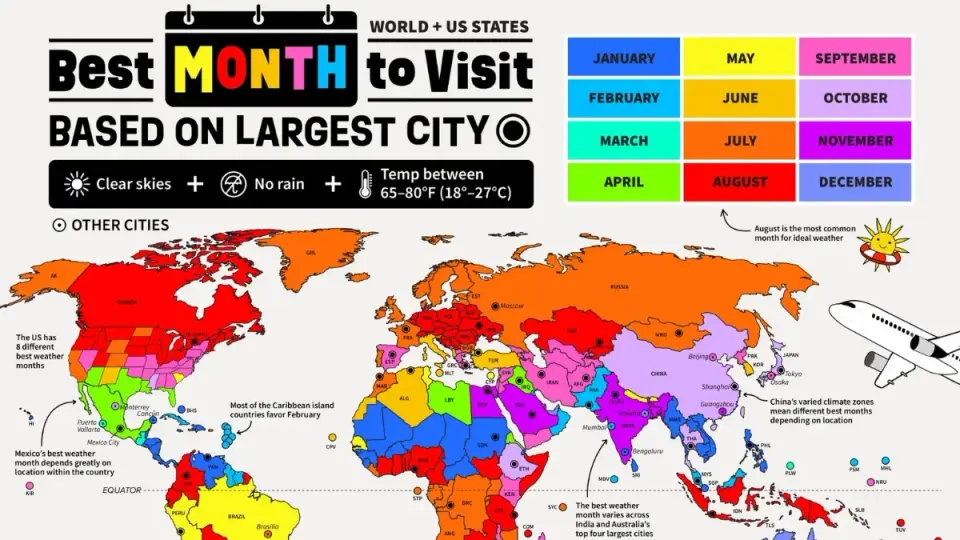
A comprehensive analysis of 261 global locations reveals that August is the optimal travel month for 63 destinations, primarily in Europe and the U.S. The study, based on Weather Spark data, prioritizes clear skies and temperatures between 65–80°F. While summer months dominate the Northern Hemisphere, January and February are ideal for tropical and Southern Hemisphere destinations. In the U.S., eight different months emerge as best across the 50 states, with Hawaii favoring January and Mississippi favoring October. This data-driven approach is reshaping how travelers schedule trips, moving away from traditional school holiday calendars toward climate-optimized windows to avoid crowds and extreme weather.
Key points
- August is the most common ideal travel month globally, ranking first for 63 of 261 locations analyzed, including much of Europe and the U.S.
- The methodology uses Weather Spark data to identify months with the best combination of clear skies and temperatures between 65–80°F (18–27°C).
- July through September account for 150 locations, or nearly 58% of the dataset, while December is recommended for only five locations.
- January and February are the best months for many tropical and Southern Hemisphere destinations, including the Caribbean, Brazil, and Australia.
- The U.S. shows significant regional variation, with eight different ideal months across its 50 states; Hawaii is the only state favoring January, and Mississippi is the only one favoring October.
- Travelers are increasingly using climate intelligence and 30-year climate normals to plan trips, aiming to avoid peak crowds and extreme weather conditions.
Background
This analysis builds on a growing trend in 2026 where travelers are shifting from traditional, calendar-based scheduling to data-driven, climate-centric planning. Previous coverage noted that destinations like Panama and Spain are top choices for expats, highlighting the importance of long-term livability and comfort. The current focus on weather-based timing reflects a broader industry move toward sustainable tourism, where spreading visitor demand across different months helps reduce ecological strain and overcrowding in popular hotspots.
How outlets are covering it
Visual Capitalist and Voronoi present the core data, emphasizing that August is the global sweet spot due to favorable weather in the Northern Hemisphere. They highlight that while summer is ideal for Europe, it can also bring larger crowds and higher prices, suggesting shoulder seasons as a compromise. Nomad Lawyer expands on the implications, arguing that this shift is driven by a desire for travel quality and the use of machine learning to suggest off-peak windows. Nomad Lawyer also notes that climate change is making historic travel peaks less reliable, pushing the industry toward 'weather-guaranteed' policies and dynamic booking systems. All sources agree that regional variation is critical, as a single national month does not apply to large countries like the U.S., China, or Australia.
Why it matters
Understanding the optimal travel months based on weather data allows travelers to maximize their experience by avoiding extreme heat, rain, or overcrowding. For the tourism industry, this data supports the development of flexible booking systems and sustainable tourism models that distribute visitor flows more evenly throughout the year, protecting local economies and environments from the strain of peak-season overcrowding.
What to watch
As climate patterns continue to shift, the 'best' months for travel may change, requiring travelers and tour operators to rely on real-time climate intelligence and dynamic forecasting. The adoption of AI-powered weather planners and 'weather-guaranteed' policies is expected to grow, offering travelers more precise and resilient travel experiences. Destinations may also adjust their marketing and infrastructure to accommodate visitors during their newly identified optimal weather windows.
Want the full story? Read the original reporting
Read on Visual Capitalist