
Bend Tragedy and AI Sector Shifts
By tl;dr Editorial Team · Published
Listen to this briefing · 6 min
Podcast feedYesterday’s news cycle was dominated by a devastating school shooting in Oregon and significant shifts in the technology sector, from open-source governance to AI hardware and valuation. Below is a breakdown of the day’s most critical developments.
Nation
The most urgent news came from Bend, Oregon, where a 16-year-old former student, Griffin J. John II, killed four people at Silver Rail Elementary School on October 15. The victims included three young boys and a 25-year-old teacher, while two others were injured. The attack ended when an armed bystander, identified as Kaylub Giamanco, entered the school and fatally shot the attacker, preventing further casualties. Governor Tina Kotek praised Giamanco, but the incident has intensified local grief and sparked renewed debate regarding gun access and school safety in Oregon, even amidst stricter state laws. In a separate domestic development, the Bryson Fire in Malibu has burned 146 acres, triggering mandatory evacuations in three canyon areas. Although no structures have been lost yet, strong Santa Ana winds and low humidity threaten containment efforts, with over 100 homes currently at risk.

Bend School Shooting: 16-Year-Old Kills 4, Bystander Stops Attack
A 16-year-old former student killed four people at Silver Rail Elementary School in Bend, Oregon, on October 15, before being shot dead by an armed bystander. The victims included three boys aged 5, 8, and 11, and a 25-year-old teacher. Two others, a 7-year-old girl and a 54-year-old teacher, were injured. Police identified the shooter as Griffin J. John II, a former special education student at the school. A community member, identified by family as Kaylub Giamanco, entered the school and fatally shot the attacker, preventing further casualties. Governor Tina Kotek praised the bystander, while families of the victims released statements honoring the deceased. The incident has intensified local grief, with a candlelight vigil held in Bend, and raised questions about gun access and school safety in Oregon.
Source: The Guardian

Bryson Fire in Malibu reaches 146 acres as Santa Ana winds threaten containment
The Bryson Fire in western Malibu has burned 146 acres and triggered mandatory evacuations in three canyon areas. Firefighters have achieved 17% containment, but strong Santa Ana winds and low humidity are expected to hinder efforts through Saturday. No structures or lives have been lost so far, though over 100 homes are threatened.
Source: NBC News
Technology
The tech sector saw major structural changes in how AI is integrated into software and hardware. The Linux kernel project has officially dropped the mandatory 'Assisted-by' tag for AI-generated code, a move defended by Linus Torvalds as 'utterly stupid' regulation. Simultaneously, maintainers are adopting Meta’s large language models via a new bot named Sashiko to automate patch reviews. This shift contrasts with other open-source projects that have banned AI contributions entirely, highlighting a tension between efficiency and accountability. In hardware, Nvidia and Microsoft launched the RTX Spark platform, a new Arm-based Windows laptop designed for local AI inference. While the device offers workstation-grade power for running large models without cloud dependency, early reviews note significant trade-offs in gaming performance and battery life. Meanwhile, OpenAI has tightened security protocols after a Saudi engineer was charged with planting a hidden recording device in an executive conference room, illustrating the rising risks of physical espionage in the AI industry.

Linux Kernel Abandons AI Disclosure Tags, Embraces Meta LLMs for Automated Reviews
The Linux kernel project has officially dropped the mandatory 'Assisted-by' tag for AI-generated code, a move defended by Linus Torvalds as 'utterly stupid' regulation. Simultaneously, maintainers are integrating Meta’s large language models via a new bot named Sashiko to automate patch reviews and commit message generation. While Torvalds personally uses Anthropic’s Claude Code for complex refactoring, the project faces criticism over potential race conditions in AI-written code and the overwhelming volume of AI-generated bug reports. This shift marks a significant departure from other open-source projects like NetBSD and System76, which have banned AI contributions entirely.
Source: Hackaday
Linux Kernel Drops AI Disclosure Tag After Torvalds Calls Rules 'Utterly Stupid'
The Linux kernel maintainers have officially dropped the requirement for contributors to label AI-assisted commits with an 'Assisted-by' tag. Linus Torvalds defended the move on the mailing list, calling such rules 'utterly stupid' and arguing that human understanding matters more than the tools used. This shift follows Torvalds' recent use of Anthropic's Claude Code for a major page cache patch, which initially passed review but later required fixes for a race condition. The kernel project is simultaneously adopting Meta's LLMs for automated code reviews via a new bot called Sashiko, marking a significant pivot toward AI integration in open-source development.
Source: The New Stack

Nvidia RTX Spark Launches: A New Arm-Based Windows Platform for Local AI
Nvidia and Microsoft launched the RTX Spark platform on October 16, 2026, introducing a new class of Windows laptops built on Arm architecture. The N1X superchip combines a Grace CPU, Blackwell GPU, and up to 128GB of unified memory to enable local AI inference and agentic workflows without cloud dependency. While the hardware offers workstation-grade power in a portable form factor, early reviews highlight significant trade-offs in gaming performance, battery life, and software stability compared to x86 and Apple silicon competitors.
Source: PCMag

OpenAI Tightens Security After Saudi Engineer Charged With Planting Hidden Recorder
OpenAI has issued urgent security warnings to employees regarding foreign espionage attempts, including 'honey pot' schemes, following the arrest of a Saudi engineer who planted a hidden recording device in an executive conference room. The incident has prompted heightened counterintelligence measures across the AI industry and raised concerns about the protection of proprietary technology.
Source: New York Post
Markets
Investor sentiment in the artificial intelligence sector appears to be cooling. Anthropic’s initial public offering valuation has reportedly dropped from $2 trillion to $1.5 trillion following an investor day in San Francisco. The reduction follows the release of third-quarter revenue figures of $16.8 billion, which, while profitable, showed a slower sequential growth rate than the previous quarter. Market skeptics argue that this deceleration undermines the hypergrowth narrative, while bulls view the lower valuation as a pragmatic adjustment. This shift signals a potential reassessment of valuations across the AI sector as investors demand more concrete evidence of sustainable growth rather than relying on run-rate figures.
World
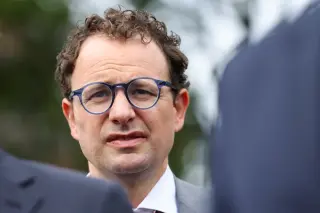
Diplomatic tensions in the Middle East took center stage as Chinese Foreign Minister Wang Yi met Israeli President Isaac Herzog in Baku, Azerbaijan. Wang demanded that Israel halt and reverse its 'forced establishment' of West Bank settlements, calling the Palestinian issue the century's greatest historical injustice. He urged a return to dialogue for a political solution and emphasized the immediate priority of opening access to Gaza to prevent a humanitarian catastrophe. Herzog expressed satisfaction with the meeting but cited security threats from Iran. This encounter signals China's growing assertiveness in Middle Eastern diplomacy, challenging traditional Western influence and positioning itself as a key player in resolving the Israel-Palestine conflict.
Health and Culture
In health news, a new study published in Nature challenges the assumption that plastics are chemically inert. Researchers found that when microplastics interact with water, they spontaneously generate reactive oxygen species, specifically hydroxyl radicals. This chemical activity, which increases with the plastic's hydrophobicity, may contribute to cellular damage and inflammation, providing a potential molecular mechanism for microplastic toxicity. On the cultural front, Iron Maiden has confirmed a 16-date North American tour for spring 2027, marking the final leg of their 50th-anniversary 'Run for Your Lives' run. The tour, which targets previously missed regions like the Pacific Northwest and Southeast, concludes with festival headline slots and features a historic all-British support lineup.

Study: Water Activates Microplastics, Generating Harmful Radicals
A new study in Nature challenges the assumption that plastics are chemically inert. Researchers found that when microplastics interact with water, they spontaneously generate reactive oxygen species (ROS), specifically hydroxyl radicals. This chemical activity, which increases with the plastic's hydrophobicity, may contribute to cellular damage, inflammation, and disease. While the exact contribution to human health remains uncertain, the findings suggest that the interface between water and plastic is a critical factor in toxicity.
Source: Gizmodo

Iron Maiden Confirms Final 2027 North American Leg with Festival Headliners
Iron Maiden has confirmed a 16-date North American tour for spring 2027, marking the final leg of their 50th-anniversary 'Run for Your Lives' run. The tour, organized by Live Nation, targets previously missed regions like the Pacific Northwest and Southeast, concluding with festival headline slots at Sonic Temple and Boardwalk Rock. Bassist Steve Harris noted the band had planned a break but extended the tour due to strong fan support. Support acts include Bullet for My Valentine and The Raven Age, creating the first all-British three-band bill for Maiden since 1983.
Source: Variety
These stories reflect a day marked by tragic violence, evolving technological standards, and shifting global power dynamics. As communities mourn in Oregon and investors reassess AI valuations, the focus remains on how new technologies and international relations will shape the coming year.