
AI Backlash Triggers Tech Sell-Off and Political Shifts
By tl;dr Editorial Team · Published
Listen to this briefing · 10 min
Podcast feedThe previous 24 hours were defined by a sharp correction in global technology markets, driven by political resistance to artificial intelligence infrastructure. As investors reassess the sustainability of massive data center spending, the industry faces a new reality where regulatory and social risks outweigh immediate financial performance. This tension is reshaping corporate strategies, from Microsoft’s pivot on user experience to Anthropic’s cautious approach to its public listing, while geopolitical instability in the Middle East adds further uncertainty to global energy and supply chains.
Markets and Politics
Global technology stocks suffered a severe sell-off, with the Nasdaq entering correction territory and the Philadelphia Semiconductor Index dropping 12.2%. The decline was driven by fears that new U.S. political leadership will restrict data center construction, potentially stalling AI demand. Valuations for memory chipmakers Micron and Sandisk have collapsed to near 5x forward earnings, despite strong underlying business fundamentals, as investors prioritize political risk over current profitability. The Nasdaq Composite fell 5.5%, closing more than 10% below its recent peak, while Asian tech stocks tumbled, with South Korea’s SK Hynix down 10.44% and Japan’s SoftBank Group falling 10.83%. Micron stock dropped 14% in a single day, extending its one-month decline to 36%, while Sandisk fell 19% in a day and 29% over the month.
This market turmoil reflects a fundamental shift in U.S. energy and technology policy following the 2026 midterm elections. A historic Democratic sweep, driven significantly by voter backlash against AI data centers, saw Democrats win the Texas governorship and a Senate seat for the first time in decades. Gov.-elect Gina Hinojosa has called for an immediate moratorium on new data center approvals until protective legislation is passed. Nationally, voters overwhelmingly opposed local data center construction, leading Democratic leaders to demand a federal pause on AI infrastructure development. CNN’s Voter Poll found that approximately 56% of voters considered AI and data centers a crucial or major factor in their voting decision. While industry advocates argue for sensible regulation rather than bans, the political shift threatens billions in planned investments and has already triggered significant declines in semiconductor stock prices. The conflict between federal pro-AI stances and local voter sentiment creates a regulatory uncertainty that may force tech companies to relocate operations or delay projects, with significant implications for the U.S. economy and its competitive position in the AI race.

Chip Stocks Crash as Data Center Fears Trigger Global Tech Sell-Off
Global technology stocks suffered a severe sell-off, with the Nasdaq entering correction territory and the Philadelphia Semiconductor Index dropping 12.2%. The decline was driven by fears that new U.S. political leadership will restrict data center construction, potentially stalling AI demand. Valuations for memory chipmakers Micron and Sandisk have collapsed to near 5x forward earnings, despite strong underlying business fundamentals, as investors prioritize political risk over current profitability.
Source: Seeking Alpha

Midterm voters reject data centers, prompting Democratic calls for national moratorium
The 2026 U.S. midterm elections saw a historic Democratic sweep driven significantly by voter backlash against artificial intelligence data centers. In Texas, Democrats won the governorship and a Senate seat for the first time in decades, with candidates campaigning heavily on opposition to data center expansion. Gov.-elect Gina Hinojosa has called for an immediate moratorium on new data center approvals until protective legislation is passed. Nationally, voters overwhelmingly opposed local data center construction, leading Democratic leaders to demand a federal pause on AI infrastructure development. While industry advocates argue for sensible regulation rather than bans, the political shift threatens billions in planned investments and has already triggered significant declines in semiconductor stock prices.
Source: Financial Times
Technology Strategy
In response to the market turmoil and public opposition, major tech companies are adjusting their strategies. Anthropic is proceeding with its initial public offering despite the sharp market sell-off and public opposition to AI infrastructure. The company aims for a valuation between $1.25 trillion and $1.75 trillion, down from earlier targets, as it navigates political and financial headwinds. Anthropic has committed approximately $895.4 billion to compute and infrastructure, with most of this spend related to data centers, which face growing public opposition. The outcome of the IPO could signal whether AI companies can attract public investment despite growing public opposition and regulatory scrutiny.
Simultaneously, Microsoft is integrating Copilot into the new Windows 11 Search interface as an optional feature, reversing its previous mandatory approach. The updated search, built on WinUI 3, prioritizes speed and native system actions over AI chat. This change follows user backlash against intrusive AI features and aligns with a broader strategy to make AI tools modular rather than forced. Microsoft is rolling out this update to select markets before the end of 2026, aiming to balance modernizing desktop functionality with respecting traditional PC control. Meanwhile, Samsung has released its first clip-on open-ear earbuds, the Galaxy Buds On, in the United States for $229.99. The device features a 6.65-gram lightweight design and AI integration, positioning it as a key component of Samsung’s broader AI-driven ecosystem. Additionally, preorders for Google and Samsung’s Android XR smart glasses begin on November 12, featuring Gemini AI and cameras but lacking displays, facing privacy concerns and delayed full production until 2027.

Microsoft Makes Copilot Optional in New Windows 11 Search Update
Microsoft is integrating Copilot into the new Windows 11 Search interface as an optional feature, reversing its previous mandatory approach. The updated search, built on WinUI 3, prioritizes speed and native system actions over AI chat. This change follows user backlash against intrusive AI features and aligns with a broader strategy to make AI tools modular rather than forced.
Source: Wccftech

Anthropic Pushes Forward With IPO Amid AI Backlash and Market Turmoil
Anthropic is proceeding with its initial public offering despite a sharp market sell-off and public opposition to AI infrastructure. The company aims for a valuation between $1.25 trillion and $1.75 trillion, down from earlier targets, as it navigates political and financial headwinds.
Source: CNBC

Google and Samsung Launch Android XR Smart Glasses Preorders on Nov. 12
Preorders for Google and Samsung’s Android XR smart glasses begin on November 12, with Warby Parker and Gentle Monster as key partners. The devices feature Gemini AI and cameras but lack displays, facing privacy concerns and delayed full production until 2027.
Source: PCMag

Samsung Launches $230 Open-Ear Galaxy Buds On in US
Samsung has released its first clip-on open-ear earbuds, the Galaxy Buds On, in the United States for $229.99. The device features a 6.65-gram lightweight design, 11.3mm speakers, and AI integration, launching alongside the updated Galaxy SmartTag 3.
Source: SammyGuru
World and Science
Geopolitical tensions in the Middle East remain a critical factor for global energy markets. Qatar is mediating a potential deal to reopen the Strait of Hormuz and allow UN inspectors access to Iran’s nuclear sites, contingent on the US lifting its naval blockade and releasing frozen assets. Iran has submitted a seven-point proposal demanding sanctions relief and war reparations before negotiations resume. Meanwhile, US President Donald Trump is considering renewed military strikes, with CENTCOM preparing for operations, while Iran deepens ties with Russia and warns of broader retaliation if attacks resume. The outcome of these negotiations will determine whether the Strait of Hormuz, which carries about one-fifth of global oil supplies, reopens, potentially easing energy price pressures. A failure could lead to renewed US strikes, escalating regional conflict and further disrupting global energy markets.
In the realm of scientific advancement, a new multi-agent AI system, AutoDNA, developed by researchers at Shanghai Jiao Tong University, can autonomously design and execute complex life science experiments, including DNA synthesis and data storage, with minimal human intervention. The system, described in a paper published in Nature, uses multiple specialized AI agents to plan protocols, control robotic arms, and operate over 20 types of laboratory equipment. In tests, the system achieved expert-level success rates in DNA synthesis, reduced experiment times by 3.2 times through parallel processing, and successfully stored and retrieved digital information in DNA over 11,382 steps. While the system demonstrated the ability to identify a clinically significant KRAS G13D mutation from a real-world sample, it is not yet ready for regulated clinical use. Humans are still required to restock reagents and maintain hardware, and the system encountered 14 equipment errors during testing, six of which required human intervention. This development represents a significant shift in scientific research, potentially accelerating the pace of discovery by automating complex, time-consuming experiments.
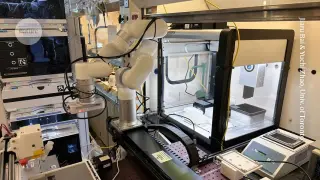
AI agents autonomously design and execute complex DNA experiments in new lab system
A new multi-agent AI system, AutoDNA, developed by researchers at Shanghai Jiao Tong University, can autonomously design and execute complex life science experiments, including DNA synthesis and data storage, with minimal human intervention. The system, described in a paper published in Nature, uses multiple specialized AI agents to plan protocols, control robotic arms, and operate over 20 types of laboratory equipment. In tests, the system achieved expert-level success rates in DNA synthesis, reduced experiment times by 3.2 times through parallel processing, and successfully stored and retrieved digital information in DNA over 11,382 steps. While the system demonstrated the ability to identify a clinically significant KRAS G13D mutation from a real-world sample, it is not yet ready for regulated clinical use. Humans are still required to restock reagents and maintain hardware, and the system encountered 14 equipment errors during testing, six of which required human intervention.
Source: Nature

Qatar mediates Iran nuclear inspection deal as US weighs new strikes
Qatar is mediating a potential deal to reopen the Strait of Hormuz and allow UN inspectors access to Iran’s nuclear sites, contingent on the US lifting its naval blockade and releasing frozen assets. Iran has submitted a seven-point proposal demanding sanctions relief and war reparations before negotiations resume. Meanwhile, US President Donald Trump is considering renewed military strikes, with CENTCOM preparing for operations, while Iran deepens ties with Russia and warns of broader retaliation if attacks resume.
Source: The Guardian

Qatar proposes phased deal to end US-Iran war and reopen Strait of Hormuz
Qatar has proposed a new framework to end the eight-month US-Iran war and reopen the Strait of Hormuz. The plan involves the US lifting its naval blockade and releasing frozen Iranian assets in exchange for IAEA inspections of nuclear sites. While Trump is reviewing the offer, fresh strikes on Qeshm Island and internal US disagreements over the conflict's cost complicate negotiations.
Source: The Independent
Culture
The Archive of Our Own (AO3), a major fan fiction platform, has been offline since October 29 due to a security breach. The Organization for Transformative Works (OTW) estimates restoration will take two to four weeks, with no data loss confirmed. The outage has triggered a community crisis as users uploaded stories to public drives, causing backlash from authors concerned about consent and AI scraping. While the site is volunteer-run and ad-free, the incident highlights tensions between commercial interests and amateur creators. The AO3 outage underscores the fragility of volunteer-run digital infrastructure and the growing tensions between amateur creators and commercial interests in the fan fiction space. It highlights the risks of AI-driven content scraping and the ethical complexities of digital ownership. The incident may influence future policies on fan fiction platforms and the broader discourse on intellectual property in the age of AI.

As the tech sector navigates this period of political and financial turbulence, the coming weeks will be crucial in determining whether the industry can adapt to stricter regulations and public sentiment. The balance between innovation and social acceptance will define the next phase of the AI era.