
AI agents autonomously design and execute complex DNA experiments in new lab system
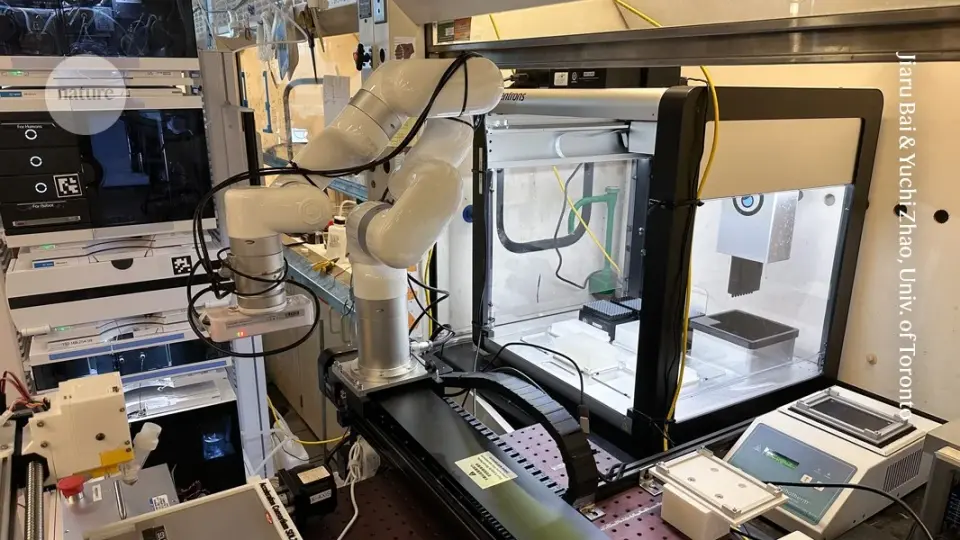
A new multi-agent AI system, AutoDNA, developed by researchers at Shanghai Jiao Tong University, can autonomously design and execute complex life science experiments, including DNA synthesis and data storage, with minimal human intervention. The system, described in a paper published in Nature, uses multiple specialized AI agents to plan protocols, control robotic arms, and operate over 20 types of laboratory equipment. In tests, the system achieved expert-level success rates in DNA synthesis, reduced experiment times by 3.2 times through parallel processing, and successfully stored and retrieved digital information in DNA over 11,382 steps. While the system demonstrated the ability to identify a clinically significant KRAS G13D mutation from a real-world sample, it is not yet ready for regulated clinical use. Humans are still required to restock reagents and maintain hardware, and the system encountered 14 equipment errors during testing, six of which required human intervention.
Key points
- AutoDNA, developed at Shanghai Jiao Tong University, is a multi-agent AI system that designs and executes DNA experiments from a single natural-language prompt.
- The system uses Google Gemini 2.5 Pro and integrates multiple AI agents with distinct roles, including paper searching, experimental design, reagent management, and equipment control.
- In testing, AutoDNA achieved a 97.8% success rate in enzymatic DNA synthesis, comparable to skilled human researchers, and reduced sequential experiment times from 1,433 minutes to 454 minutes.
- The system successfully stored and retrieved the English sentence 'Intelligence is the ability to adapt to change' in DNA, a task that required 11,382 hardware steps and took 203 hours.
- AutoDNA correctly identified a KRAS G13D mutation from a real-world clinical sample, though the paper does not claim the system is ready for hospital use.
- During testing, 14 equipment errors occurred; the AI resolved 8 autonomously, while 6 required human intervention.
Background
The development of autonomous 'self-driving' labs has been a growing area of research, with previous systems typically handling narrow, predefined workflows. The concept of AI agents managing entire lab operations, including instrument placement and collision avoidance, has been explored in preprints, such as one posted to arXiv in October 2026, which described a system that could design a lab from scratch using virtual simulations. The AutoDNA system represents a step toward end-to-end automation, moving beyond single-task automation to complex, multi-step experimental workflows. South Korea is also pursuing similar goals, with a national project aiming to develop an AI scientist capable of handling the entire research process by 2035.
How outlets are covering it
Nature highlights the potential of AI agents to drastically reduce the effort required to set up automated labs and to plan robotic movements that avoid collisions, while noting that integrating necessary cameras and sensors could be resource-intensive. Crypto Briefing emphasizes the novelty of AutoDNA's ability to handle end-to-end workflows across many machines with a single prompt, contrasting it with previous automated setups that struggled with switching instruments or changing plans mid-stream. 조선일보 (Chosun Ilbo) focuses on the system's efficiency gains, such as the 3.2-fold speed increase, and its ability to make autonomous decisions, like using alternative equipment when a device is occupied, while also noting the need for enhanced reproducibility and safety controls. All sources agree that while the system is highly capable, it is not fully autonomous, as humans are still required for maintenance and error resolution, and the system is not yet ready for regulated clinical use.
Why it matters
The development of AutoDNA and similar AI-driven lab systems represents a significant shift in scientific research, potentially accelerating the pace of discovery by automating complex, time-consuming experiments. The ability of AI to design and execute experiments end-to-end, with minimal human intervention, could reduce the time and cost associated with traditional lab work and enable researchers to tackle more complex problems. The successful identification of a clinically significant mutation from a real-world sample hints at potential applications in genetic testing and diagnostics, although significant hurdles remain before such systems can be used in regulated clinical settings. The development of these systems also raises questions about the future role of scientists in the research process, as AI takes on more of the experimental design and execution tasks.
What to watch
Researchers will need to focus on enhancing the reproducibility, equipment safety, and control mechanisms of AI-driven lab systems, particularly for risky biological experiments. The scientific community will need to develop ways to check the reasoning of AI systems and catch errors before they consume days of machine time and expensive reagents. The transition from academic demonstrations to regulated clinical settings will be a long road, and replication by other groups will be the real test of these systems' capabilities. South Korea's national project aims to develop an AI scientist capable of handling the entire research process by 2035, and the government is promoting the establishment of AI-based autonomous laboratory research centers.
- These AI agents design your perfect robot-powered lab — and run it for you Nature
- An AI-native experimental laboratory for autonomous biomolecular operations Nature
- Chinese AI Scientist Completes 11,382-Step Experiment in 203 Hours 조선일보
- Shanghai Jiao Tong University’s AutoDNA lab lets AI agents run DNA experiments Crypto Briefing
- AI agents run this automated biology lab that sequences DNA and more Nature
Want the full story? Read the original reporting
Read on Nature