
Covenant unveils Anthem missile to disrupt long-range weapons market
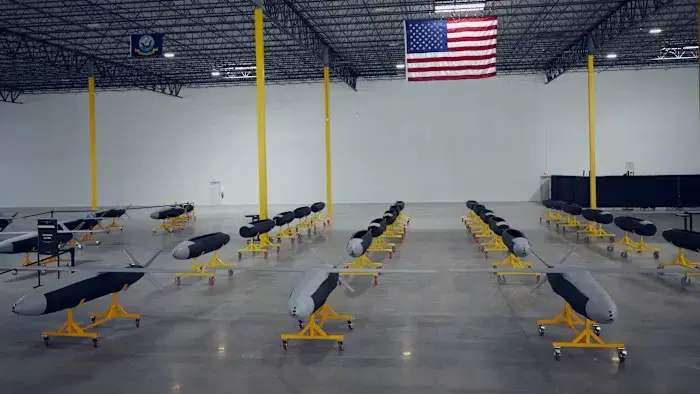
Covenant, a defense startup backed by Peter Thiel’s Founders Fund, has emerged from stealth to launch the Anthem, a low-cost, long-range missile designed to mass-produce deep-strike capabilities. The company is opening factories in Dallas, Leipzig, and Israel, aiming to produce 1,000 units per site by 2027 and 5,000 by 2028. This move addresses Western shortages in precision munitions caused by conflicts in Iran and Ukraine, offering a cheaper alternative to legacy systems like the Tomahawk.
Key points
- Covenant is building three factories in the US, Germany, and Israel to mass-produce the Anthem missile, targeting 5,000 units annually per site by 2028.
- The Anthem is designed as a cost-effective alternative to the Tomahawk, with a 250kg warhead and a range that remains confidential but is intended to counter threats from Russia, China, and Iran.
- The company has raised $250 million, with backers including Founders Fund, Andreessen Horowitz, and 8VC, and has secured approximately €130 million in orders, including contracts with the US Army and Navy.
- Covenant emphasizes a European supply chain for its German operations to mitigate concerns about US technological dependence, despite its US-centric investor base.
- The startup has conducted over 200 trial flights of the Anthem, including tests with the US military, to validate its performance and reliability.
Background
This development follows recent efforts by Western nations to bolster long-range strike capabilities in response to the Russia-Ukraine war and the conflict in Iran. Previous initiatives, such as the UK’s plan to share Storm Shadow blueprints with Ukraine and France’s supply of interceptor missiles, highlight the urgency to diversify and expand missile production. Covenant’s entry into the market aligns with a broader trend of defense tech startups seeking to disrupt traditional defense primes by offering scalable, affordable solutions.
How outlets are covering it
The Financial Times highlights Covenant’s ambition to disrupt the market dominated by established players like Raytheon and Lockheed Martin, emphasizing the company’s focus on low cost and high producibility. CNBC focuses on the strategic gap Anthem fills between short-range drones and expensive legacy missiles, noting the company’s rapid scaling and significant funding. The Jerusalem Post underscores the importance of mass production and the alignment with the Pentagon’s Replicator Initiative, while also noting the company’s reliance on Israeli defense technology. All sources agree on the urgency of addressing missile shortages but differ in emphasis: the FT focuses on market disruption, CNBC on the strategic gap, and the Jerusalem Post on production and policy alignment.
Why it matters
Covenant’s entry into the long-range missile market signals a shift in Western defense procurement, moving away from reliance on legacy systems and towards scalable, cost-effective solutions. This could reshape the global defense industry, potentially reducing dependence on US technology and enhancing European autonomy in defense capabilities. The success of Anthem could also influence future defense policies and procurement strategies, particularly in the context of ongoing conflicts and the need for rapid, large-scale production of precision munitions.
What to watch
Covenant plans to begin serial production at its Dallas and Leipzig facilities in early 2027, with the goal of scaling to 5,000 units per site by 2028. The company is also developing a maritime variant of the Anthem for the US Navy and expects to secure additional contracts in the coming months. Its success will depend on its ability to deliver on time, at scale, and with the performance expected by its customers, while navigating potential scrutiny over its US-centric investor base and European supply chain claims.
- Thiel-backed start-up to mass-produce ‘deep strike’ missiles in Europe and US Financial Times
- Andreessen- and Thiel-backed defense startup opens U.S. missile factory as it exits stealth CNBC
- Silicon Valley-backed Covenant unveils low-cost, mass-producible cruise missile Reuters
- US Startup Plans Mass Production Of Cruise Missiles in Germany Bloomberg.com
- Covenant emerges from stealth and unveils Anthem, a deep‑strike precision missile The Jerusalem Post
Want the full story? Read the original reporting
Read on Financial Times