
BYD Leads China’s July Auto Sales as Leapmotor and Zeekr Hit Records
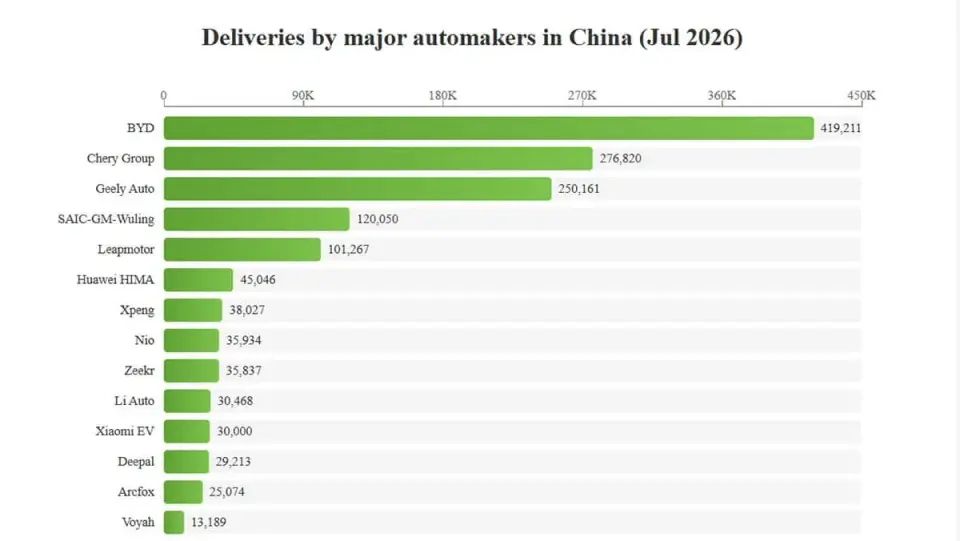
BYD dominated China’s July 2026 auto market with 419,211 sales, up 21.8% year-on-year, driven by record overseas deliveries. Leapmotor and Zeekr also set monthly records, while Nio, Xpeng, and Li Auto saw month-on-month declines despite strong annual growth. Huawei HIMA and Xiaomi EV reported subdued results, with HIMA falling for the second consecutive month.
Key points
- BYD sold 419,211 new energy vehicles in July, marking the third consecutive month of annual growth and a 21.76% increase year-on-year.
- Chery Group ranked second with 276,820 sales, setting a fifth consecutive monthly export record with 202,533 vehicles shipped abroad.
- Geely Auto recorded 250,161 sales, with overseas deliveries exceeding 100,000 for the second straight month.
- Leapmotor achieved its first monthly delivery milestone above 100,000 units, reaching 101,267, up 102% year-on-year.
- Zeekr set its fourth consecutive monthly record with 35,837 deliveries, rising 111% year-on-year.
- Nio, Xpeng, and Li Auto all posted month-on-month declines in July, though Nio’s 35,934 deliveries were up 71% year-on-year.
Background
China’s EV market has seen shifting dynamics in 2026, with BYD consistently leading sales and expanding overseas presence. Earlier in the year, CPCA forecast a slight dip in July NEV retail to around 980,000 units due to seasonal slowdown, with NEV retail penetration expected to reach 64.5%. The US market is also facing long-term contraction pressures, but China’s domestic and export growth remains robust, particularly for brands like Chery and BYD.
Why it matters
The July 2026 data highlights a bifurcated Chinese auto market: established leaders like BYD and Chery are scaling exports and maintaining growth, while newer EV brands face month-to-month volatility. Leapmotor and Zeekr’s record highs signal strong consumer demand for mid-tier EVs, while declines in Nio, Xpeng, and Li Auto suggest supply constraints or seasonal adjustments. Huawei HIMA’s continued decline may reflect market saturation or competitive pressure. These trends will influence Q3 2026 production and export strategies across the industry.
What to watch
Automakers will likely focus on Q3 2026 production adjustments to address supply constraints, particularly for Xpeng’s Mona L03 and Li Auto’s headlight issues. BYD and Chery may continue pushing overseas expansion, while Leapmotor and Zeekr could sustain momentum if demand holds. Huawei HIMA and Xiaomi EV may introduce new models or promotions to reverse declines. CPCA’s forecast of 980,000 NEV retail units in July suggests a seasonal dip, but strong annual growth indicates resilience in the broader market.
- Roundup: July 2026 deliveries by major automakers in China CnEVPost
- BYD's sales rise for third month, buoyed by exports Reuters
- BYD July Sales Signal Challenge to Reach Annual Target Bloomberg.com
- Price war fears grip China’s EV market after woeful July sales figures South China Morning Post
- Weekly Recap: July sales jump and Australia novated leases TradingView
Want the full story? Read the original reporting
Read on CnEVPost