
Waratah Super Battery completes second full-power grid test after 11-month transformer repair
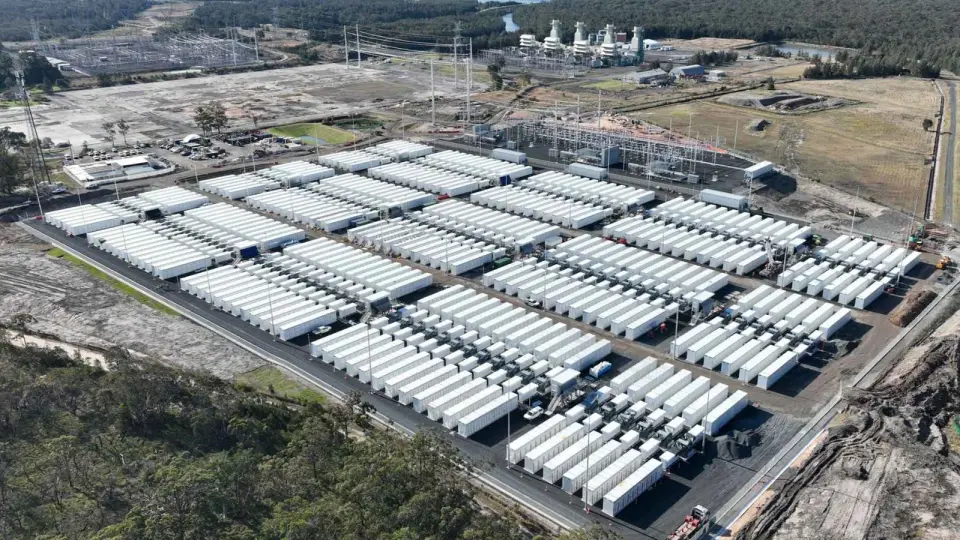
Australia's largest battery, the 850-megawatt Waratah Super Battery, successfully completed its second full-power test in three days, discharging 700 megawatts for two hours and charging at 850 megawatts. This milestone follows an 11-month delay caused by a catastrophic transformer failure that halved its capacity. The tests confirm the battery can now fulfill its role as a 'shock absorber' for the New South Wales grid, allowing transmission lines to carry more renewable energy. While the battery was originally built to replace the Eraring coal plant, that plant's closure has been delayed until 2029, meaning the battery is now providing grid stability years before its primary purpose is needed.
Key points
- The Waratah Super Battery discharged 700 megawatts for two hours on September 11, 2026, and charged at 850 megawatts, marking its second full-power test in three days.
- A transformer failure in October 2025 reduced the battery's capacity to 350 megawatts for nearly a year, delaying its full contract by over 12 months.
- The battery serves as a 'System Integrity Protection Scheme' (SIPS) asset, acting as a real-time safety valve to prevent transmission overloads in New South Wales.
- The replacement transformer, weighing 187 tons, was manufactured domestically by Wilson Transformer Company to avoid 12-18 month international lead times.
- The battery was originally commissioned to replace the Eraring coal plant, but Eraring's closure has been delayed to April 2029, making the battery's current role a stopgap for renewable integration.
Background
The Waratah Super Battery is located on the site of the former Munmorah coal power station in New South Wales, Australia. It was developed by Akaysha Energy, backed by BlackRock, and is designed to provide grid stability as the country transitions away from coal. The battery's construction and commissioning have been marked by significant delays, including a catastrophic transformer failure in October 2025. The broader context involves Australia's efforts to integrate more renewable energy into its grid while managing transmission bottlenecks. The battery's role as a 'shock absorber' is part of a strategy to allow existing transmission lines to carry more power than they could safely handle without such support, reducing the need for new, expensive transmission infrastructure.
How outlets are covering it
All three sources agree on the core facts: the Waratah Super Battery successfully completed its second full-power test on September 11, 2026, discharging 700 megawatts for two hours and charging at 850 megawatts. They also agree that this follows an 11-month delay caused by a transformer failure. However, they differ in emphasis. AutoNotion highlights the battery's role as a 'safety valve' for the grid and its potential as a model for the US Sun Belt, where stranded solar sits far from demand. WattClarity focuses on the technical details of the SIPS tests and the battery's progress toward commercial operations. Renew Economy emphasizes the battery's role in allowing more renewable energy to reach demand centers and the delay in the Eraring coal plant's closure. Energy-Storage.News provides detailed technical information on the transformer failure and replacement, including the estimated cost and the use of a domestic manufacturer to avoid long lead times.
Why it matters
The successful completion of the Waratah Super Battery's full-power tests is significant because it demonstrates the viability of using large-scale battery storage to manage grid stability and allow existing transmission infrastructure to carry more renewable energy. This approach could be a cost-effective alternative to building new transmission lines, which can take a decade or more. The battery's role as a 'shock absorber' is particularly important in regions with high renewable energy generation but limited transmission capacity, such as the US Sun Belt. The delay in the Eraring coal plant's closure also highlights the challenges of transitioning away from fossil fuels, as the battery is now providing grid stability years before its primary purpose is needed.
What to watch
Akaysha Energy will now wait for the tests to be verified before the full SIPS contract is put in place, which is more than a year behind the original schedule. The battery is expected to continue operating on an interim basis until the full contract is finalized. The Eraring coal plant's closure has been delayed to April 2029, meaning the Waratah Super Battery will continue to provide grid stability for several more years. The success of the Waratah Super Battery could serve as a model for other regions with similar transmission bottlenecks, potentially leading to the deployment of more large-scale battery storage systems in the US and other parts of the world.
- An 850-megawatt battery pushed 700 megawatts into the grid for two straight hours on Friday and then pulled almost 850 back out of it, its second full-power test in three days, nearly eleven months after a transformer failure cut its grid contract in half Autonocion.com
- Second SIPS testing completed at Waratah Super Battery on Friday afternoon 11th September 2026 wattclarity.com.au
- Australia’s most powerful battery flexes muscles with second shock absorber test and biggest ever charge Renew Economy
- Australia: Akaysha Energy’s Waratah Super Battery tests full SIPS obligation as 850MW output recorded Energy-Storage.News
- Rebuilt Transformer Energized at Waratah: Australia’s Largest Battery Nears Full Capacity Tech Times
Want the full story? Read the original reporting
Read on Autonocion.com