
Leaked Melanoma Trial Data Triggers 18% Moderna Drop Despite Clinical Success
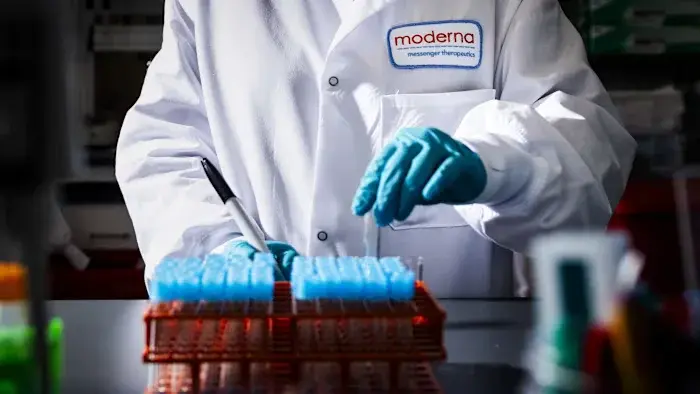
Moderna and Merck released Phase 3 data for their personalized melanoma vaccine, intismeran, after a leak forced early disclosure. The therapy, combined with Merck’s Keytruda, reduced recurrence or death risk by 42% over two years, meeting clinical goals but falling short of the 49% seen in earlier trials. Despite positive outcomes, Moderna’s stock fell 18% due to inflated investor expectations, while Merck’s shares dropped 1%.
Key points
- Moderna and Merck released detailed Phase 3 trial results for intismeran ahead of schedule after a data leak, originally planned for a Saturday conference in Madrid.
- The personalized mRNA vaccine, paired with Merck’s Keytruda, reduced the risk of melanoma recurrence or death by 42% at two years, compared to 70% recurrence-free survival with Keytruda alone.
- Moderna’s shares fell 18% on Thursday, hitting a record intraday drop of 26%, despite the stock remaining more than 200% higher than its August 2026 levels.
- Merck’s shares dropped 4% intraday but recovered to close down 1%, as the vaccine is a smaller part of its overall portfolio compared to Moderna’s reliance on the therapy.
- The trial involved over 1,100 patients with high-risk melanoma, with the vaccine requiring nine doses over three weeks and a six-week manufacturing process per patient.
Background
In August 2026, Moderna and Merck announced initial success for intismeran, causing Moderna’s stock to surge 177% in a single day. The company has been the top performer in the S&P 500 this year. In October, the NIH announced a major cancer research initiative, further boosting Moderna’s shares by 14% before the leak. The current data release follows a Phase 3 trial that began in 2023, with regulatory approval expected next year.
How outlets are covering it
Financial Times and AP News emphasize the clinical significance of the 42% risk reduction, with AP highlighting expert praise for the 'new frontier' of personalized cancer vaccines. Yahoo Finance focuses on the market reaction, noting that the 18% drop reflects inflated expectations rather than clinical failure, as the stock had nearly quadrupled since August. BMO Capital Markets analyst Evan Seigerman, cited by Financial Times, argues the results are meaningful but insufficient to sustain the prior rally. AP notes that the vaccine’s success may extend to other cancers like lung and bladder, while Yahoo Finance points out that broader biotech indices remained stable, with Eli Lilly gaining $33 billion in market value.
Why it matters
The event underscores the volatility of biotech stocks driven by clinical trial data and the gap between medical success and market expectations. It highlights the potential of mRNA technology in personalized cancer treatment, with intismeran representing a first-of-its-kind approach. The leak also raises questions about data management and market stability in the pharmaceutical sector, as the premature release triggered chaotic trading despite positive outcomes.
What to watch
Moderna and Merck are meeting with the US drug regulator and expect approval for intismeran next year. The companies are also testing the therapy in bladder, lung, and other cancers. Investors will watch Saturday’s full data release at the European Society for Medical Oncology conference in Madrid, particularly for lower-risk patient outcomes. The trial continues to track longer-term participant results.
- Moderna shares sink after leaked cancer data missed expectations Financial Times
- Moderna’s Stock Plummets After Cancer-Vaccine Data Shared on Social Media WSJ
- Cancer Vaccine Cuts the Risk of Melanoma Recurrence, Merck and Moderna Report The New York Times
- A novel mRNA cancer vaccine helps reduce the chances of melanoma patients' tumors returning AP News
- Moderna stock crashes as leaked melanoma data threatens its record August rally Yahoo Finance
Want the full story? Read the original reporting
Read on Financial Times