
KOSPI Crash Sparks 'Zero-Loss' Sentiment as AI Valuations Collapse
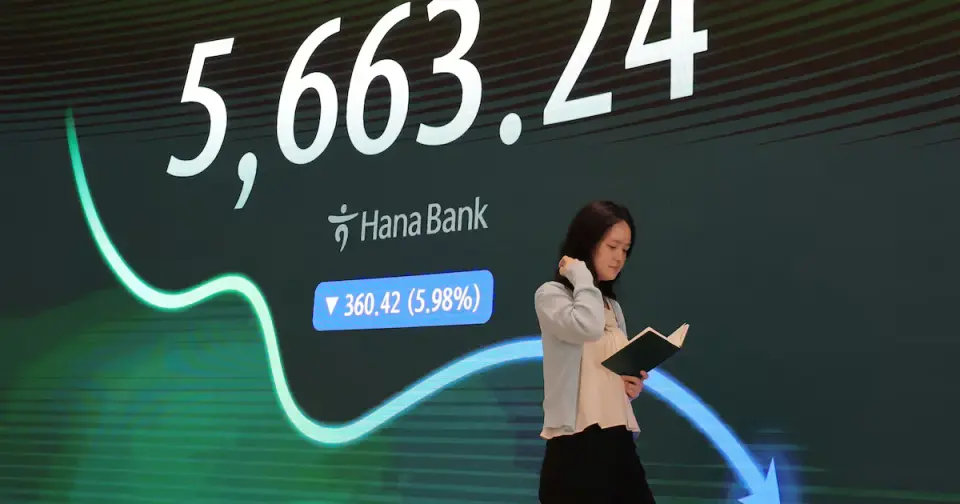
South Korea's KOSPI index has suffered a severe 35.8% decline from its June peak, triggering a shift in investor sentiment from fear to relief among those who avoided heavy exposure to semiconductor giants. The crash, which included a 10.84% single-day drop and circuit breaker activation, has led office workers to embrace the concept of 'JOMO' (Joy of Missing Out), prioritizing capital preservation over potential gains in the volatile AI sector.
Key points
- The KOSPI fell from a record high of 9,385.59 on June 19 to 6,023.66 on July 28, a 35.8% drop over 39 days.
- Samsung Electronics and SK Hynix, which account for over half the index's market capitalization, saw significant declines despite record earnings, with Samsung falling 13.39% and SK Hynix 14.65% on July 28.
- Investors are adopting a 'zero-loss investment' mindset, viewing the avoidance of losses as a success metric rather than seeking profit.
- The market experienced extreme volatility, including an 18% surge on July 31 followed by a 4% drop on August 3.
- Regional markets were affected, with Japan's Nikkei 225 falling 1% and Chinese markets showing relative resilience compared to the Korean selloff.
Background
This crash follows a period of rapid ascent in AI-linked technology stocks, which had driven the KOSPI to record highs in mid-2026. The subsequent correction marks the steepest monthly decline for the index since the 2008 financial crisis, reflecting a broader reassessment of AI valuations across Asian markets.
How outlets are covering it
The Chosun Daily emphasizes the psychological shift among retail investors, highlighting the cultural phenomenon of 'JOMO' and the relief felt by those who avoided leveraged products or domestic stocks. In contrast, Investing.com focuses on the structural drivers of the crash, noting that Samsung and SK Hynix fell despite reporting massive profit jumps, indicating that the selloff was driven by valuation concerns and AI sentiment rather than fundamental earnings failures. Investing.com also contextualizes the event within broader Asian market weakness, while The Chosun Daily centers on the domestic Korean investor experience and meme culture surrounding corporate leaders.
Why it matters
The KOSPI crash signals a potential correction in the global AI investment bubble, with major semiconductor firms facing pressure despite strong financial performance. This volatility affects regional markets and highlights the risks of concentrated index exposure, influencing investor behavior and potentially prompting regulatory or market stability measures in South Korea.
What to watch
Market participants will monitor whether the 'zero-loss' sentiment persists or if a rebound occurs, particularly given the recent 18% surge. Investors may continue to shift toward dollar-denominated assets or non-tech sectors, while regulators may assess the impact of the circuit breaker and potential leverage restrictions on individual investors.
- JOMO Trumps FOMO as KOSPI Crash Fuels Zero-Loss Satisfaction 조선일보
- Live Q&A: What’s Next For South Korea’s Volatile Stock Market? Bloomberg.com
- Why did South Korean stocks just crash? Noahpinion
- When the Chips Are Down Paul Krugman | Substack
- Asia stocks tumble as KOSPI extends losses; AI shares drag regional markets Investing.com
Want the full story? Read the original reporting
Read on 조선일보