
Maersk to Pilot Anemoi Rotor Sails on Container Ship Amid Tightening Maritime Emissions Rules
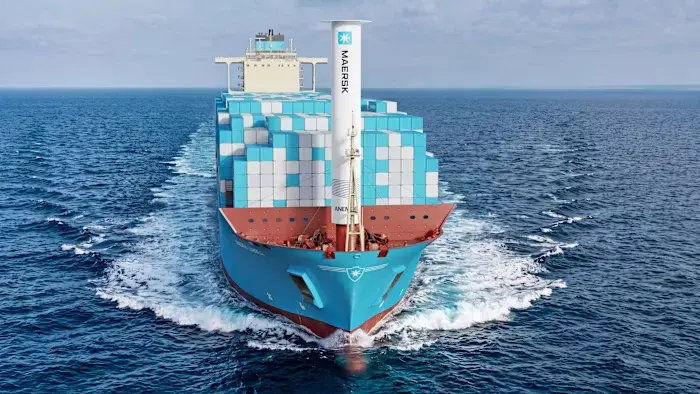
Maersk has agreed to install a 35-meter rotor sail from British firm Anemoi on a container ship, marking the first such deployment on a boxship. The pilot aims to cut fuel use and emissions as the industry faces stricter regulations, though commercial hurdles remain.
Key points
- Maersk signed a deal with Anemoi to retrofit a 35m-high rotor sail onto a medium-sized container ship, specifically an 8,700 TEU vessel in the Maersk Lima class.
- The installation is scheduled for mid-2027 and will be tested on North and South Atlantic routes to assess fuel savings and emissions reductions.
- Anemoi estimates each rotor sail saves approximately one tonne of fuel and three tonnes of CO2 per day, with costs ranging from $600,000 to $1.2 million per unit.
- The technology uses the Magnus effect to generate propulsion and can operate in wind speeds up to 35 meters per second, addressing the challenge of limited deck space on container ships.
- The move is driven by EU emissions trading rules and IMO decarbonization targets, though Boston Consulting Group notes commercial payback periods may exceed typical charter contracts.
Background
The maritime sector accounts for roughly 3% of global carbon emissions, prompting the EU to include shipping in its emissions trading system since 2024. While wind-assisted propulsion has been adopted on tankers and bulk carriers due to spare deck space, container ships have lagged. This pilot follows a broader trend where wind propulsion installations have doubled annually in recent years, reaching approximately 110 commercial vessels over 400 gross tonnage.
How outlets are covering it
The Financial Times emphasizes the regulatory pressure from the EU and IMO as the primary driver for Maersk’s decision, highlighting the technical challenge of deck space on container ships. Lloyd’s List frames the deal as a sign that wind propulsion is moving from proof-of-concept to commercial scaling, noting that Odfjell has already validated similar technologies on tankers. Ocean News & Technology focuses on the specific technical details, confirming the sail’s dimensions and the mid-2027 installation timeline, while stressing the collaboration between Maersk and Anemoi. All sources agree on the environmental motivation but differ on the emphasis: FT and Lloyd’s List focus on industry-wide trends and regulatory compliance, while ON&T highlights the specific engineering partnership.
Why it matters
This pilot is a critical test for whether wind-assisted propulsion can be economically viable for container shipping, a sector with minimal spare deck space. Success could accelerate adoption across the industry, helping meet decarbonization targets, while failure would highlight the commercial barriers, such as high upfront costs and misaligned incentives between shipowners and charterers, that hinder green technology adoption.
What to watch
The rotor sail is expected to be installed in mid-2027, after which Maersk will evaluate its performance on Atlantic routes. The results will determine whether Anemoi’s technology can be scaled across Maersk’s fleet and other container lines, potentially influencing future IMO regulations and investment in maritime decarbonization.
- Maersk turns to wind sails to cut fuel for container ships Financial Times
- Anemoi courts Korean shipbuilders for wind propulsion The Korea Herald
- Wind propulsion reaches shipping’s scaling moment as Maersk backs container trial Lloyd's List
- Anemoi Marine Technologies To Install First Rotor Sail On A Maersk Container Vessel Ocean News & Technology
Want the full story? Read the original reporting
Read on Financial Times