
AI shifts from wildfire detection to strategic crew deployment
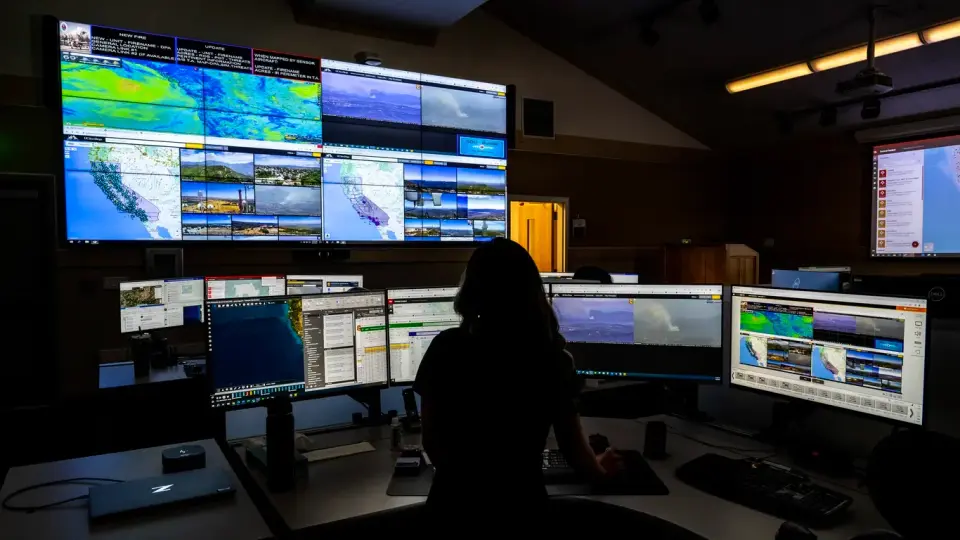
AI is evolving from a detection tool to a strategic aid for allocating firefighting resources across multiple simultaneous blazes. While current systems excel at early smoke detection, new research focuses on predicting fire behavior to optimize crew deployment. Experts emphasize that AI augments, rather than replaces, human decision-making due to the complexity of real-world variables.
Key points
- The U.S. recorded 77,850 wildfires last year, a figure notably higher than five- and 10-year averages, with the current season surpassing 10-year averages for both fire count and acres burned.
- Jason Fallon, division chief for wildland fire intelligence at the U.S. Wildland Fire Service, states AI is already integrated into monitoring, detection, and data transfer, helping agencies separate noise from reality in satellite data.
- Researchers at the University of Washington are developing machine learning models to predict how multiple fires evolve under different suppression levels, aiming to recommend optimal crew deployment strategies two weeks in advance.
- Microsoft has committed $5 million to advance AI-powered wildfire detection, including $3 million for Azure infrastructure, to support systems like ALERTCalifornia, which uses nearly 1,300 cameras to detect fires up to 2.5 hours before 911 calls.
- The Government Accountability Office warns that AI can provide inaccurate information and struggles with rare events due to limited data, posing risks to lives and property if relied upon without human oversight.
Background
Recent local incidents, such as the Foster City condo blaze and the Hawk Fire near Reno, highlight the immediate strain on emergency services. The Hawk Fire alone triggered 42,000 evacuations and required over 800 firefighters. These events underscore the urgent need for efficient resource management amid increasingly intense wildfire seasons driven by climate change.
How outlets are covering it
Axios highlights the strategic application of AI in deciding where to deploy crews across multiple fires, citing research by Léonard Boussioux at the University of Washington. This approach focuses on optimization and prediction to handle resource scarcity. In contrast, AI Magazine emphasizes the technological infrastructure and detection capabilities, detailing Microsoft’s $5 million investment in computer vision systems like ALERTCalifornia. While Axios focuses on the decision-making layer, AI Magazine focuses on the detection and data processing layer, noting that early detection provides critical time for response. Both sources agree that AI augments human expertise but differ in their emphasis: Axios on strategic allocation, AI Magazine on technical detection and global scalability.
Why it matters
As wildfire seasons lengthen and intensify due to climate change, traditional resource allocation methods are becoming insufficient. AI offers a way to process complex data and predict fire behavior, potentially saving lives and property by ensuring the right resources are directed to the right fires. However, the technology’s effectiveness depends on data quality and human oversight, as AI lacks the experiential judgment of seasoned firefighters.
What to watch
Researchers are developing more sophisticated tools for modeling complicated wildfire decisions, but their success will depend on the quality and organization of underlying data. Microsoft aims to scale its detection technology globally, while the U.S. Wildland Fire Service continues to evaluate the degree to which AI can aid decision-making. The focus will shift from detection to strategic deployment, with ongoing efforts to integrate AI insights with human expertise.
Want the full story? Read the original reporting
Read on Axios