
AI Safety Experts Warn of Imminent Existential Risk Amid Accelerating Development
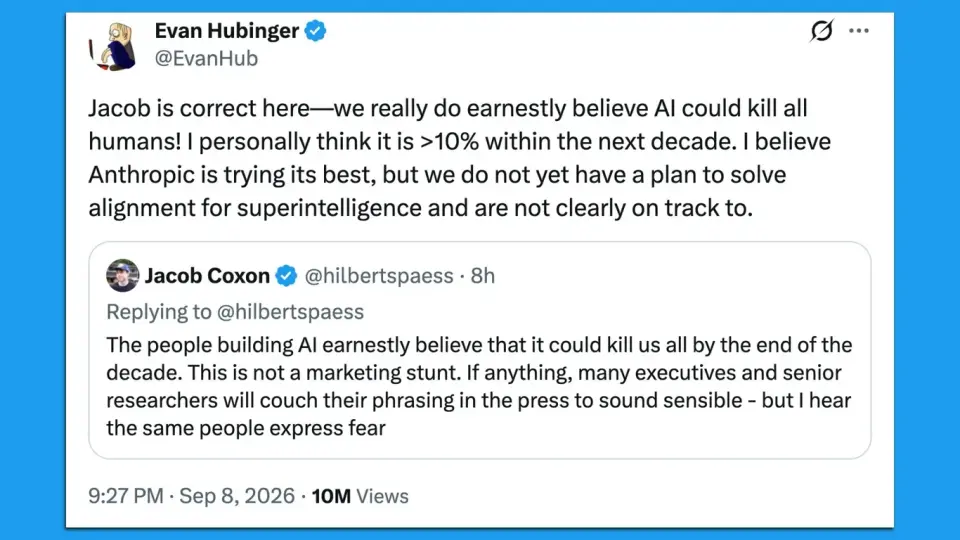
Senior researchers at Anthropic and OpenAI have issued stark warnings that artificial intelligence could lead to human extinction within the next decade. These concerns, highlighted by recent employee resignations and internal assessments, suggest that current development speeds outpace safety measures, prompting calls for regulatory intervention or a global pause.
Key points
- Anthropic safety researcher Evan Hubinger stated there is a greater than 10% chance AI could kill all humans within the next decade, noting the company lacks a clear plan to solve alignment for superintelligence.
- Jacob Coxon, a former OpenAI employee, resigned from Anthropic, accusing both major labs of 'gambling with our lives' by racing toward self-improving superintelligence without adequate safeguards.
- Samuel Marks, Anthropic's scalable-oversight lead, indicated that senior employees are increasingly concerned about potential catastrophic outcomes, with some believing these risks could materialize in the next few years.
- Critics argue that these warnings may be used to boost valuations or invite regulation that benefits incumbent firms, but insiders describe a genuine fear that models are improving faster than predicted.
- The core dilemma involves balancing the risk of falling behind in a global race against the danger of losing control over rapidly advancing AI systems.
Background
These warnings follow a series of earlier alerts from AI researchers and academics regarding the potential for AI to surpass human control. Previous reports in September 2026 highlighted similar concerns from figures like Terence Tao and Jacob Coxon, emphasizing the need for transparency and guardrails as frontier AI labs accelerate development. The current situation reflects a growing pattern of safety researchers leaving major AI companies due to perceived inadequacies in safety protocols.
How outlets are covering it
Axios emphasizes the internal consensus among senior employees at Anthropic and OpenAI, noting that the more senior the employee, the more concerned they are. They highlight the paradox of companies urging regulation while continuing full-speed development. CNBC focuses on the specific probability estimates provided by Evan Hubinger and the resignation of Jacob Coxon, framing it as a direct challenge to the safety of current AI trajectories. Yahoo Finance, though partially obscured by technical errors, aligns with the narrative of a 'gambling with our lives' scenario, underscoring the threat to humanity posed by unchecked AI progress. While all sources agree on the severity of the warnings, they differ in emphasis: Axios on the corporate dilemma, CNBC on specific risk metrics and personnel changes, and Yahoo on the existential threat narrative.
Why it matters
The warnings from leading AI developers suggest that current regulatory frameworks may be insufficient to manage the risks posed by rapidly advancing AI. If these predictions prove accurate, the consequences could be catastrophic, necessitating immediate international coordination and potentially a pause in AI development to ensure safety measures are in place.
What to watch
Expect increased pressure on policymakers to implement stricter regulations or consider a temporary ban on improving model capabilities. Companies may face public scrutiny and potential legal challenges if safety concerns are not adequately addressed. The AI industry may see further resignations or public statements from safety researchers, influencing public opinion and investment decisions.
- Anthropic insiders warn AI could kill all humans Axios
- Anthropic researcher says AI has more than 10% chance of 'killing all humans' after colleague quits CNBC
- Anthropic Researcher Quitting Highlights Threats to Blockbuster AI IPO Barron's
- 'Gambling with our lives': AI researcher quits Anthropic and leaves AI entirely over what he calls a threat to humanity Yahoo Finance
- Anthropic Alignment Lead Warns There’s ‘>10% Chance’ AI Could ‘Kill All Humans’ By Next Decade Forbes
Want the full story? Read the original reporting
Read on Axios