
Mathematicians denounce OpenAI's Navier-Stokes claim as 'predatory' amid race for other Millennium Prizes
OpenAI's claim that 10,000 AI agents solved the Navier-Stokes existence-and-smoothness problem has triggered a severe backlash from the global mathematics community. Critics accuse the company of scooping the work of human researchers and prioritizing publicity over rigorous verification. While OpenAI reportedly targets the Hodge Conjecture next, experts debate whether AI can truly solve the remaining five million-dollar Millennium Prize Problems or merely find counterexamples.
Key points
- OpenAI announced on Sept. 8, 2026, that its AI agents solved the Navier-Stokes problem, one of seven unsolved Millennium Prize Problems carrying a $1 million reward.
- Mathematicians Tristan Buckmaster and Levent Alpöge allege OpenAI learned of their ongoing work and raced to publish first, with an OpenAI representative allegedly threatening them not to go public.
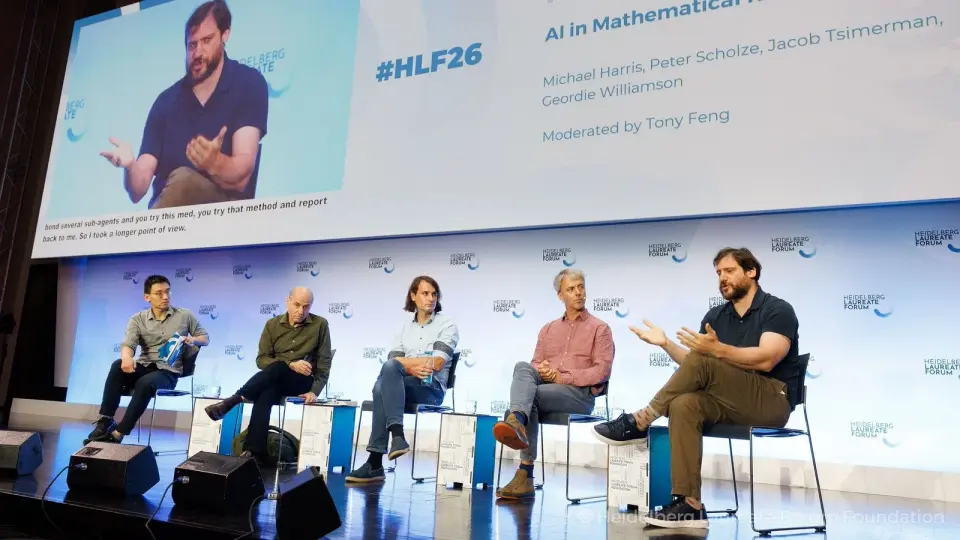
- Columbia University professor Michael Harris described OpenAI's actions as 'predatory behavior' comparable to 19th-century colonial acquisition, highlighting a lack of legal recourse for such intellectual theft.
- OpenAI has reportedly withdrawn its sponsorship of the Caltech Mathathon and is now focusing on the Hodge Conjecture, though it faces scrutiny over its motives for recursive self-improvement.
- Experts rank the likelihood of AI solving remaining problems: the Birch and Swinnerton-Dyer Conjecture and Hodge Conjecture are seen as most vulnerable to AI counterexamples, while P versus NP is considered highly unlikely to be solved by AI.
Background
This controversy follows a series of AI breakthroughs in 2026, including OpenAI's Astra model solving 10 long-standing math problems in August and Anthropic's Claude disproving an 87-year-old conjecture in July. The field has already experienced tension over credit attribution, with OpenAI previously exiting a Caltech hackathon amid backlash from mathematicians concerned about AI disrupting traditional research practices.
How outlets are covering it
Live Science and The Atlantic emphasize the ethical and cultural shock within the mathematics community, highlighting the 'predatory' nature of OpenAI's actions and the resulting 'crisis in mathematical values.' Scientific American provides a technical breakdown of the remaining Millennium Prize Problems, noting that AI is more likely to find counterexamples for the Hodge and Birch-Swinnerton-Dyer conjectures than to prove complex theorems like P versus NP. Gizmodo focuses on OpenAI's strategic pivot to the Hodge Conjecture, suggesting the company is now trying to manage its public relations damage by seeking collaboration with the math community to avoid further 'PR nightmares.'
Why it matters
The incident exposes a fundamental conflict between AI-driven speed and the slow, rigorous verification process inherent in high-level mathematics. It raises questions about intellectual property, credit attribution, and whether AI can genuinely advance mathematical understanding or merely generate unverified claims that disrupt the field's social contract.
What to watch
OpenAI is expected to announce a solution to the Hodge Conjecture soon, though it is reportedly delaying the announcement to coordinate with the math community. The broader mathematical community will continue to debate the validity of AI-generated proofs and the need for new ethical guidelines to prevent 'predatory' scooping of human research.
- 'Predatory behavior': Elite mathematicians clash over OpenAI's 'solution' to million-dollar math problem Live Science
- OpenAI Is Close To Solving Another Millennium Prize Math Problem The Information
- OpenAI Reportedly Trying to Solve Hodge Conjecture Amid Feud With Math Community Gizmodo
- Math Can’t Go On Like This The Atlantic
- Which million-dollar math problem could AI solve next? Scientific American
Want the full story? Read the original reporting
Read on Live Science