
Anthropic mathematician claims AI-assisted proof of Riemann hypothesis, sparking debate over verification and human role
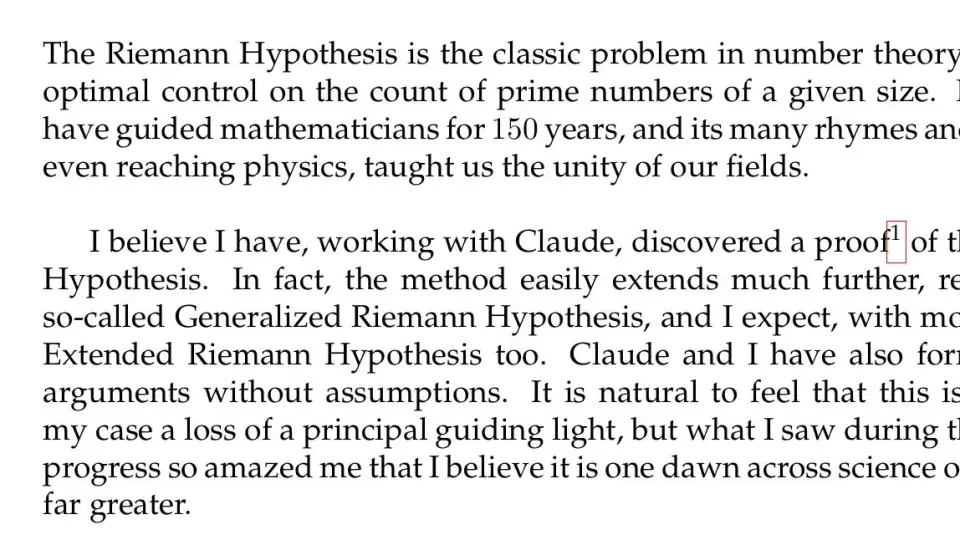
Levent Alpöge, a mathematician at Anthropic, announced on November 20, 2026, that he and the company’s AI model Claude had proven the Riemann hypothesis, a 167-year-old unsolved problem in number theory. The proof, consisting of over 250,000 lines of Lean code, has been partially verified by independent researchers but awaits final confirmation. The announcement coincided with Anthropic’s record-breaking IPO, raising questions about timing and the reliability of AI-generated mathematical breakthroughs.
Key points
- Alpöge claims he and Claude solved the Riemann hypothesis, a 167-year-old unsolved problem in number theory.
- The proof consists of over 250,000 lines of Lean code, a programming language that allows for formal verification of mathematical theorems.
- Independent researchers, including James Maynard and Alex Kontorovich, have partially verified the proof but await final confirmation.
- The announcement coincided with Anthropic’s record-breaking IPO, raising questions about timing and the reliability of AI-generated mathematical breakthroughs.
- Some mathematicians, such as Brian Conrad, have criticized Alpöge for releasing a proof he did not fully understand, while others, such as Ken Ono, have expressed concerns about the impact of AI on mathematical careers.
Background
The Riemann hypothesis, formulated in 1859 by Bernhard Riemann, is one of the seven Millennium Prize problems selected by the Clay Mathematics Institute in 2000, with a $1 million prize for its solution. In September 2026, OpenAI announced that its technology was key in a similar breakthrough with the Navier-Stokes equations, which govern the flow of fluids. This wave of AI-driven mathematical breakthroughs has sparked debate over the reliability of AI-generated proofs and their impact on the field of mathematics.
How outlets are covering it
The New York Times and CNN emphasize the significance of Alpöge’s claim, highlighting the potential for AI to master complex mathematical problems. However, they also note the ongoing debate over the reliability of AI-generated proofs and the role of human mathematicians in the process. The Guardian, through Ken Ono’s perspective, raises concerns about the impact of AI on mathematical careers and the importance of human judgment in verifying and understanding proofs. Marcus on AI, a Substack publication, criticizes the overhype surrounding the Riemann hypothesis proof, arguing that it does not generalize to other domains and does not signify the arrival of AGI. The perspectives highlight the tension between the excitement over AI’s potential and the caution needed in verifying and understanding its outputs.
Why it matters
The claim that AI has solved the Riemann hypothesis, if verified, would mark a significant milestone in the field of mathematics and AI. It could have implications for the future of mathematical research, the role of human mathematicians, and the development of AI systems. The debate over the reliability of AI-generated proofs and the impact of AI on mathematical careers highlights the need for careful verification and ethical considerations in the use of AI in scientific research.
What to watch
The next steps involve the final verification of Alpöge’s proof by the mathematical community. The Clay Mathematics Institute will assess whether the problem has been solved, a process that may take time. Additionally, the debate over the reliability of AI-generated proofs and the impact of AI on mathematical careers is likely to continue, with universities, journals, employers, and funding agencies deciding what they support and reward. The future of AI in mathematics and other scientific fields will depend on the development of reliable and ethical AI systems that can assist, but not replace, human mathematicians.
- Levent Alpöge has solved the Riemann Hypothesis with help of Claude! What does it mean? Marcus on AI | Substack
- AI has conquered mathematics’ greatest challenge The Economist
- Anthropic Mathematician Claims to Solve Riemann Hypothesis With Help From Claude The New York Times
- Anthropic worker claims to have solved a Holy Grail of math problems with the help of AI CNN
- Why I won’t leave mathematics, despite AI solving centuries-old problems | Ken Ono The Guardian
Want the full story? Read the original reporting
Read on Marcus on AI | Substack