
Aurora Innovation Pursues 2028 Profitability via Autonomous Truck Scaling
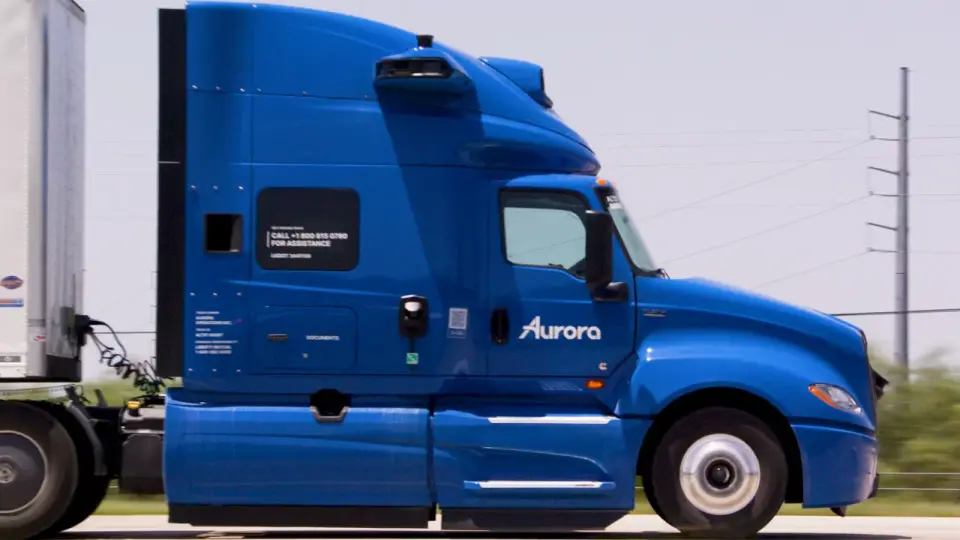
Aurora Innovation is targeting positive free cash flow by 2028, driven by a massive expansion of its driverless truck fleet. The company aims to grow from 20 to over 200 autonomous trucks by the end of 2026, leveraging a 'driver-as-a-service' model that promises lower costs than human-driven fleets. While Wall Street analysts remain bullish on the long-term potential, the company currently faces significant cash burn and skepticism regarding the practicality of replacing human drivers entirely.
Key points
- Aurora Innovation plans to reach positive free cash flow by 2028, a goal dependent on scaling its autonomous fleet from 20 to over 200 trucks by the end of 2026.
- The company’s 'driver-as-a-service' model charges customers per mile, with Bank of America estimating costs at approximately $0.85 per mile compared to $1.30 for human drivers.
- Morgan Stanley estimates that an autonomous fleet could be nearly 7.5 times as profitable as a human-driven fleet, while Cantor Fitzgerald maintains an 'Overweight' rating with a $12.00 price target.
- Aurora has logged over 440,000 fully driverless miles since 2022, with its second-generation trucks expected to reduce hardware costs by more than 50%.
- Despite bullish analyst targets, including an $18.00 target from Morgan Stanley, the company reported a net loss of approximately $270 million in the last quarter and lost over $800 million in 2025.
Background
Aurora Innovation began testing autonomous technology on public roads in 2022 and entered commercialization in April 2025. The company has faced significant financial losses, including over $800 million in 2025, while attempting to transition from development to commercial scaling. The U.S. Department of Transportation estimates there are approximately 3.5 million Class 8 semitrucks on the road, with only a fraction currently autonomous. Competitors such as Kodiak AI, Gatik, and Tesla are also developing autonomous vehicle technology, creating a competitive landscape for freight logistics.
How outlets are covering it
CNBC highlights the operational efficiency and cost savings of Aurora’s autonomous trucks, noting that the technology can operate up to 20 hours a day, unlike human drivers limited by federal break laws. However, Sean Wu of uShip questions the practicality of removing human drivers, arguing that they provide judgment, customer service, and protection beyond simple transportation. Morgan Stanley and Cantor Fitzgerald are bullish, with the former raising its price target to $18.00 and the latter maintaining an 'Overweight' rating, citing the potential for massive market disruption. Conversely, Evercore ISI maintains an 'In Line' rating with an $8.00 target, suggesting a more cautious approach despite adding Aurora to its 'Tactical Outperform' list. Timothy Sykes notes the high risk and volatility of the stock, emphasizing that while the balance sheet is strong with $1.22 billion in cash, the current revenue base is minimal at $2.0 million per quarter.
Why it matters
Aurora’s progress represents a critical test case for the viability of autonomous freight in the U.S. If the company can achieve profitability by 2028, it could reshape the logistics industry by addressing the chronic shortage of truck drivers and reducing operational costs. The success or failure of Aurora’s commercialization strategy will likely influence investor sentiment and capital allocation across the broader autonomous vehicle sector, particularly as competitors like Tesla and Kodiak AI also pursue similar technologies. The potential for a 7.5x profitability increase over human-driven fleets, as estimated by Morgan Stanley, underscores the significant financial upside if Aurora can successfully scale its operations.
What to watch
Aurora Innovation is scheduled to hold an Analyst & Investor Day on September 23, 2026, where it is expected to provide updates on its commercialization strategy and financial targets. The company aims to deploy 20 to 25 second-generation trucks by the end of the third quarter and over 200 by the end of 2026. Investors will be watching closely for any revisions to the previous $1.3 billion revenue target, as current consensus estimates are approximately 50% lower. The upcoming AV Forum on September 29, 2026, will also be a key event for assessing the company’s progress and market reception.
- Autonomous trucking company Aurora looks to accelerate toward profitability CNBC
- Aurora’s New Production Goals and Driver-as-a-Service Pivot Could Be A Game Changer For Aurora Innovation (AUR) Yahoo Finance
- How Driverless Truck Production Plans Will Impact Aurora Innovation Stock (AUR) simplywall.st
- Cantor Fitzgerald reiterates Aurora Innovation stock rating at overweight By Investing.com Investing.com UK
- AUR Stock Draws Bullish Targets Ahead Of Key 2026 Catalyst timothysykes.com
Want the full story? Read the original reporting
Read on CNBC