
Faraday Future's $89,000 Humanoid Robot Tests Public Interaction in Brooklyn Bridge Park
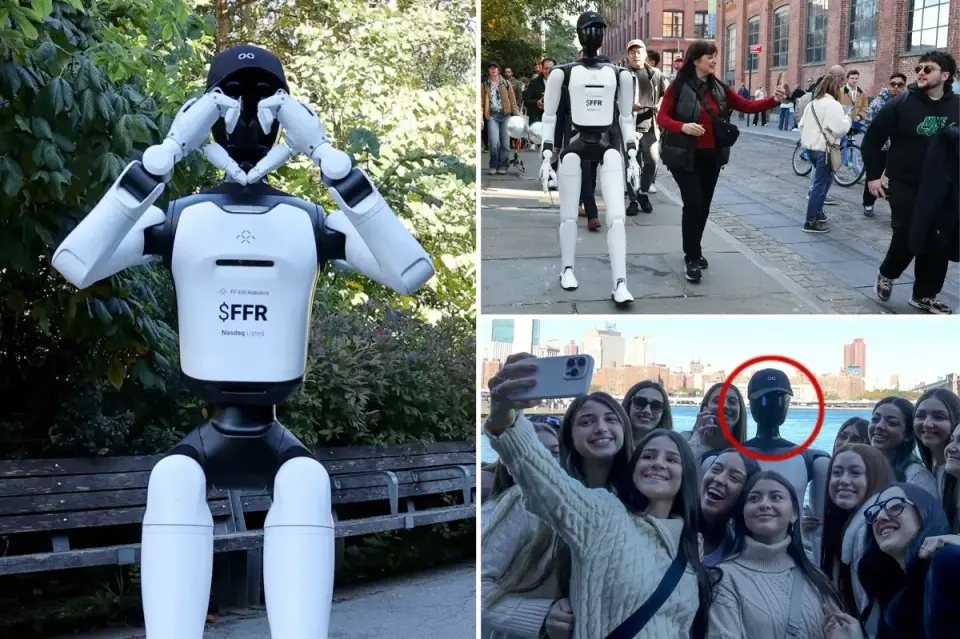
A California-based company deployed a high-cost humanoid robot in a New York City park to observe human behavior, aiming to refine its capabilities for future roles as a caregiver or companion.
Key points
- An AI-powered humanoid robot was observed interacting with the public at Brooklyn Bridge Park in New York City on Sunday, October 25, 2026.
- The robot, manufactured by California-based Faraday Future, has a retail price of $89,000 and is currently in a developmental learning phase.
- The device was operated by Chief Technology Officer Hong Rao using a remote control, with the goal of teaching the machine how to nurture and interact with humans.
- Park visitors, including a group of women from Argentina, engaged with the robot by posing for photos, dancing, and allowing it to sing to children.
- The deployment is part of a broader effort to train the robot for eventual use as a babysitter, teacher, or companion, relying on real-world data to improve its navigation and intelligence.
Background
This event follows a trend of increased public exposure to autonomous machines in urban spaces, as a similar robot was spotted playing with children in the same park in March 2026. It also arrives shortly after a warning from a Nobel Prize-winning AI expert to Congress regarding the potential consciousness of robots and the need for human-robot coexistence to avoid existential risks.
Why it matters
The public testing of expensive, life-sized humanoid robots in high-traffic areas highlights the rapid transition of AI from theoretical models to physical, social integration, raising questions about safety, public acceptance, and the commercial viability of such technology in domestic and educational settings.
What to watch
Developers will likely analyze the data collected from this public interaction to refine the robot's movement and social algorithms, potentially leading to further public trials or the release of consumer-grade units for caregiving roles.
Want the full story? Read the original reporting
Read on New York Post