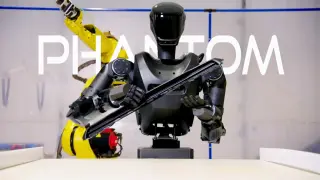
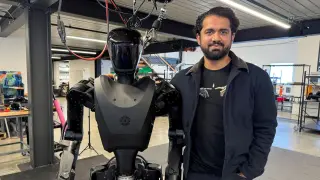
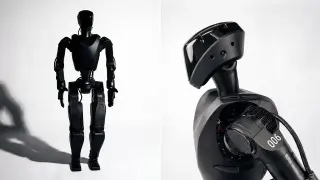
Foundation Future Industries, a San Francisco startup developing humanoid robots for military use, has terminated employee health insurance due to unpaid bills. The company, advised by Eric Trump, is seeking a bridge loan to survive until a potential $150 million investment from South Korea’s Base Group. Employees face a third missed payroll and have been warned against filing wage complaints.
China set a new Guinness World Record on November 17 in Shenzhen when 151 humanoid robots performed a synchronized dance routine within one hour. The event, organized by local authorities and robotics firms, exceeded the initial target of 110 units and featured models from ENGINEAI, Unitree, and AGIBOT. This demonstration preceded the Asia-Pacific Economic Cooperation (APEC) summit, where world leaders including Donald Trump and Vladimir Putin are visiting the city. While the spectacle highlights advances in multi-robot coordination, it contrasts with broader economic challenges in Shenzhen, including a property crisis and a shift toward gig work, as the city attempts to rebrand itself as a hub for artificial intelligence and advanced manufacturing.
Foundation Future Industries, a San Francisco-based maker of military humanoid robots, failed to pay employees on October 30, 2026, due to dwindling cash reserves. The crisis has intensified internal anger after CEO Sankaet Pathak borrowed $4.6 million from the company last year to purchase a luxury home in Sausalito, California. While Pathak is seeking hundreds of millions in new funding at a $3 billion valuation, the firm faces scrutiny over its governance structure and the accuracy of its claims regarding Pentagon contracts.
Foundation Future Robotics, backed by Eric Trump, deployed its Phantom MK 1 humanoid robots to Ukraine in February and is now in talks to supply up to 1,000 units to Israel for tunnel operations. Co-founder Mike LeBlanc predicts robots will handle most major combat within a decade, though he acknowledges human oversight remains essential. The company faces political scrutiny over its ties to the Trump family and a $24 million Pentagon contract.
An American robotics startup is in preliminary discussions with the Israel Defense Forces (IDF) to supply up to 1,000 humanoid robots for operations in Gaza. The robots, designed to detect explosives and neutralize booby traps, aim to reduce casualties among Israeli soldiers in underground tunnel networks. The company, Foundation Future Industries, has strategic ties to U.S. President Donald Trump’s son, Eric Trump, and has received significant U.S. military funding. Critics and supporters debate the ethical implications of using autonomous systems in combat zones, with some emphasizing the potential to save lives and others raising concerns about accountability and the political context of the technology.
Agility Robotics became the first US company dedicated solely to humanoid robots to go public, listing on the Nasdaq under the ticker AGLT via a merger with Churchill Capital Corp XI. The deal raised approximately $465 million, valuing the firm at $2.5 billion. CEO Peggy Johnson, formerly of Microsoft and Magic Leap, aims to commercialize the Digit 5 robot for warehouse and factory automation. Despite significant investor backing from Nvidia, Amazon, and Foxconn, the company faces steep unit economics, having generated only $1.8 million in revenue last year against a $138.1 million net loss. Agility’s core advantage is its operational data, with over 65,000 hours of commercial use across nine customer sites, including Amazon and Toyota. However, the stock dropped nearly 14% in its first full trading day amid broader market volatility, highlighting investor skepticism about the path to profitability in a competitive field that includes Tesla and Figure AI.
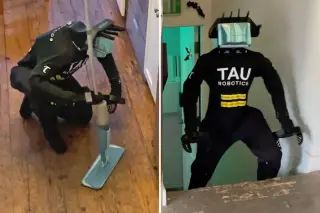
Tau Robotics is testing a service in San Francisco where humanoid robots clean homes for $100 per visit, but they are remotely piloted by humans and often fail at basic tasks.
Agility Robotics became the first US company solely focused on humanoid robots to list on the Nasdaq, raising $465 million via a SPAC merger. Despite high valuations and a $300 million contract for 1,000 units, the firm faces steep losses and intense competition from Tesla and others.
Toyota is aggressively pivoting toward humanoid robotics to diversify beyond automobiles and compete with Chinese manufacturers. The company plans to deploy 400,000 robots and invest $6.4bn annually, leveraging its manufacturing expertise and AI research to secure a significant share of the global market by 2035.
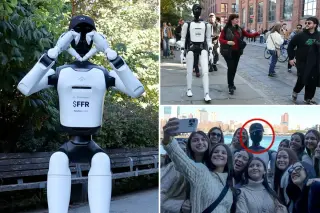
A California-based company deployed a high-cost humanoid robot in a New York City park to observe human behavior, aiming to refine its capabilities for future roles as a caregiver or companion.
Tesla has started manufacturing its Optimus humanoid robot at its Fremont, California, factory, marking the first production-quality units. CEO Elon Musk expects to begin customer deliveries by the end of 2027, but warns that scaling to 20,000 units per week will take at least a year due to complex engineering challenges. The company is replacing Model S and X production lines to accommodate this new output, with a second line in Austin planned for 10 million units annually. While Musk frames Optimus and the Cybercab as the primary drivers of Tesla’s future value, investors remain cautious about the high costs and technical hurdles involved in bringing the robot to market.
German authorities in Cologne have seized a commercially available humanoid robot and two smartphones after the device allegedly groped a 16-year-old girl and performed sexually suggestive movements. The incident, which occurred on October 10 near a fast-food outlet, was recorded and livestreamed by the robot's 16-year-old owner and his 19-year-old companion. Police are investigating whether the movements were remotely controlled or pre-programmed, though legal experts note that current German sexual harassment laws may not apply to machine-to-human contact.
German police in Cologne are investigating two young men after a humanoid robot allegedly sexually assaulted a 16-year-old girl. The incident, which occurred near a fast-food outlet on October 10, involved the robot touching the victim and making suggestive movements. Police seized the device and the suspects' phones, noting that the pair may have livestreamed the event on social media. Legal experts question how to prosecute the owners under current laws, as German sexual harassment statutes typically require direct human-to-human contact.
Bill Gates outlined a two-phase timeline for AI development during an interview on NBC's 'Meet the Press,' predicting a 20-year period of economic adjustment before an 'era of abundance' driven by humanoid robots. He warned that unchecked AI could cause 'a billion deaths' and urged federal legislators to implement mandatory safeguards, rejecting the idea of industry self-regulation. While Gates expressed optimism about long-term benefits, he emphasized the immediate need for government oversight to manage risks related to job displacement and criminal misuse.
Yanxi Technology unveiled the Yansyn-X2 at the 2026 Inclusion Conference in Shanghai, featuring a microfluidic system that produces tears on command. The robot uses AI to analyze conversational tone and trigger bionic facial expressions, aiming to enhance human-robot interaction naturalness. While the current model is stationary, it can track people and gesture, with future versions planned to use bionic muscles for smoother movements. This development reflects a broader industry trend toward emotionally responsive robots, alongside recent advancements in speed and utility seen at CES 2026 and the Beijing World Humanoid Robot Games.