
Microsoft unveils Maia 300 chip to lead AI inference and cut Nvidia reliance
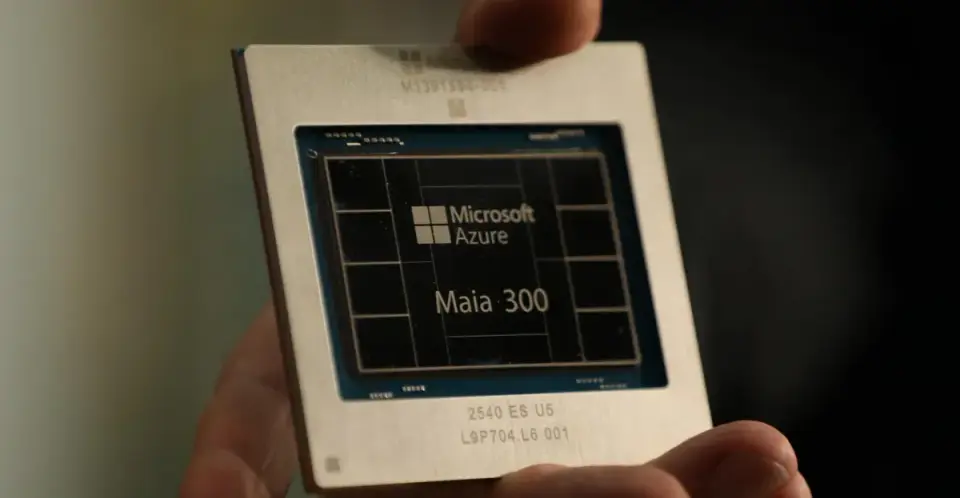
Microsoft has introduced the Maia 300, its third-generation in-house AI accelerator, which is set to become the primary inference system for its cloud services starting in 2027. The chip promises significant efficiency gains over Nvidia GPUs, aiming to reduce Microsoft's dependence on external silicon for AI workloads.
Key points
- Microsoft announced the Maia 300 chip on October 12, 2026, designed to be the primary AI inference system for its products and services.
- The chip is expected to deliver 40% more tokens per megawatt compared to leading GPU-based systems and up to 7x the rack-scale token throughput of the previous Maia 200.
- Production rollout for the Maia 300 will begin in 2027, with Microsoft targeting multi-gigawatt deployments of its in-house silicon.
- The new chip uses a chiplet architecture built on TSMC's N2P process node, separating compute, memory, and I/O functions to improve efficiency.
- Microsoft aims to reduce its reliance on Nvidia and AMD for AI inference, though Nvidia GPUs will still be used for training models.
Background
Microsoft has been developing custom AI chips since 2023, with the Maia 100 and Maia 200 already in production. The Maia 200, announced in January 2026, is currently used for Microsoft Copilot, GitHub Copilot, and other AI services. The introduction of the Maia 300 follows a broader industry trend of hyperscalers seeking bespoke chips to control costs and tailor workloads, as noted in earlier coverage of Broadcom's revenue forecasts.
How outlets are covering it
The Verge emphasizes the efficiency gains and the strategic shift away from Nvidia and AMD, highlighting the 40% improvement in tokens per megawatt. CNBC focuses on the financial implications, noting that Microsoft's finance chief Amy Hood has linked in-house chip use to margin improvements over a decade. CNBC also points out that while Microsoft will rely on Maia for inference, it will still partner with Nvidia and AMD for training models. Microsoft's Azure blog provides a detailed technical breakdown of the Maia 300's architecture, including its chiplet design and software-defined dataflow, which The Verge and CNBC mention more briefly. All sources agree on the 2027 production timeline and the chip's role in reducing Microsoft's dependence on external AI silicon.
Why it matters
The launch of the Maia 300 marks a significant step for Microsoft in reducing its reliance on Nvidia, the dominant player in AI chips. This move could impact Nvidia's market share and pricing power, as well as influence the broader AI infrastructure market. For Microsoft, it could lead to cost savings and improved margins, while also enhancing its ability to compete with other AI leaders like Google and OpenAI. The efficiency gains of the Maia 300 could also make advanced AI capabilities more accessible and affordable for Microsoft's customers.
What to watch
Microsoft plans to begin rolling out the Maia 300 chip to production workloads in 2027. The company will also share more information on its AI strategy and technology adoption trends at Microsoft Ignite 2026 in San Francisco. The success of the Maia 300 in reducing Microsoft's reliance on Nvidia and improving efficiency will be closely watched by the industry.
- Microsoft’s new AI chip makes it less reliant on Nvidia’s GPUs The Verge
- Microsoft reveals Maia 300 AI chip as it works to reduce dependence on Nvidia, AMD Yahoo Finance
- Microsoft to rely more on homegrown AI chips, reducing dependence on Nvidia CNBC
- Microsoft plans huge deployment of its own AI chips, with an eye on saving costs Reuters
- Deep dive into Azure Maia 300 architecture Microsoft Azure
Want the full story? Read the original reporting
Read on The Verge