
OpenAI Retracts Three AI-Generated Math Proofs Amidst Community Backlash
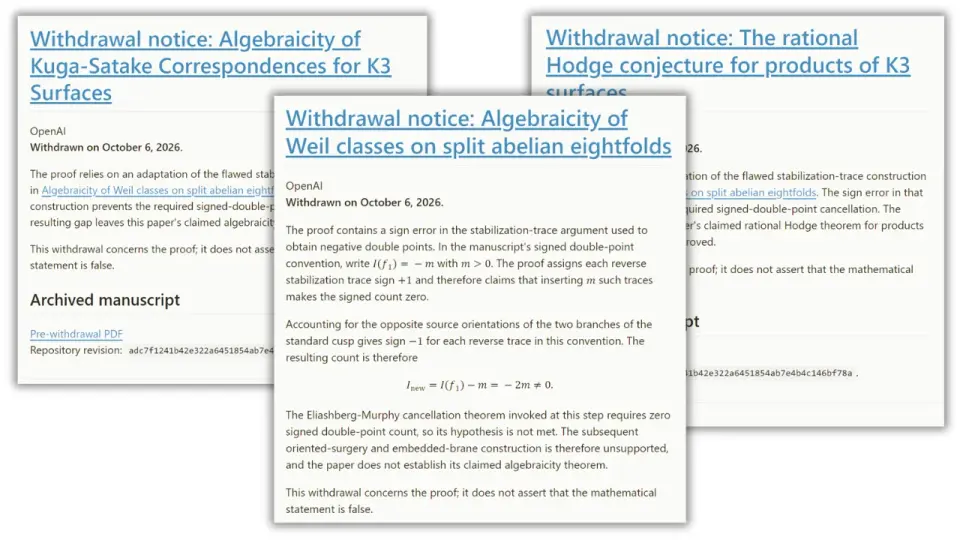
OpenAI withdrew three preprints from a massive release of 722 AI-generated mathematical manuscripts just one day after publishing them, citing a sign error that invalidated dependent proofs. While the company claims the release aims to advance human knowledge, mathematicians criticize the lack of formal verification and the sheer volume of unvetted work. The incident follows a controversial September announcement regarding the Navier-Stokes problem, further eroding trust in OpenAI’s approach to academic collaboration.
Key points
- OpenAI released 722 preprints on Oct. 6, 2026, claiming progress on 372 unsolved math problems in geometry, algebra, and computer science.
- On Oct. 7, the company withdrew three manuscripts due to a sign error that invalidated arguments in one paper and constructions in two dependent papers.
- OpenAI stated it revised 14 other manuscripts with proof repairs and corrected statements, noting that roughly 50% of the results were released without full formalization.
- The Advisory Group on Mathematics and Artificial Intelligence (AGMAI) recommended releasing results without waiting for full formalization, a decision OpenAI is now reviewing.
- Mathematicians criticize the release as a 'demonstration of power' rather than scholarship, with some calling the proofs unintelligible or 'AI slop'.
Background
This release follows OpenAI’s September 8 announcement of a solution to the Navier-Stokes problem, which sparked significant controversy. Leading researchers alleged OpenAI rushed the announcement without proper write-ups or citation of prior work, leading to a statement endorsed by over 8,000 researchers. The current preprint dump has intensified concerns about the transparency and verification of AI-generated research, with some mathematicians calling for a return to human-centered scientific understanding.
How outlets are covering it
Retraction Watch highlights the rapid withdrawal of three papers due to a cascading sign error, noting that Cornell mathematician Alex Townsend believes more errors will likely be found. He argues OpenAI should have prioritized Lean-verified proofs first. The Conversation emphasizes the poor quality of the writing, with one expert describing a paper as so unintelligible it would be rejected by a journal editor. New Scientist focuses on the potential significance of the results, noting claims related to the Riemann hypothesis and Kakeya conjecture, while acknowledging that many improvements are marginal. OpenAI’s spokesperson defends the release as iterative, stating they welcome scrutiny and will correct errors promptly, while Dan Roberts, a research lead, announced the company will continue updating the repository with errata.
Why it matters
The incident underscores the growing tension between AI-driven research speed and the rigorous verification standards of the mathematical community. It raises questions about the reliability of AI-generated proofs and the ethical implications of releasing unvetted work at scale. The backlash may influence future protocols for AI-assisted research, potentially leading to stricter requirements for formal verification and transparency in academic publishing.
What to watch
OpenAI plans to continue updating its GitHub repository with new formalizations and errata. The company is working with the AGMAI to understand if their release protocols need updating. Mathematicians will spend years verifying the remaining 719 manuscripts, with some results potentially reshaping fields like number theory and geometry if they hold up to scrutiny.
- OpenAI withdraws three preprints a day after releasing 722 manuscripts on unsolved math problems Retraction Watch
- ‘Breathtaking,’ ‘Devastating’: Mathematics Reels After New OpenAI Release The New York Times
- Is this the ‘mathocalypse’? Why OpenAI’s latest results dump has left mathematicians in shock The Conversation
- AI Solved One Math Problem and Everyone Freaked Out. It Just Cracked Hundreds More. WSJ
- The most interesting mathematical discoveries in OpenAI’s 722 new papers New Scientist
Want the full story? Read the original reporting
Read on Retraction Watch