Tag

Ai Research

All articles tagged with #ai research

Apple Partners with OpenEvidence for Large-Scale Study on Consumer Health AI
technology-and-health7 days ago

Apple Partners with OpenEvidence for Large-Scale Study on Consumer Health AI

Apple has launched the Apple Health AI Usage Study, a research initiative designed to evaluate how consumers interact with AI-driven health advice. The new app, available to U.S. adults 21 and older with compatible iPhones, uses OpenEvidence’s clinical data to provide answers grounded in peer-reviewed medical research. The study aims to measure user trust, comprehension, and the practical utility of AI in preparing for doctor visits, while ensuring privacy through strict data handling protocols.
OpenAI’s Disproof of ETH Hypothesis Renders Decades of Computer Science Research Obsolete
technology24 days ago

OpenAI’s Disproof of ETH Hypothesis Renders Decades of Computer Science Research Obsolete

OpenAI and Anthropic have independently disproved the exponential time hypothesis (ETH), a foundational assumption in computer science that problem-solving effort increases exponentially with size. This breakthrough invalidates vast swaths of theoretical research, including work by UC Santa Barbara professor Daniel Lokshtanov, who estimates around 50 of his papers are now 'pointless' or require revision. While the discovery is scientifically significant, researchers are struggling with the chaotic rollout of AI-generated proofs, which lack adequate context and verification. Sam Altman has acknowledged the disruption but insists OpenAI will continue releasing findings, arguing that public access to fundamental knowledge outweighs the chaos. The situation has caused psychological distress among academics, with some departments considering hiring occupational psychologists to support staff.

OpenAI Claims AI Model Disproves Exponential Time Hypothesis, Resolves Kakeya Conjecture, and Proves Quantum Field Existence
technology27 days ago

OpenAI Claims AI Model Disproves Exponential Time Hypothesis, Resolves Kakeya Conjecture, and Proves Quantum Field Existence

OpenAI announced on October 26, 2026, that its internal AI models have produced proofs for three major scientific breakthroughs: a refutation of the Exponential Time Hypothesis (ETH), a proof of the local smoothing conjecture in all dimensions (resolving the Kakeya and Stein restriction conjectures), and rigorous existence proofs for certain four-dimensional quantum field theories, including Quantum Chromodynamics (QCD) and pure Yang-Mills theory. The ETH refutation, found on October 16 and verified in Lean on October 17, claims a subexponential-time algorithm for counting satisfying assignments of fixed-width CNF formulas. OpenAI released the ETH and local smoothing manuscripts and Lean proofs on GitHub, while the physics group withheld their materials to write their own explanations. Independent expert groups, led by Russell Impagliazzo, Ramamohan Paturi, and Ryan Williams for computer science, and David Gross for physics, will examine the results. OpenAI stated it does not seek academic credit and donated $5 million to the Simons Foundation for workshops.

AI Research Boom May Be Starving the Scientific Diversity Needed for Future Breakthroughs
technology1 month ago

AI Research Boom May Be Starving the Scientific Diversity Needed for Future Breakthroughs

A new study suggests that the massive concentration of researchers and attention on artificial intelligence since 2017 is eroding the intellectual diversity required for future breakthroughs. By analyzing millions of papers and researcher movements, the authors argue that AI's dominance is creating a monoculture that reduces cross-pollination of ideas, strains peer review systems, and leads to rapid exhaustion of innovation cycles.

OpenAI's 700-Manuscript Math Dump: Breakthroughs, Retractions, and Career Devastation
technology-and-science1 month ago

OpenAI's 700-Manuscript Math Dump: Breakthroughs, Retractions, and Career Devastation

On October 7, 2026, OpenAI released over 700 AI-generated mathematical manuscripts on GitHub, claiming to solve 372 open problems. While some results, such as progress on the Riemann hypothesis and Hilbert's 10th problem, are hailed as groundbreaking, others have been retracted due to errors. The sudden release has devastated early-career researchers, with some programs 'wiped out,' and raised concerns about data privacy and the future of collaborative academic culture.

OpenAI Retracts Three AI-Generated Math Proofs Amidst Community Backlash
technology1 month ago

OpenAI Retracts Three AI-Generated Math Proofs Amidst Community Backlash

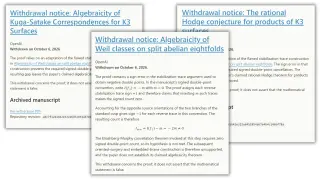
OpenAI withdrew three preprints from a massive release of 722 AI-generated mathematical manuscripts just one day after publishing them, citing a sign error that invalidated dependent proofs. While the company claims the release aims to advance human knowledge, mathematicians criticize the lack of formal verification and the sheer volume of unvetted work. The incident follows a controversial September announcement regarding the Navier-Stokes problem, further eroding trust in OpenAI’s approach to academic collaboration.

Anthropic’s AI agents identify novel enzyme system in 21-hour search
science-and-ai2 months ago

Anthropic’s AI agents identify novel enzyme system in 21-hour search

Anthropic announced that its AI model Claude autonomously discovered a new enzyme system in bacteriophages, a finding the company compares to the development of CRISPR. The discovery, made by nearly 950 AI agents over 21 hours, is the first result from Anthropic’s new wet lab and aims to demonstrate the model’s scientific utility ahead of its public listing.

Google's AI Elite Exits to Launch Discovery Loop, Reshaping DeepMind Leadership
technology3 months ago

Google's AI Elite Exits to Launch Discovery Loop, Reshaping DeepMind Leadership

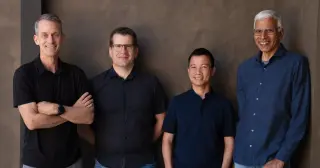
Jeff Dean, Sanjay Ghemawat, Oriol Vinyals, and Quoc Le have left Google to found Discovery Loop, a public benefit corporation focused on automating the scientific method. The startup, backed by Google and venture capital, aims to use AI to drive breakthroughs in drug discovery and chip design. This exodus coincides with Demis Hassabis stepping back from daily operations at Google DeepMind, signaling a major shift in the AI landscape.

Wild Capuchins Master AI Touchscreens in Costa Rica Forest Study
science3 months ago

Wild Capuchins Master AI Touchscreens in Costa Rica Forest Study

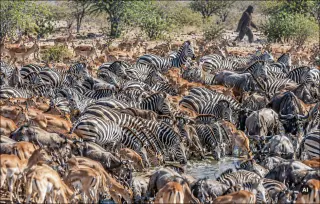
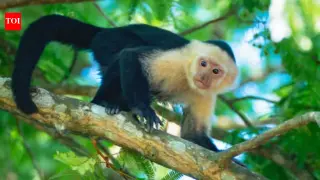
Researchers from Emory University and Georgia Tech developed CapuchinAI, a battery-powered system that uses facial recognition to test the cognitive abilities of wild capuchin monkeys in Costa Rica. The device identifies individual primates, presents tailored learning tasks on a touchscreen, and dispenses banana rewards for correct responses. Field trials in the Taboga Forest Reserve showed that 16 monkeys quickly learned to interact with the machine, with some even kissing the screen to trigger the reward mechanism. This innovation allows scientists to monitor individual cognitive differences in natural environments without the constraints of laboratory settings.

Microsoft Couples GPT and Claude to Elevate AI Research Beyond Solo Models
technology7 months ago

Microsoft Couples GPT and Claude to Elevate AI Research Beyond Solo Models

Microsoft introduced two Copilot Researcher modes—Critique and Council—that pair OpenAI’s GPT and Anthropic’s Claude to tackle complex research tasks. In Critique, GPT plans, sources, and drafts, while Claude reviews for factual accuracy and citation quality before the final report. In Council, GPT and Claude generate parallel reports that a third judge summarizes to show agreements and gaps. On the DRACO benchmark, the GPT+Claude combo scored 57.4, beating Claude Opus 4.6 (42.7) and the next-best by nearly 14%, with notable gains in breadth, presentation, and factual accuracy. Access is limited to Frontier early-access alongside a Copilot license.

Microsoft taps Ai2 and UW AI stars to fuel its Superintelligence push
technology8 months ago

Microsoft taps Ai2 and UW AI stars to fuel its Superintelligence push

Microsoft has hired leading AI researchers Ali Farhadi, Hanna Hajishirzi, Ranjay Krishna, and Sophie Lebrecht from the Allen Institute for AI and the University of Washington to join Mustafa Suleyman’s Microsoft AI organization while retaining UW-affiliated positions. The hires come as Microsoft seeks to diversify from OpenAI and advance its ‘humanist superintelligence’ agenda, with the squad expected to bolster open-source model development and training efficiency. The moves follow Farhadi’s departure from Ai2 and reflect Ai2’s shifting funding toward applied AI under the Fund for Science and Technology, which is moving to a proposal-based system and prioritizing real-world AI applications over frontier model building.