
Satellite imagery reveals the massive land and energy footprint of America's AI data center boom
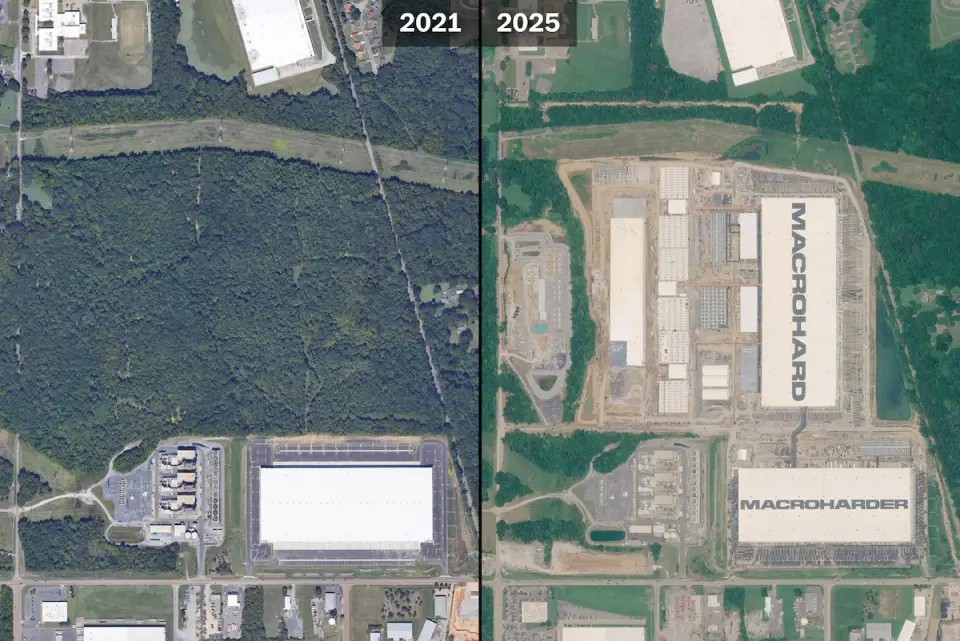
Satellite imagery reveals that the U.S. data center boom is transforming vast tracts of farmland and desert into massive industrial complexes. While nearly 100 hyperscale centers are operational, 120 are under construction, and 460 are planned. This expansion is driven by AI demand, pushing construction into rural areas for cheaper power and land, though it raises concerns about grid strain, pollution, and community health.
Key points
- The U.S. currently has nearly 100 hyperscale data centers, each consuming at least 100 megawatts of power, equivalent to powering 80,000 homes.
- According to Cleanview, 120 data centers are under construction and 460 more are planned, with many expected to be built by 2030.
- Satellite images show that 60% of new hyperscale centers are built on previously undeveloped land, including 33% on farmland, 12% on forest, and 11% on shrubland.
- Elon Musk’s xAI built 'Colossus 2' near Memphis, the country’s largest operating data center, which uses temporary gas turbines and off-grid power generation in Mississippi due to grid limitations.
- Meta is constructing 'Hyperion' in rural Louisiana, a campus larger than Central Park, which will be powered by seven new gas-fired plants approved by Entergy.
Background
Recent archive coverage highlights growing community resistance to data centers, with Berkshire Hathaway’s Greg Abel noting increased pushback from local populations. Additionally, earlier reports indicated that Elon Musk’s companies are accelerating in-house energy production, including gas turbines and solar capacity, to support AI infrastructure. These developments align with current satellite imagery showing a shift from urban to rural construction sites to meet the massive power demands of AI.
How outlets are covering it
The Washington Post emphasizes the physical scale and land-use changes, noting that data centers are moving to rural areas due to cheaper costs and proximity to fiber internet, despite grid strain. Dissent Magazine focuses on the health and environmental consequences, particularly in Louisiana’s 'Cancer Alley,' where oncology nurse Dorothy Slater highlights the risks of new gas-fired power plants for Meta’s data center, noting that state officials have denied higher cancer risks despite toxic air pollution. The Association of Health Care Journalists highlights the intersection of AI infrastructure, climate change, and public health, featuring experts who analyze the environmental impacts of data center power generation. STLtoday.com, while largely obscured by technical code, suggests advocacy for regulations on data center lights, indicating broader community concerns about the environmental footprint of these facilities.
Why it matters
The rapid expansion of data centers is reshaping the American landscape, consuming vast amounts of land and energy. This shift raises critical questions about environmental sustainability, public health, and energy equity, as rural communities face increased pollution and grid strain. The move to off-grid power generation and new gas plants highlights the tension between technological advancement and environmental protection, potentially exacerbating health disparities in already vulnerable areas.
What to watch
The Louisiana Public Service Commission is set to vote in December on the approval of seven new gas-fired power plants for Meta’s data center. Meanwhile, construction continues on 120 data centers, with 460 more planned, potentially leading to further land use changes and energy demands. Advocates and health experts are likely to push for stricter regulations and environmental assessments to mitigate the impacts of this infrastructure boom.
- See how data centers are changing the American landscape The Washington Post
- Death by Data Centers Dissent Magazine
- Watch: How data centers impact the environment and health in rural areas Association of Health Care Journalists
- As data centers expand, advocates in Missouri call for regulations on lights to help birds STLtoday.com
- Former EPA officials: Trump administration is allowing data centers to make people sick thelensnola.org
Want the full story? Read the original reporting
Read on The Washington Post