
SpaceX Achieves Historic Upper Stage Catch, but Super Heavy Booster Fails
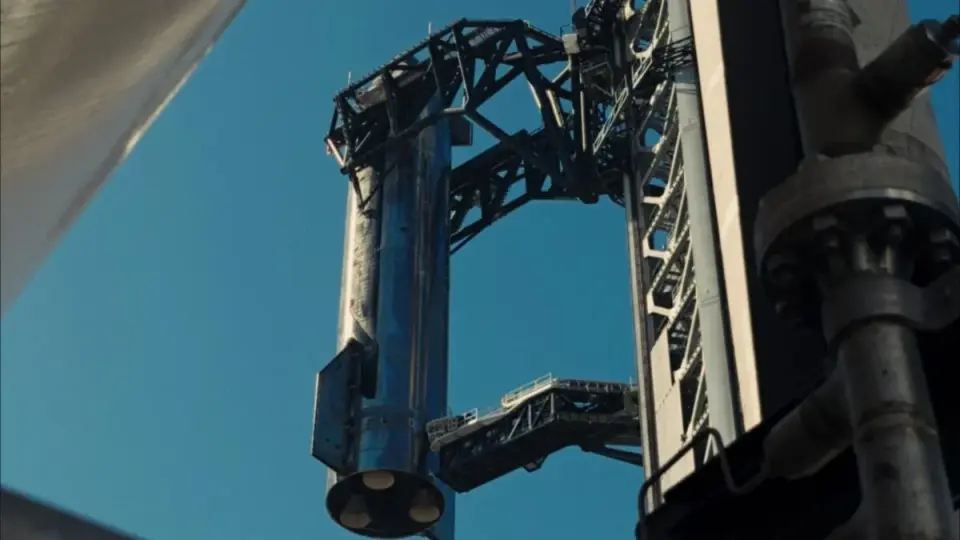
SpaceX successfully recovered its Starship upper stage from orbit for the first time, but the Super Heavy booster failed to return and exploded over the Gulf of Mexico. The mission marks a major step toward fully reusable rockets, though the company must now investigate the booster's failure and prove the upper stage can fly again.
Key points
- SpaceX caught the Starship upper stage with tower arms at Starbase, Texas, on Nov. 14, 2026, after a 22-hour orbital mission.
- The Super Heavy booster failed to return to the launch site due to a low-fuel alarm and exploded over the Gulf of Mexico.
- The upper stage deployed 26 Starlink Version 3 satellites and completed 14 orbits before reentry.
- SpaceX aims to refly the recovered upper stage by early 2027 to demonstrate rapid reusability.
- The company must investigate the booster's failure before attempting another double-catch mission.
Background
This follows SpaceX's previous successful catches of Super Heavy boosters on three earlier test flights, though the company had not yet recovered an upper stage from orbit. The mission also coincides with broader corporate developments, including a $74 billion AI investment and regulatory scrutiny of a potential Tesla merger, as noted in our archive.
How outlets are covering it
Gizmodo and Space.com emphasize the historic nature of the upper stage catch while highlighting the booster's failure as a setback. The New York Times frames the event as a key milestone in SpaceX's decade-long quest for reusable rockets, contrasting it with Falcon 9's partial reusability. Spaceflight Now provides technical details on the flight plan, noting the booster's early abort due to low fuel mass. All sources agree on the partial success but differ in emphasis: some focus on the engineering hurdle, while others highlight the broader implications for SpaceX's 2030 goal of 10,000 annual launches.
Why it matters
The successful upper stage catch is a critical step toward SpaceX's vision of fully and rapidly reusable orbital launch systems. It demonstrates the feasibility of recovering large rockets from orbit, which could reduce launch costs and enable ambitious projects like Mars missions. However, the booster's failure underscores the technical challenges remaining, and the need to prove the upper stage can fly again before scaling up launch cadence.
What to watch
SpaceX will investigate the Super Heavy booster's low-fuel alarm and subsequent abort. The company plans to refly the recovered upper stage by early 2027, as stated by COO Gwynne Shotwell. Future missions will focus on achieving a double-catch of both stages in a single flight to enable rapid refurbishment and reuse.
- SpaceX Just Caught a Falling Starship. Now What? Gizmodo
- SpaceX Makes History With Successful Rocket Catch in Texas The New York Times
- Starship returns to Starbase and a successful tower catch Spaceflight Now
- Relive Starship's historic Flight 15 with our best photos from launch and 'Mechazilla' tower catch Space
- When will humans actually fly on Starship? Ars Technica
Want the full story? Read the original reporting
Read on Gizmodo