
T-Mobile Drops Starlink Branding as Big Three Launch Satellite Joint Venture
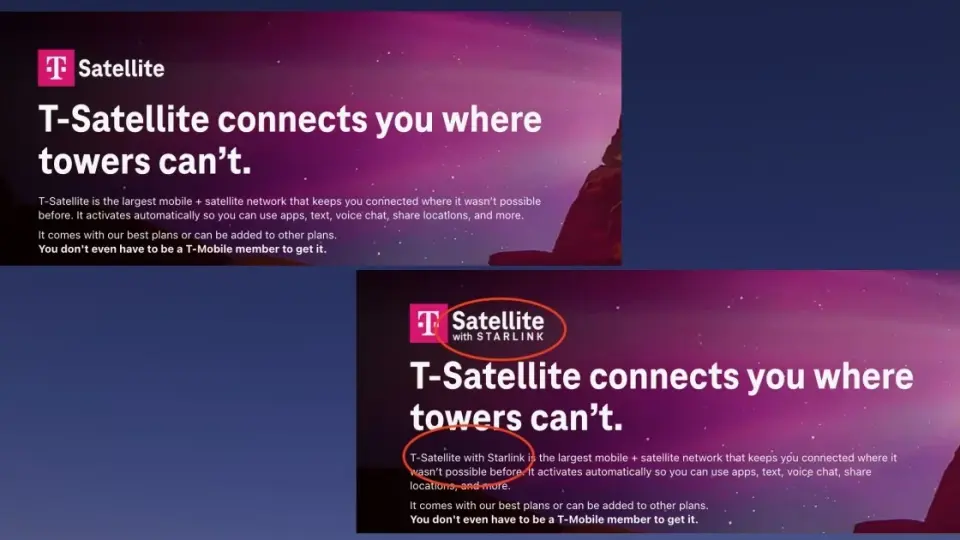
T-Mobile removed Starlink branding from its T-Satellite website coinciding with the official launch of a joint venture between T-Mobile, AT&T, and Verizon. The new entity, led by interim CEO Paul Roth, aims to pool spectrum and resources to eliminate coverage dead zones. While existing carrier-satellite agreements remain in place, the move signals a strategic shift to counter SpaceX's direct-to-cell ambitions and support alternative providers like AST SpaceMobile.
Key points
- T-Mobile quietly removed 'with Starlink' from its T-Satellite logo and introductory text, though Starlink remains mentioned on support and business pages.
- AT&T, T-Mobile, and Verizon officially launched their joint venture on October 2, 2026, following an announcement in May.
- Paul Roth, a former executive at AT&T and Cingular, was named interim CEO of the new venture.
- The joint venture aims to pool radio spectrum and adopt unified technical specifications to improve direct-to-device satellite access.
- The carriers stated that existing satellite agreements, including T-Mobile's partnership with SpaceX, will remain in place.
- T-Mobile CEO Srini Gopalan noted that T-Satellite usage accounts for only 0.0002% of total network traffic, describing it as a complementary service.
Background
In September 2026, T-Mobile's CFO dismissed Starlink Mobile as a non-competitive threat, arguing that SpaceX's plan to deploy femtocells was impractical. Meanwhile, SpaceX continued expanding its constellation, surpassing 11,000 satellites in August 2026. The current joint venture follows a May 2026 announcement of an 'agreement in principle' to address coverage gaps, marking the transition from a conceptual framework to an operational entity.
How outlets are covering it
PCMag highlights the timing of T-Mobile's removal of Starlink branding as a potential signal of tension, noting that T-Mobile executives have described satellite services as merely 'complementary' while SpaceX signals plans to compete directly with carriers. Fierce Network emphasizes the strategic necessity of the joint venture, suggesting it counters SpaceX's potential entry into the mobile market and supports competitors like AST SpaceMobile. Engadget frames the move as a hedge against dedicated satellite providers like Starlink and Amazon's Leo, noting that while consumer benefits are promised, the primary driver is competitive defense. GSMArena focuses on the operational details, such as the appointment of Paul Roth and the commitment to a standards-based approach, without emphasizing the competitive tension as heavily as other outlets.
Why it matters
The formalization of this joint venture represents a significant consolidation of resources among the US's largest wireless carriers. By pooling spectrum and standardizing satellite access, the Big Three aim to neutralize the competitive threat posed by SpaceX's direct-to-cell ambitions while ensuring that alternative satellite providers can access the market. This move could reshape the landscape of mobile coverage, potentially reducing reliance on individual carrier-satellite partnerships in favor of a unified industry approach, though existing agreements like T-Mobile's with SpaceX remain intact for now.
What to watch
The joint venture will likely proceed with identifying specific spectrum to pool and developing common technical specifications. A permanent CEO will be appointed to replace Paul Roth. The carriers may begin integrating satellite services more broadly across their networks, potentially reducing the prominence of individual partnerships like T-Mobile's with Starlink. SpaceX may respond to the joint venture's formation, potentially accelerating its own terrestrial network plans or adjusting its strategy for direct-to-cell services.
- T-Mobile Quietly Drops Starlink Name From Its T-Satellite Website PCMag
- AT&T, T-Mobile and Verizon make satellite JV official Fierce Network
- The big 3 US carriers just created a new company to fill in dead zones How-To Geek
- AT&T, T-Mobile And Verizon Have Officially Teamed Up To End Coverage Gaps Engadget
- AT&T, Verizon, and T-Mobile officially launch joint venture to end dead zones - GSMArena.com news GSMArena.com
Want the full story? Read the original reporting
Read on PCMag