
China's LandSpace Achieves First Land-Based Reusable Rocket Landing
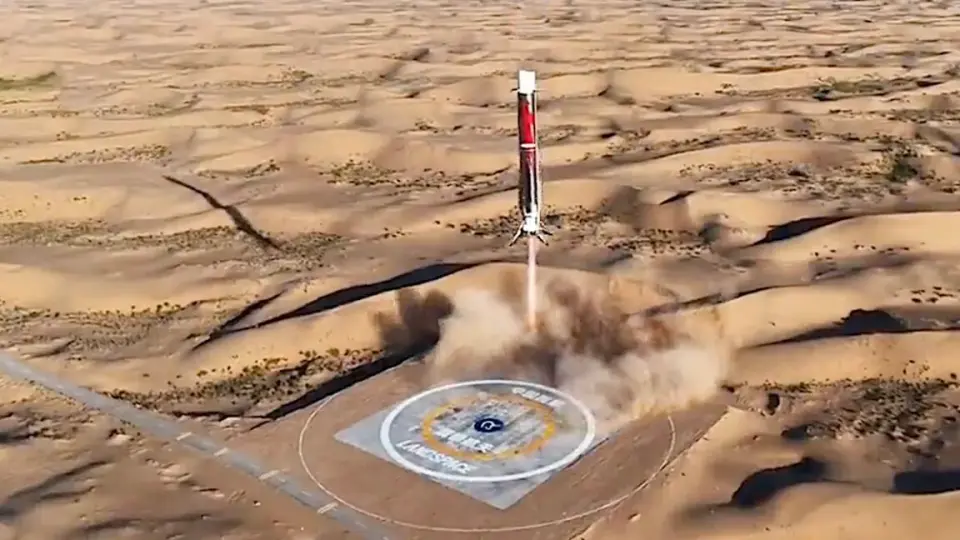
LandSpace successfully landed the Zhuque-3 rocket booster in the Gobi Desert on August 19, 2026, marking China's second orbital-class booster recovery and the first on land. The mission followed a successful sea-based recovery by CASC in July and precedes potential reuse flights for satellite constellations.
Key points
- LandSpace's Zhuque-3 rocket achieved a propulsive landing of its first-stage booster in northwestern China on August 19, 2026.
- This is the second successful recovery of an orbital-class booster in China, following the Long March 10B sea recovery in July 2026.
- The Zhuque-3 uses methane fuel and stainless steel construction, resembling SpaceX's Falcon 9 but with different propulsion.
- LandSpace plans to inspect and reuse the booster, aiming for at least 20 flights per booster to support satellite mega-constellations.
- China's reusable rocket efforts are accelerating, with multiple companies testing new vehicles, potentially challenging US dominance in launch frequency.
Background
China has been developing reusable rockets for years, with initial test flights in December 2025 resulting in missed landings. The Long March 10B achieved the first successful recovery in July 2026 via a net-catch system in the South China Sea. LandSpace's Zhuque-3 follows this milestone, demonstrating land-based recovery capabilities. The Zhuque-2, a smaller methane-fueled rocket, reached orbit in 2023, paving the way for the larger Zhuque-3.
How outlets are covering it
Ars Technica emphasizes the significance of LandSpace's achievement as a sign of China's growing launch capability and the potential for rapid reuse. Space.com highlights the technical success of the landing and the company's plans for booster reuse. Yahoo Finance focuses on the impact on SpaceX stock, noting increased competition from Chinese and US rivals. All sources agree on the technical success but differ in emphasis: Ars Technica on geopolitical implications, Space.com on engineering details, and Yahoo Finance on market reactions.
Why it matters
This milestone demonstrates China's rapid progress in reusable rocket technology, potentially reducing launch costs and increasing launch frequency. It could impact the global aerospace market, particularly for satellite constellations, and challenge SpaceX's dominance. The success also signals a shift in the competitive landscape, with multiple Chinese companies advancing reusable technology.
What to watch
LandSpace plans to inspect and reuse the Zhuque-3 booster, with potential flights in the coming months. Other Chinese companies, including CASC and Galactic Energy, are also testing reusable rockets. SpaceX may face increased competition as it transitions from Falcon 9 to Starship, while US companies like Rocket Lab and Stoke Space continue developing reusable systems.
- The floodgates are open after another Chinese company lands a reusable rocket Ars Technica
- SpaceX stock in focus after China rocket milestone, share unlock ahead Yahoo Finance
- Touchdown! Private Chinese rocket aces landing on 2nd-ever flight (video) Space
- China becomes first to recover orbital launch rockets with 2 distinct paths South China Morning Post
- China successfully recovers rocket stage on land for the first time Dallas News
Want the full story? Read the original reporting
Read on Ars Technica