
Chicago Unveils Private $2.25B Plan for 15-Minute O'Hare Express Train
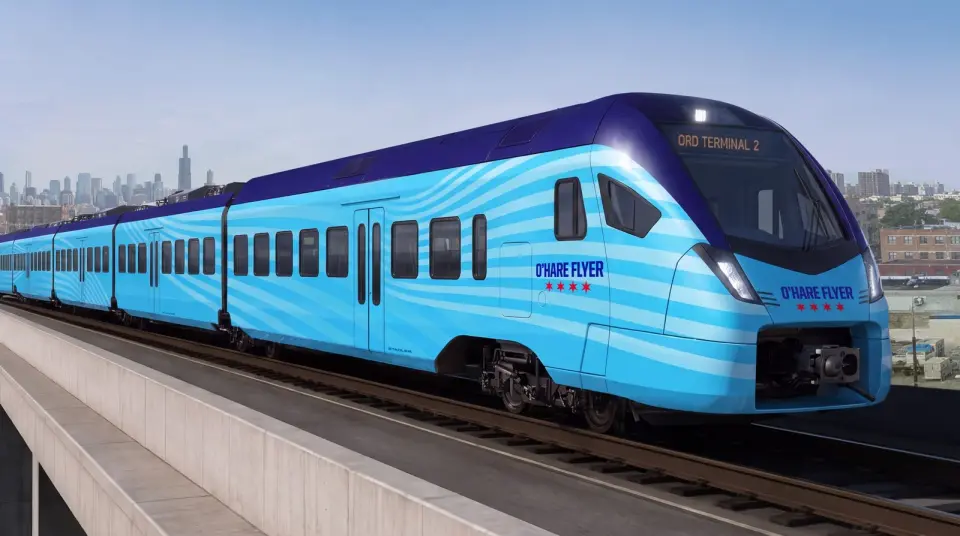
A private consortium has announced the 'O'Hare Flyer,' a proposed $2.25 billion battery-electric express train designed to connect Chicago’s O'Hare Airport to the Loop in 15 minutes. The project, which aims to launch within five years, would utilize existing freight rail rights-of-way owned by CSX, Canadian National, and Union Pacific. Unlike previous proposals, this plan relies entirely on private funding and federal loans, avoiding direct government subsidies. The service would depart every 15 minutes from Terminal 2 to a new station at the Old Post Office, offering a premium alternative to the CTA Blue Line and ride-hailing services.
Key points
- The O'Hare Flyer is a privately funded project with an estimated cost of $2.25 billion, seeking to launch within five years.
- The train would run on dedicated freight tracks owned by CSX, Canadian National, and Union Pacific, requiring new construction only for the final 1.5 miles to the airport.
- Service is planned to run every 15 minutes between O'Hare Terminal 2 and a new station at the Old Post Office on Van Buren Street.
- The project uses battery-electric trains, described as 'whisper-quiet,' and includes concierge-level service with luggage racks in every car.
- Ticket prices are not yet set but are expected to be higher than the CTA Blue Line but lower than ride-hailing services, which typically cost over $50.
Background
Chicago has long struggled with efficient airport connectivity, with previous high-speed proposals, including a 2018 concept involving Elon Musk’s Boring Company, failing to materialize. The current O'Hare Flyer proposal builds on earlier private initiatives but distinguishes itself by securing letters of intent from major freight railroads and emphasizing a fully private funding model. The project has been in development for three years, involving key figures like Kristi Lafleur, former CEO of the Chicago Skyway, and Mark Walbrun, a rail expert who helped redesign Union Station. This initiative follows a period of increased scrutiny on Chicago’s transportation infrastructure, including recent FAA investigations into aircraft tire damage at O'Hare, highlighting the need for reliable and efficient transit solutions.
How outlets are covering it
Block Club Chicago and ABC7 Chicago emphasize the speed and private nature of the project, highlighting the 15-minute travel time and the lack of government funding. The Chicago Sun-Times provides a more critical view, noting that while the project is privately funded, it still requires federal Railroad Rehabilitation and Improvement Financing loans and faces potential regulatory hurdles from city and federal agencies. The Chicago Tribune editorial board supports the project, calling it a necessary upgrade for Chicago’s global competitiveness, but warns of potential bureaucratic delays and union demands. All outlets agree that the project represents a significant step forward in Chicago’s airport connectivity, though they differ on the feasibility of the timeline and the potential impact on existing transit services like the CTA Blue Line.
Why it matters
The O'Hare Flyer could transform Chicago’s airport connectivity, offering a faster and more reliable alternative to current options. If successful, it would position Chicago as a leader in urban transit innovation, potentially boosting tourism and economic activity. The project’s private funding model could set a precedent for future infrastructure developments, reducing the burden on public budgets. However, the success of the project depends on navigating complex regulatory and logistical challenges, including securing approvals from multiple railroads and city officials. The outcome will also influence public perception of private infrastructure projects in the U.S., potentially encouraging similar initiatives in other cities.
What to watch
The O'Hare Flyer team plans to meet with public officials and community groups in the coming months to discuss the project. They will need to secure final agreements with CSX, Canadian National, and Union Pacific, as well as obtain necessary approvals from federal agencies and the city. The project aims to launch within five years, but the timeline is contingent on these approvals and the resolution of any regulatory hurdles. Public meetings and further announcements are expected as the project progresses.
- O’Hare Flyer Train Would Bring Visitors From Airport To Downtown In Just 15 Minutes Block Club Chicago
- Plans unveiled for 15 minute express 'O'Hare Flyer' trains from airport to downtown ABC7 Chicago
- O'Hare to the Loop in 15 minutes? This company thinks it can finally bring fast rail to Chicago Chicago Sun-Times
- Editorial: An express train from the Loop to O'Hare International Airport in 15 minutes? We're on board Chicago Tribune
- A 15-minute train to O’Hare? This group thinks it’s finally cracked the code. Crain's Chicago Business
Want the full story? Read the original reporting
Read on Block Club Chicago