
Public PoC Released for Critical FortiSIEM Path Traversal Flaw
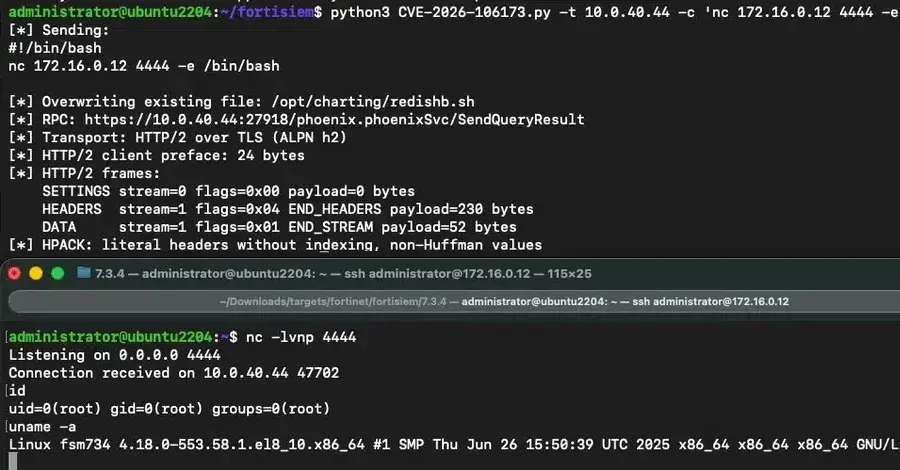
A proof-of-concept exploit has been released for CVE-2026-106173, a critical path traversal vulnerability in Fortinet FortiSIEM that enables unauthenticated remote code execution. The flaw, rated 9.4 on the CVSS scale, allows attackers to overwrite system files via crafted gRPC packets. Fortinet patched the issue in version 7.5.1, while version 7.6 remains unaffected. The exploit leverages null-byte injection to bypass filename restrictions and overwrite a Redis health-check script executed by a cron job.
Key points
- CVE-2026-106173 is a critical path traversal flaw in FortiSIEM with a CVSS score of 9.4, allowing unauthenticated remote code execution.
- Fortinet released patches last week; users of FortiSIEM 7.5.0 must upgrade to 7.5.1 or higher, while version 7.6 is not affected.
- The vulnerability exists in the gRPC service on TCP port 27918, specifically within the SendQueryResult() function which fails to validate the 'query-id' parameter.
- Attackers can use directory traversal sequences and null-byte injection to overwrite existing files, bypassing the automatic filename suffix added by the server.
- The exploit targets the 'redishb.sh' script, which runs every 60 seconds via cron to perform Redis health checks, allowing attackers to inject malicious code.
Background
This incident follows a recent trend of critical path traversal and remote code execution vulnerabilities in software ecosystems. In September, WordPress patched a similar critical path traversal flaw (CVE-2026-87902) that was exploited within hours of the patch release. Additionally, in late October, PHP released emergency patches for 'PHP2Shell' flaws that allowed unauthenticated code execution, with early exploit attempts reported by Cloudflare. These events highlight the ongoing risk of unauthenticated remote code execution vulnerabilities in widely used software components.
Why it matters
The release of a public proof-of-concept exploit for a critical, unauthenticated remote code execution vulnerability significantly increases the risk of widespread exploitation. FortiSIEM is a security information and event management system used by organizations to monitor and respond to security threats. A compromise of such a system could provide attackers with visibility into network activities and potentially facilitate further attacks. The specific targeting of a cron-executed script suggests a method for persistent access, making immediate patching essential for affected users.
What to watch
Organizations using FortiSIEM 7.5.0 must upgrade to version 7.5.1 or higher immediately to mitigate the risk. Users of version 7.6 are not affected but should monitor for any further advisories. Security teams should review logs for any suspicious activity on TCP port 27918 and ensure that their systems are patched against other recent critical vulnerabilities, such as those in PHP and WordPress, to maintain a robust security posture.
Want the full story? Read the original reporting
Read on The Hacker News