
Tschabalala Self’s 'Lady in Blue' Unveiled on London’s Fourth Plinth
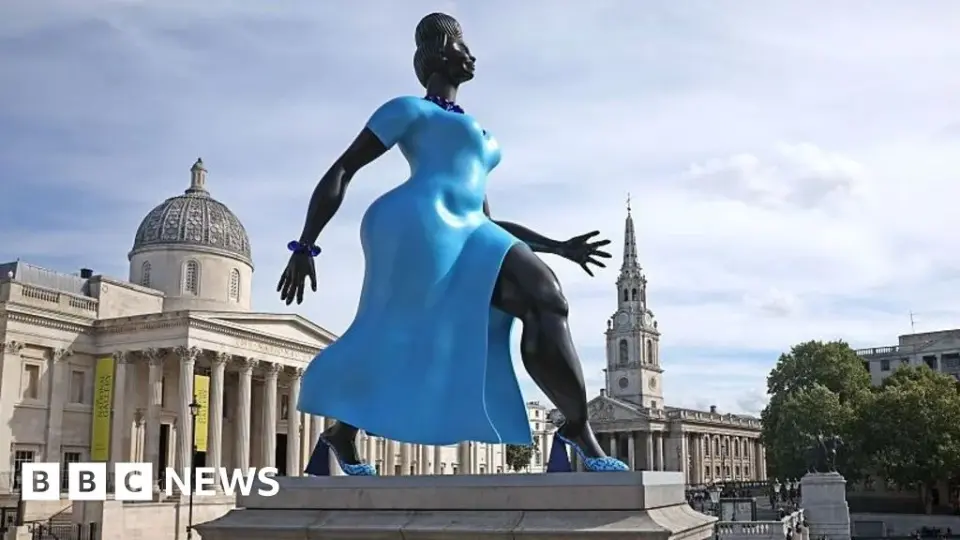
New York artist Tschabalala Self’s bronze sculpture 'Lady in Blue' has been unveiled on London’s Fourth Plinth, replacing a previous work by Teresa Margolles. The 10-foot statue depicts a striding Black woman in a lapis lazuli-blue dress, intended to represent a contemporary 'everywoman' rather than a historical figure. It will remain in Trafalgar Square for two years before moving to Norway, with the next commission scheduled for 2028.
Key points
- The sculpture is the 16th artwork installed on the Fourth Plinth since the program began in 1998.
- It replaces 'Mil Veces un Instante' by Teresa Margolles, which was described as a poignant tribute to trans lives.
- The bronze figure is patinated with pigment refined from lapis lazuli, a semi-precious stone used by artists for millennia.
- Self was selected in March 2024 alongside Andra Ursuta, whose work is scheduled for 2028.
- The statue will be permanently installed in Fornebu, Norway, after its two-year stint in London.
Background
The Fourth Plinth, left empty for over 150 years after funding for an equestrian statue of William IV ran out, was reactivated by the Royal Society of Arts in 1998. It has since hosted roughly one new sculpture every two years, including notable works by Mark Wallinger and Marc Quinn. Recent coverage in our archive noted other public art controversies, such as the vandalism of Self’s previous UK sculpture, 'Seated,' in Bexhill-on-Sea in 2023, where vandals spray-painted the Black figure white, prompting a community clean-up effort.
How outlets are covering it
BBC and Artnet News emphasize the sculpture’s role in representing a contemporary, relatable Londoner, with Self describing it as a symbol of shared ambitions and a move away from commemorating monarchs or military commanders. CNN highlights the racial dimension, noting that 'Lady in Blue' is one of the rare statues in London depicting a Black woman, out of approximately 1,500 statues in the city. The Guardian offers a critical aesthetic perspective, praising the sculpture’s 'humour and life' and comparing its bold, physical presence to futurist art, while acknowledging the sociopolitical weight of the unveiling speeches. Artnet News provides financial context, noting that the mayor of London approved a budget of just over £1 million for the 2026 and 2028 commissions, with reports suggesting Self is paid £30,000 and given up to £140,000 for production costs.
Why it matters
The unveiling marks a shift in London’s public art landscape toward contemporary, inclusive representation, challenging the traditional dominance of male historical figures in Trafalgar Square. It also highlights ongoing debates about race, representation, and public space in the UK, particularly in light of past incidents of vandalism against sculptures depicting Black women.
What to watch
The sculpture will remain on the Fourth Plinth for two years. After its London tenure, it will be permanently installed in Fornebu, Norway. The next commission, by Romanian artist Andra Ursuta, is scheduled for 2028.
- 'Everywoman' statue unveiled on Trafalgar Square's Fourth Plinth BBC
- London’s latest Fourth Plinth sculpture is a woman going places CNN
- Tschabalala Self’s Lady in Blue review – this striding scupture fills the fourth plinth with humour and life theguardian.com
- Tschabalala Self’s ‘Lady in Blue’ Storms London Artnet News
- ‘A tribute to everyday women’: Tschabalala Self's Fourth Plinth commission unveiled in London The Art Newspaper
Want the full story? Read the original reporting
Read on BBC