
Van Gogh’s Starry Night Accurately Depicts Turbulence Decades Before Scientific Validation
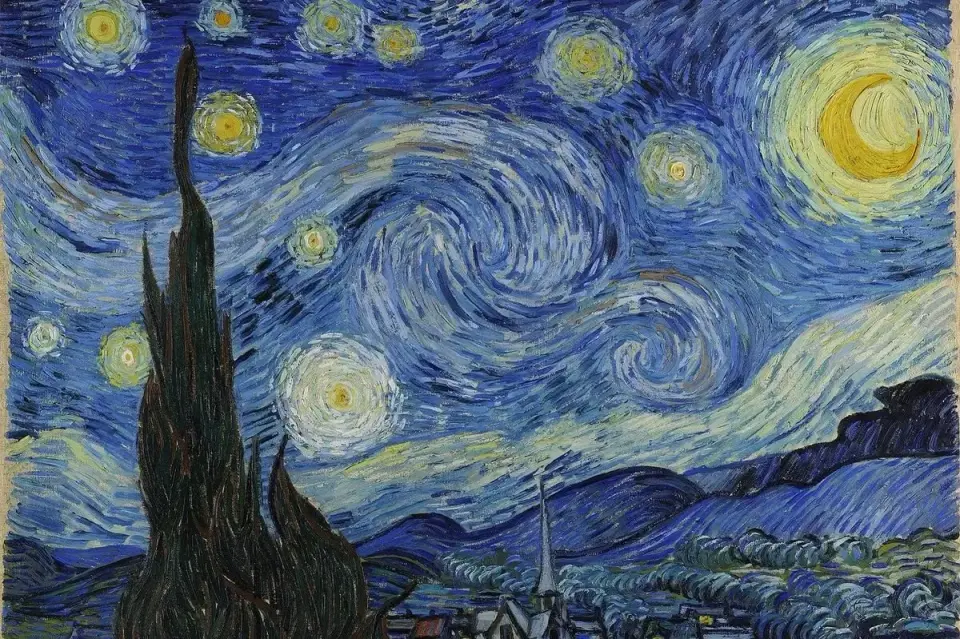
Recent mathematical analysis reveals that Vincent van Gogh’s 1889 painting 'Starry Night' accurately captures the physical concept of turbulence, a fluid dynamic phenomenon scientists only fully understood in the 20th century. This discovery highlights van Gogh’s intuitive grasp of natural patterns, surpassing other Impressionists in depicting energy cascades.
Key points
- Van Gogh died in 1890 at age 37 in Auvers-sur-Oise, France, after a self-inflicted gunshot wound, having struggled with mental instability and self-doubt.
- The painting 'Starry Night' was created in 1889 while van Gogh was in an asylum, following a psychotic episode that resulted in him cutting off part of his ear.
- Mathematical analysis, inspired by Hubble Space Telescope imagery in the mid-2000s, confirmed that van Gogh’s swirling brushstrokes accurately model turbulent flow, a concept involving irregular energy cascades in fluids.
- While other Impressionists focused on luminance and light, van Gogh uniquely depicted turbulence, a feat not matched by contemporaries like Edvard Munch despite their use of swirling colors.
- Van Gogh’s work captured this complex natural phenomenon approximately a century before scientists developed the technology to fully understand and describe it mathematically.
Background
This story revisits a long-standing debate about van Gogh’s mental state and artistic genius. While his 1890 death and 1889 ear incident are well-documented, the scientific validation of his artistic techniques emerged later. The Van Gogh Museum notes that his ear mutilation followed a conflict with Paul Gauguin, highlighting his deteriorating mental health. This analysis builds on earlier discoveries that linked his visual style to physical laws, reinforcing his status as a pioneer in both art and intuitive scientific observation.
Why it matters
The finding bridges art and science, demonstrating that artistic intuition can capture complex physical phenomena before formal scientific understanding. It challenges the narrative that van Gogh’s work was solely a product of mental illness, instead highlighting a profound, if accidental, grasp of fluid dynamics that remains relevant in modern physics.
What to watch
Researchers may continue analyzing other van Gogh works for similar scientific accuracies, potentially uncovering more instances where his artistic techniques align with physical laws. This could lead to new interdisciplinary studies exploring the intersection of 19th-century art and modern fluid dynamics.
Want the full story? Read the original reporting
Read on Upworthy