
Lucas Museum Opens in L.A. with 1,300 Works, Minimal Text, and a $1B Price Tag
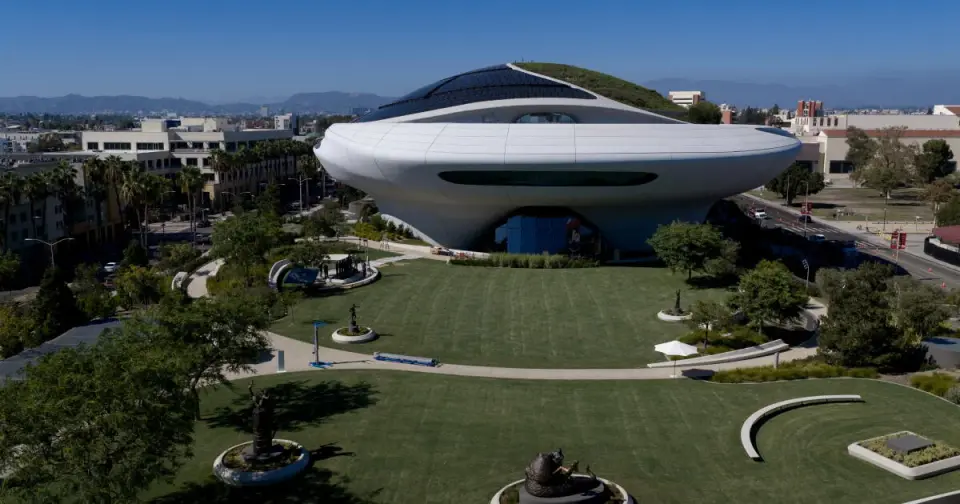
The Lucas Museum of Narrative Art opens in Los Angeles on September 22, 2026, after a 16-year development period and two failed site attempts. The 300,000-square-foot, spaceship-shaped building in Exposition Park houses over 1,300 works, including Star Wars props, Norman Rockwell paintings, and Frida Kahlo’s 'Self Portrait Dedicated to Dr. Eloesser.' Admission is $25 for adults and free for children. The museum deliberately minimizes wall text, prioritizing visual impact over academic analysis, and features a rooftop restaurant, a non-lending library, and gardens designed by Mia Lehrer.
Key points
- The museum opened September 22, 2026, in South Los Angeles’ Exposition Park, following abandoned plans in San Francisco and Chicago.
- The 300,000-square-foot building, designed by MAD Architects and Stantec, features a 90-foot-diameter oculus and glass-tube elevators.
- The collection includes 1,300 displayed works, with Star Wars artifacts comprising only 7% of the exhibits.
- Notable acquisitions include Norman Rockwell’s 'Shuffleton’s Barbershop' (estimated $20–30 million) and Frida Kahlo’s 1940 self-portrait.
- Admission is $25 for adults and free for children; the museum includes a non-lending library and the Skywalker Grill restaurant.
- The museum minimizes interpretive text, with George Lucas stating the goal is to connect visitors to works without analysis.
Background
The Lucas Museum of Narrative Art was first proposed in 2010. Previous attempts to build the museum in San Francisco and Chicago failed due to public opposition and legal challenges. Construction in Los Angeles began in 2017 but faced delays due to the pandemic and supply chain issues. The project cost approximately $1 billion, funded by George Lucas. The museum’s opening follows a period of staff turnover, including the departure of former director Sandra Jackson-Dumont in April 2026.
How outlets are covering it
The Los Angeles Times emphasizes the museum’s experiential design, highlighting the oculus, elevators, and minimal text as a deliberate choice to prioritize visual connection over academic analysis. CNN focuses on the museum’s philosophical stance on 'narrative art,' noting its alignment with recent trends at institutions like MoMA and Tate Britain to broaden the cultural canon. CNN also highlights the museum’s management turbulence, including staff layoffs and the departure of key curators. The New York Times frames the museum as a long-awaited realization of Lucas’s vision, questioning the definition of 'narrative art' while acknowledging the breadth of the collection. All sources agree on the museum’s scale, cost, and the limited presence of Star Wars content relative to the overall collection.
Why it matters
The Lucas Museum represents a significant shift in how art institutions define and display 'narrative art,' blending high art with pop culture and minimizing traditional interpretive frameworks. Its $1 billion cost and 16-year development period underscore the challenges of large-scale cultural projects. The museum’s minimal text approach and broad collection may influence future museum curation and public engagement strategies.
What to watch
The museum will rotate exhibitions, particularly for works on paper like comics and photography, to protect fragile materials. Future plans include new displays from the permanent collection, commissions, and loans. The museum’s long-term strategy for exhibitions and public engagement remains under development, with senior curator Ryan Linkof stating that 'there will always be something new to see.'
- 11 must-see things at the sprawling Lucas Museum of Narrative Art Los Angeles Times
- Three cities, 16 years and $1 billion later, the Lucas Museum of Narrative Art opens CNN
- MAD's spaceship-like Lucas Museum revealed ahead of opening Dezeen
- What Is ‘Narrative Art’? The Lucas Museum Finally Shows Us Its Vision. nytimes.com
- Lightsabers rub shoulders with ancient pottery in spaceship-like museum newatlas.com
Want the full story? Read the original reporting
Read on Los Angeles Times