
GLASS Consortium Study Reveals Divergent Genomic Paths in Recurrent IDH-Mutant Gliomas
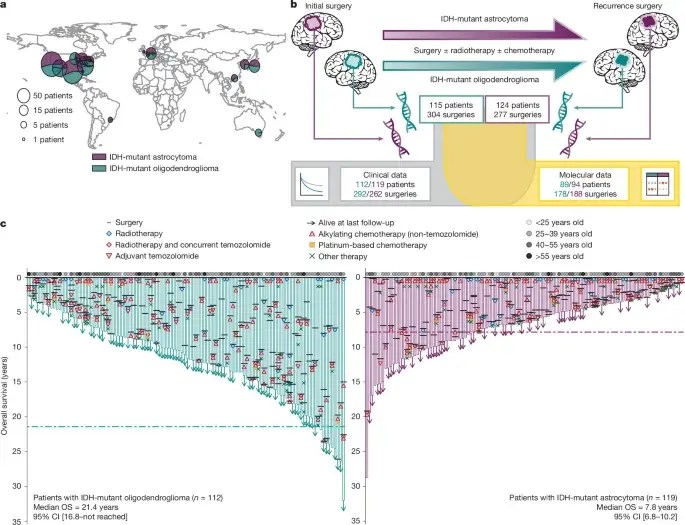
A large international study published in Nature shows that astrocytomas and oligodendrogliomas, two types of IDH-mutant glioma, evolve differently after treatment. While both tumors recur, oligodendrogliomas tend to acquire specific point mutations in growth-promoting genes, whereas astrocytomas undergo large-scale chromosomal instability. These distinct evolutionary trajectories, driven by chemotherapy and radiation, offer new targets for predicting treatment resistance and improving patient outcomes.
Key points
- The Glioma Longitudinal Analysis (GLASS) Consortium analyzed 183 patients with IDH-mutant gliomas using whole-genome and whole-exome sequencing from longitudinal tumor samples.
- Oligodendrogliomas at recurrence frequently acquired new mutations in PI3K and NOTCH1, associated with increased tumor mutational burden, regardless of prior treatment.
- Astrocytomas at recurrence were characterized by focal oncogene amplifications and homozygous deletions of CDKN2A/B, leading to chromosomal instability, including chromothripsis and whole-genome doubling.
- Temozolomide treatment was linked to specific mutational signatures (SBS11 and SBS119) in both tumor types, while radiotherapy was associated with the ID8 signature specifically in astrocytomas.
- The study confirms that treatment acts as an evolutionary force, selecting for resistant clones, and that the initial genomic profile of a tumor predicts its future evolutionary path.
Background
IDH-mutant gliomas are the most common primary malignant brain tumors in adults under 50, classified into astrocytomas and oligodendrogliomas by the 2021 WHO classification. Despite advances, these tumors almost invariably recur and develop treatment resistance. Previous studies, such as those from the GLASS Consortium, have identified hypermutation and CDKN2A/B deletions as markers of progression, but the specific divergent genomic responses of the two subtypes to treatment had not been fully characterized until this study.
How outlets are covering it
The primary source, Nature, provides a detailed genomic analysis, highlighting specific mutations like PI3K and NOTCH1 in oligodendrogliomas and chromosomal instability in astrocytomas. Secondary sources, including Newswise and Bioengineer.org, emphasize the clinical implications, noting that these distinct evolutionary paths could help clinicians tailor treatments and predict resistance. UA.NEWS offers a concise summary, focusing on the international collaboration and the potential for more accurate treatment selection. All sources agree on the fundamental finding that the two glioma types evolve differently, but the primary source offers the most granular data on mutational signatures and chromosomal events.
Why it matters
Understanding the distinct genomic evolution of astrocytomas and oligodendrogliomas is crucial for developing targeted therapies and predicting treatment resistance. By identifying the specific genetic changes that occur after recurrence, researchers can potentially intervene earlier to prevent the development of treatment-refractory clones, ultimately improving survival rates for patients with these aggressive brain tumors.
What to watch
The GLASS Consortium data will serve as a reference for understanding how current and new therapies, including IDH inhibitors like vorasidenib, alter tumor behavior. Future research will likely focus on using these genomic markers to guide treatment decisions and develop strategies to steer tumor evolution, aiming to make therapies more effective and prolong patient survival.
- Divergent genomic evolution in astrocytomas and oligodendrogliomas Nature
- What happens when brain tumors return? International study tracks genetic changes behind recurring cancers Medical Xpress
- Two Types of Recurring Brain Cancer—Radically Different Mutations | Newswise Newswise
- Researchers identify distinct genetic evolution in recurrent gliomas — News-Medical UA.NEWS
- Recurring Brain Tumors Follow Distinct Genetic Paths, Global Study Finds Bioengineer.org
Want the full story? Read the original reporting
Read on Nature