
"Cross-Cultural Study: Exploring Global Variations in Music Perception and Rhythm Interpretation"
TL;DR Summary
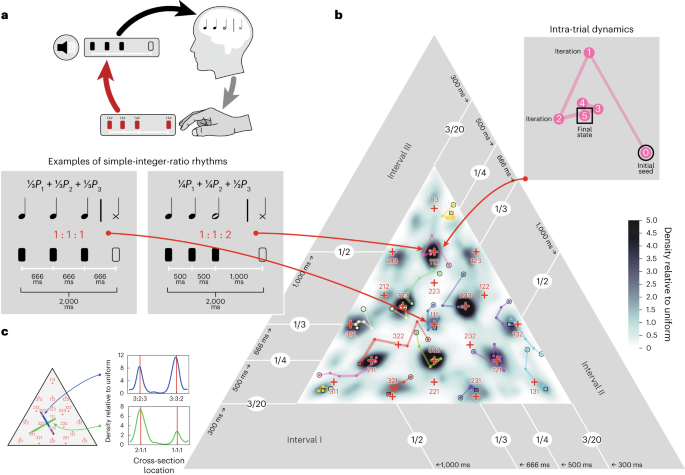
A cross-cultural study involving 39 participant groups from 15 countries revealed that all groups exhibited discrete mental representations of rhythm, with modes at small-integer-ratio rhythms being a widespread feature. The study used an iterated reproduction paradigm to measure Bayesian priors on simple periodic rhythms, finding that while all groups showed discrete modes, the presence of specific small-integer rhythms varied across cultures. The results suggest that small-integer-ratio rhythm categories are a common feature of human mental representations, but their presence and prominence vary cross-culturally.
Topics:health#cross-cultural-comparison#mental-representations#music-cognition#music-cross-cultural-study#rhythm-representation#small-integer-ratio-rhythms
- Commonality and variation in mental representations of music revealed by a cross-cultural comparison of rhythm priors in 15 countries Nature.com
- Music's Universal Pulse: Body and Emotions Unite Across Cultures Neuroscience News
- Exposure to different kinds of music influences how the brain interprets rhythm Medical Xpress
- Do all humans feel music the same way? Big Think
- Experts find cultural differences in how we interpret rhythm Earth.com
Reading Insights
Total Reads
0
Unique Readers
22
Time Saved
160 min
vs 160 min read
Condensed
100%
31,986 → 83 words
Want the full story? Read the original article
Read on Nature.com