
Neurons Map the Cellular Grammar of Human Language
TL;DR
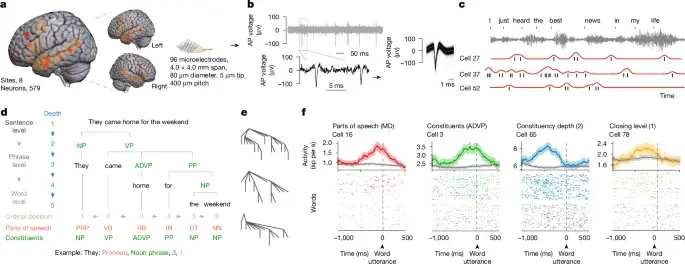
Recordings from 579 neurons across the human frontotemporal cortex during natural speech show individual cells encode fine-grained linguistic features: some respond to parts of speech, others to sentence constituents or dependency depth, and some track combinatorial feature sets. The neuron population also encodes sentence context, with language encoding being left-lateralized and varying by region. Large language models’ contextual embeddings better predict neural activity than syntax/semantics alone, revealing distributed cellular building blocks and a micro-to-macro map of how language is represented in the brain.
- Mapping the neuronal building blocks of human language with language models Nature
- With neuronal data, AI models predict grammar, meaning and context of spoken sentences Medical Xpress
- Decoding Human Language Neurons with AI Bioengineer.org
- A hidden brain pathway may help explain how humans learned to speak Earth.com
Want the full story? Read the original reporting
Read on Nature